
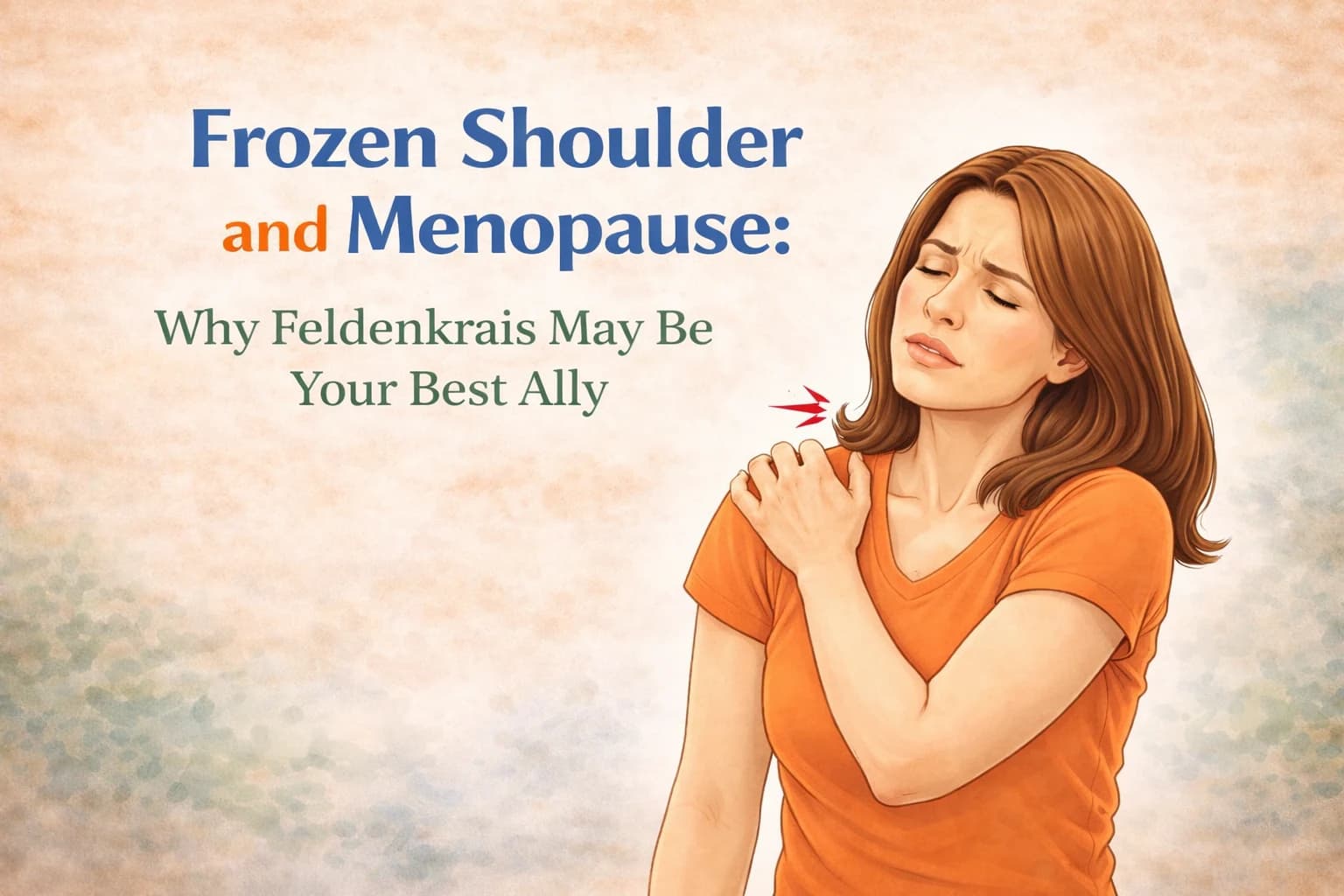
Frozen Shoulder & Menopause: A Feldenkrais Approach
Frozen shoulder is surprisingly common in midlife women. Feldenkrais addresses the whole-body pattern that treatments like cortisone and physio often miss.
You notice it one morning reaching for something on a high shelf. A sharp limit. A shoulder that simply will not go where you ask it to. Or maybe it started months ago as a dull ache that has gradually tightened into something more serious.
Frozen shoulder, clinically known as adhesive capsulitis, is one of the most common and most frustrating shoulder conditions in midlife women. The joint capsule thickens, loses its elasticity, and the shoulder becomes painful, stiff, and restricted, sometimes severely so. And it often happens right around the years of perimenopause and menopause, which is not a coincidence.
Why Midlife Women Are Disproportionately Affected
Frozen shoulder affects roughly 2-5% of the general population, but women between 40 and 60 carry a much higher share of cases. The mean age of onset in research studies is 56, which places it squarely in the menopausal transition for many women.
The hormonal connection is real. Estrogen plays a role in maintaining the health and pliability of connective tissue throughout the body, including the joint capsule. When estrogen levels fall during perimenopause, connective tissue can become less supple and more prone to the inflammatory changes that lead to adhesive capsulitis.
But it is rarely just hormones. Menopause and physical changes interact with years of accumulated postural patterns, chronic stress held in the shoulders and neck, sleep disruption, and reduced movement variety. The shoulder does not freeze in isolation. It freezes in a body that has been doing a lot of other things for a long time.
The Three Stages, and Why They All Hurt in Different Ways
Frozen shoulder typically moves through three phases, though the timeline varies widely from person to person.
The freezing phase is the most painful. The shoulder aches, often at night, and range of motion begins to decline. This phase can last anywhere from 6 weeks to 9 months.
The frozen phase brings less acute pain but significant stiffness. Reaching overhead, across the body, or behind the back becomes difficult or impossible. This is often the phase where women seek help, because the limitation is now affecting daily life in obvious ways.
The thawing phase is when motion gradually returns. This can take 6 months to 2 years. Most people eventually recover most of their range, though many are left with some residual restriction if they do not actively support the recovery.
What Conventional Treatments Offer
There are several well-established treatments for frozen shoulder, and most people benefit from using more than one.
Physiotherapy is the most commonly recommended approach. A good physio will work on restoring range of motion through manual therapy, targeted stretching, and progressive exercises. It is effective, though often uncomfortable during the painful freezing phase.
Cortisone injections can significantly reduce inflammation and pain, particularly in the early stages. They do not resolve the underlying capsular tightening, but they create a window where movement work becomes more tolerable and more effective.
Hydrodilation (also called hydrodilatation) involves injecting fluid into the joint capsule to stretch it. Studies show it can accelerate recovery, particularly when combined with physiotherapy.
Surgery is reserved for cases that do not respond to conservative treatment. Manipulation under anesthesia and arthroscopic capsular release are both used. Most people do not need to go this route.
What none of these approaches address directly is the way the whole body has reorganized around the painful, restricted shoulder. That is where Feldenkrais comes in.
The Whole-Body Pattern Around a Frozen Shoulder
When one shoulder becomes painful and limited, the body does not simply wait for it to heal. It compensates. The opposite shoulder works harder. The neck tightens and shortens on the affected side. The ribcage loses mobility. The spine curves subtly to accommodate the restriction. Breathing changes.
These compensations make sense in the short term. But over months and years, they become habits. The nervous system has learned a new way of organizing movement that protects the shoulder, and it holds onto that organization even after the acute pain has eased. This is why so many women come out of the frozen phase with their range of motion technically improved but still feeling held, guarded, and unable to use the shoulder freely.
The pattern does not automatically release just because the inflammation has resolved.
How the Feldenkrais Method® Works with Frozen Shoulder
The Feldenkrais Method® does not treat the shoulder directly. It works with the whole-body pattern that has built up around it.
A Feldenkrais® lesson for shoulder restriction might start entirely elsewhere: with how the pelvis moves, how the ribs expand on one side, how the neck finds length and ease. These are not detours. The shoulder sits at the top of a kinematic chain that runs from the feet upward. When the lower links in that chain are held and restricted, the shoulder above pays the price regardless of what is happening inside the joint itself.
What makes Feldenkrais distinctive is the method of inquiry. Rather than stretching the shoulder toward a goal or repeating an exercise, the lessons invite you to notice, gently and without strain, what is happening. Tiny, almost imperceptible movements. Attention to what is easy versus what requires effort. Rest woven through the lesson rather than pushed past.
When movement is that small and that unhurried, the nervous system stops bracing. It starts to listen. And when it listens, it begins to update the pattern it has been holding.
The Intersection of Stress and Frozen Shoulder
This is something that often surprises people: chronic stress held in the body is not just a feeling. It is a physical organization. The shoulders rise. The neck shortens. The ribcage tightens. Breathing becomes shallow and high.
In women who have been carrying significant stress for years, this organization can become so habitual that it no longer registers as tension. It just feels like how the body is. But it loads the shoulder joint continuously, day and night, in ways that physiotherapy and injections cannot fully address.
Feldenkrais lessons that calm the overall holding pattern often produce a noticeable and surprising improvement in shoulder freedom, not because anything structural has changed, but because the compression driving the problem has eased.
What Recovery Can Look Like
Many women who add Feldenkrais work alongside their other treatment describe it as finding the missing piece.
The physiotherapy loosens the joint. The injection reduces the inflammation. But the lessons teach the body how to stop recreating the conditions that loaded the shoulder in the first place. They restore a sense of whole-body ease that makes the gains from other treatments stick rather than gradually eroding.
Feldy's program is built around exactly this: guided audio lessons done lying down, at home, in your own time. The lessons work through the spine, ribcage, neck, and shoulders progressively, with a gentleness that is specifically suited to people who are in pain or coming through a difficult recovery.
Try a Lesson Before You Commit to Anything
Try a full Feldenkrais lesson for free. No equipment, no experience needed. Just a comfortable place to lie down.
Try a Free LessonWhen to Start and What to Expect
The question people often ask is when to begin. The answer is: whenever you are.
In the freezing phase, when pain is acute, Feldenkrais lessons are gentle enough to do without aggravating the shoulder. You are not moving the shoulder at all in most lessons, at least not directly. You are reorganizing everything around it. And if a clinician finds that the ache is bursitis rather than a frozen shoulder, our shoulder bursitis exercises follow the same idea: lying down, with the arm kept low.
In the frozen phase, lessons can help maintain the mobility you have and prevent the compensatory patterns from becoming permanent.
In the thawing phase, they can accelerate the recovery of natural, coordinated movement throughout the arm and shoulder girdle.
Many women say the first thing they notice is not in the shoulder itself. It is in the neck. Or the breath. Or the way they stand up from a chair. The body reorganizes in ways that are surprising, and often moving.
It is a slow process. Frozen shoulder is a slow condition. But adding a movement practice that works with your nervous system rather than against it is one of the most reliable ways to come out the other side feeling like yourself again.
FAQ about Frozen Shoulder and Menopause with the Feldenkrais Method
Why is frozen shoulder more common in women during perimenopause and menopause?
Falling estrogen levels affect the connective tissue throughout the body, including the joint capsule of the shoulder. Women between 40 and 60 account for a disproportionate share of frozen shoulder cases. Hormonal changes, accumulated postural tension, and a nervous system under prolonged stress all appear to contribute.
Can the Feldenkrais Method® help with frozen shoulder?
Yes. Feldenkrais does not force the shoulder to move more. Instead, it works through the whole-body movement patterns that are restricting and loading the shoulder from below. Many people notice improved range of motion and reduced pain after a few weeks of regular practice, alongside other treatments.
How is Feldenkrais different from physiotherapy for frozen shoulder?
Physiotherapy typically focuses on restoring range of motion in the joint through stretching, manual work, and targeted exercises. Feldenkrais works differently: it addresses how the entire body, including the spine, ribcage, and pelvis, is organized and how that organization affects the shoulder. The two approaches complement each other well.
Should I still see a doctor or physiotherapist if I have frozen shoulder?
Yes, absolutely. Frozen shoulder can benefit from physiotherapy, cortisone injections, and in some cases hydrodilation or surgery. Feldenkrais is not a replacement for medical care. It addresses the layer of nervous system organization and whole-body movement patterns that other treatments do not reach.
How long does frozen shoulder last?
Untreated, frozen shoulder typically lasts between 15 months and 3 years. Most people do recover fully over time, but the process is slow and often painful. Active treatment, including physiotherapy, injection therapy, and movement work like Feldenkrais, is associated with faster recovery and less disability.
I have had frozen shoulder for two years and still cannot raise my arm fully. Can Feldenkrais help at this stage?
Yes. Feldenkrais can be useful at any stage of frozen shoulder, including the chronic or recovery phase. The lessons do not require full range of motion. They work with whatever movement you currently have, helping the nervous system release unnecessary holding and gradually rediscover what is available.
Can I do Feldenkrais at home for frozen shoulder?
Yes. Feldenkrais lessons are done lying down and require no equipment. Programs like Feldy's are audio-guided and designed for home practice. You work entirely within your comfortable range of movement, so there is no risk of pushing too far.
Start your free 7-day trial
Start free trialMore Articles

Curiosity: Gentler Than Correction
What changes when the question in your mind shifts from "Am I doing it right?" to "What do I notice?"
Oct 16, 2026
Why Patients Do Their Exercises in Clinic but Not at Home
Home exercise program adherence often drops between visits. Why "three sets of ten" can stall at home, and one small idea from Feldenkrais teaching.
Oct 12, 2026
Sore After Physical Therapy? What to Do the Next Day
Soreness after physical therapy is often a normal part of the work. What to watch for, and how gentle movement can sit alongside your program.
Oct 4, 2026Ready to Start Moving Better?
Try your first lesson for free. No credit card required.