

For hypermobility & joint instability
Steadier joints. Quieter muscles. No stretching.
Relearn trust in joints you stopped counting on.
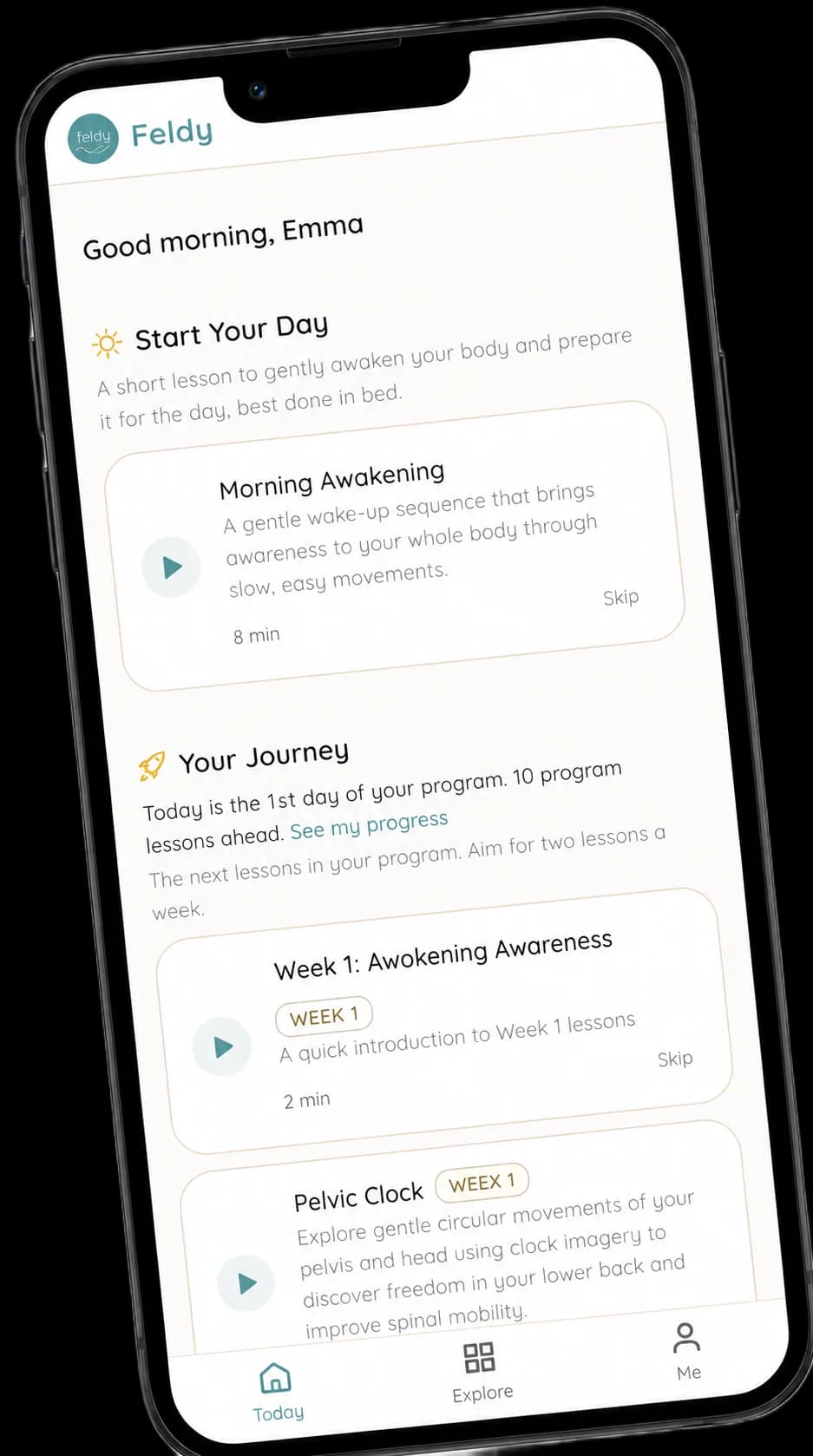
Feldy is an online movement program based on the Feldenkrais Method®: gentle, guided audio lessons you do lying down at home. No stretching, you have range to spare. What the lessons build is the felt sense of where your joints are and how to support them. Free 7 day trial, no card needed.

For hypermobility & joint instability
Still hurting after stretching, exercises, or physical therapy? Try a gentler approach.
Feldy is a guided online movement program based on the Feldenkrais Method®. Instead of asking you to stretch or strengthen an already sensitive back, it helps retrain how you move, so everyday movement can become easier and more comfortable. Many members notice a difference within their first week.
7 days free. No credit card needed.
Does this sound like your joints?
- Your joints go further than they should, then they ache for it.
- A shoulder or a kneecap slips, subluxes, or feels one wrong move from giving way.
- You are exhausted by evening, because your muscles never stop bracing to hold you together.
- You bump into door frames and misjudge stairs, clumsy in ways you cannot explain.
- You have quietly given up tennis, deep yoga, dancing. Not because you cannot start, but because you cannot trust your joints to finish.
- And when you ask for help, you are told you are just flexible. Lucky, even.
The flexibility never left. The trust did.
Hypermobility is rarely a flexibility problem. You have range to spare. What is often missing is control: a clear sense of where each joint is and how to support it through its range. That sense, proprioception, tends to be quieter in hypermobile bodies, so the muscles grip to compensate and the joints still feel unstable. Feldenkrais works on that sense directly. As your nervous system builds a clearer map of your body, steadiness can come from coordination instead of gripping. No stretching involved.

Why Feldenkrais works for hypermobility & joint instability
1. You do not need more range. You may need control of the range you have.
Most movement advice chases flexibility. A hypermobile body has that covered. Feldenkrais works on precision and coordination instead, so your joints are supported through their generous range rather than drifting to the painful end of it.
2. Stability is a skill of the nervous system, not a stretch.
A joint can feel steadier when your brain knows clearly where it is and the muscles around it share the load. The lessons build that internal sense, so the constant gripping many hypermobile bodies rely on to feel safe can begin to ease.
3. Change comes from noticing, not forcing.
No stretching, no straining. You pay close attention to small movements in a comfortable, supported range, and that attention is what tends to give your joints a clearer, steadier home.
From people with hypermobility & joint instability
“I am the bendy one who could always touch the floor, but my joints ached and I never felt steady. Every physio gave me more stretches, which made it worse. These lessons are the opposite. Nothing stretches. After a few weeks my knees stopped feeling like they might wander off, and I trust my ankles on the stairs again.”
Sophie L.
Hypermobile, 29
“I did not realize how much energy I spent just holding myself together until some of it came back. I always felt clumsy and tired, gripping to keep my joints in place without knowing it. The lessons gave me a clearer sense of where my body actually is. The gripping eased, and so did the exhaustion.”
Anna T.
Hypermobile, 36
97% of Chava’s students said they would definitely recommend Feldenkrais to a friend.
How this works, in plain terms
- 1
Lie down on your bed or the floor, propped with as much support as you like. No equipment, nothing to push against.
- 2
Press play and follow Chava's voice. The movements are small, slow, and stay well inside an easy range. You never stretch, push, or hang in a joint, and anything that does not feel right, you skip.
- 3
Notice the difference. Many people stand up and feel their feet meet the floor more fully, the joints a little steadier underneath them.
What you will feel in the first lesson
- 1.You may sense where a joint sits in space more clearly than usual. The movements never leave an easy range.
- 2.Your breath may deepen on its own, and the quiet, constant gripping you use to feel stable may start to soften.
- 3.Standing up afterwards, your feet may meet the floor with fuller, steadier contact.
Common Questions about Hypermobility & joint instability (FAQ)
I am already too flexible. Will this make me looser?
No. There is no stretching in the lessons, deliberately. Feldenkrais is about control and coordination, not range. The aim is a clearer sense of your joints and steadier support through the range you already have, not more of it.
I have hEDS or a connective tissue condition. Is this appropriate?
Many people with Ehlers-Danlos and related conditions find this kind of gentle, exploratory movement a good fit, partly because it avoids the overstretching and overexertion that tend to cause flares. Feldenkrais is not a medical treatment for hypermobility spectrum or connective tissue disorders, so keep working with your medical team. Every movement stays entirely within your control.
Can I do this if my joints sublux or feel like they might give way?
Yes. You lie down, fully supported, and move within a small, comfortable range. There is nothing to push into and nothing that loads a joint. You decide what feels stable, and any movement can get smaller, or become simply imagining it. Many people find it one of the gentlest ways to work with a joint they do not trust.
Will this help the fatigue and clumsiness, not just the joints?
Often, yes. Bracing all day to feel stable is exhausting, and a faint sense of position is part of what makes movement feel clumsy. As your internal map sharpens, many people find the fatigue and the coordination improve along with joint comfort.
What if I do not feel anything in the first lesson?
Common, and fine. The first effects are often subtle. Change tends to show up afterwards, in how steady standing feels, in how your joints are the next day, or by the second or third lesson.
What if it does not help me?
Every subscription starts with a free 7 day trial, no credit card needed. Do a lesson or two and see how your joints respond before you pay anything.
Have a question? Write to me at ask-chava@feldy.me. I answer every email personally.
Try Feldy free for 7 days. See how steady your joints can feel.
No equipment. No forcing. Nothing goes further than feels easy, pleasant, and safe.
When flexible has started to mean unsupported, there is another way in. Do less, sense more.
Have a question? Write to me at ask-chava@feldy.me. I answer every email personally.