
For knee or hip pain
Less knee and hip pain. More ease. The gentler way.
Rebuild trust in joints you have been negotiating with.
A gentle, intelligent online movement program for knee or hip pain, working with the whole body. Watch the explainer, then try free for 7 days. No card needed.
7 days free. No credit card needed.
For knee or hip pain
Still hurting after stretching, exercises, or physical therapy? Try a gentler approach.
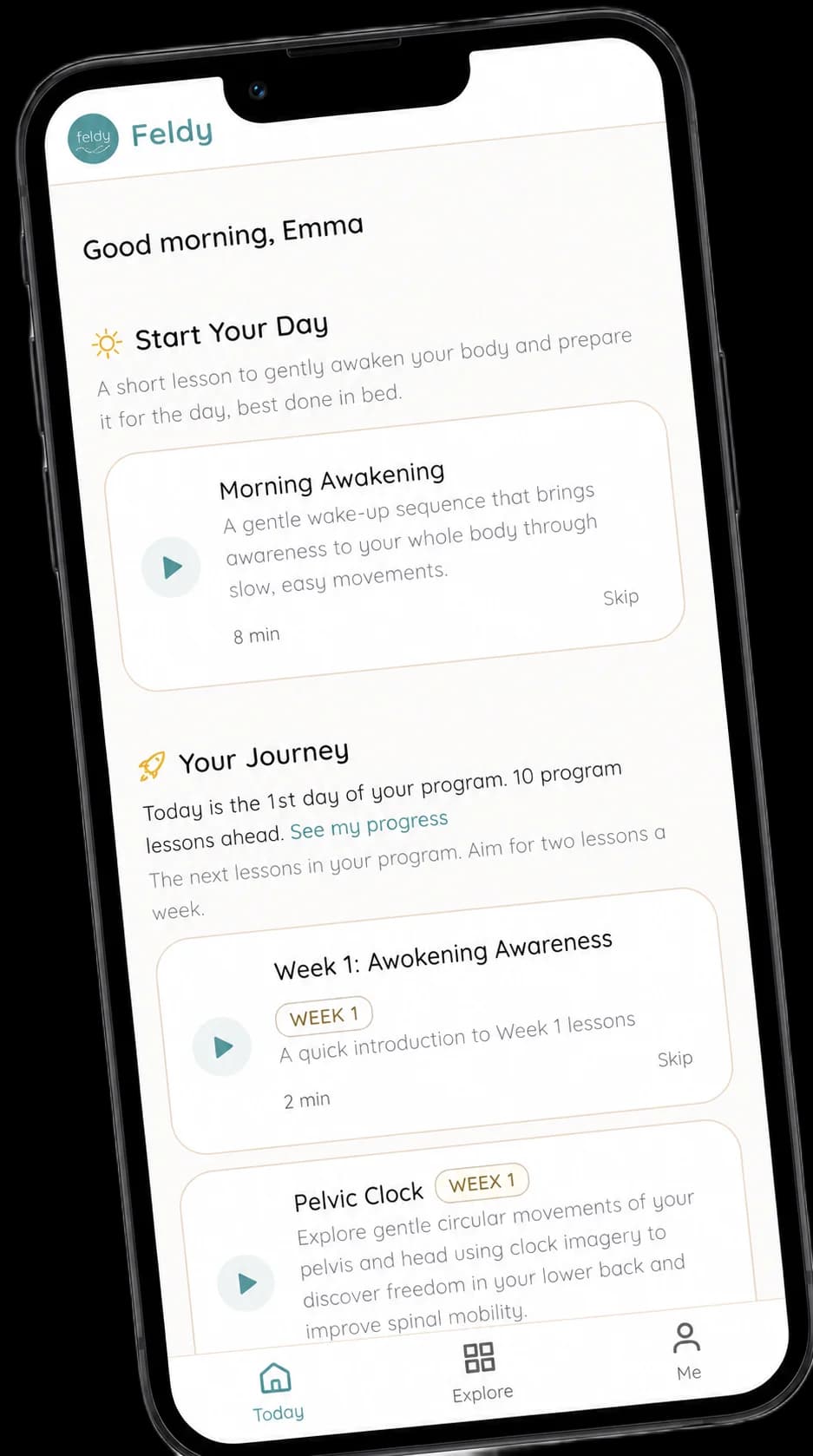
Feldy is a guided online movement program based on the Feldenkrais Method®. Instead of asking you to stretch or strengthen an already sensitive back, it helps retrain how you move, so everyday movement can become easier and more comfortable. Many members notice a difference within their first week.
7 days free. No credit card needed.
Does this sound like your knees and hips?
- You plan your day around how many stairs are in it.
- Your hip catches when you stand up from a chair, or after a long car ride.
- One leg feels heavier than the other. You have stopped trying to figure out which one.
- You avoid movements you used to do without thinking. Sitting cross-legged. Standing up from the floor. Walking down a hill.
- Your scan came back clean. The pain did not get the memo.
You have not lost the use of your legs. You have lost trust that the joint will hold up.
For many people, persistent knee or hip pain is less about damage in the joint and more about a movement pattern that loads it unevenly. The body learned to limp or guard for a reason, often years ago. The pattern keeps running long after the reason has passed. Feldenkrais speaks to that nervous system directly. When the brain learns a more even way to move, the load can spread through the whole system again, and the joint has less to carry alone.

Why Feldenkrais works for knee or hip pain
1. Your knee and hip have less to carry alone when your pelvis remembers how to move.
The hip and knee sit at the end of a chain that starts at the pelvis. When the pelvis stops moving freely, the load downstream concentrates on those joints. The lessons invite movement back at the source so the load can spread through the whole system again.
2. Slow, attentive movement can quiet the protective gait.
After an injury, a fall, or years of asymmetric load, the nervous system learns to limp or guard. The limp can outlast the original cause by years. Small, gentle motion tends to teach the system it may not need to guard so strongly, and a more even gait often returns on its own.
3. Change comes from noticing, not forcing.
You will not stretch the joint. You will not strengthen around it. You will pay close attention to small movements, in positions where the joint is unloaded, and that attention is what tends to create change you can feel before you stand back up.
From people with knee or hip pain
“After my hip replacement, physio got me functional, but I still moved like I was protecting something. Feldy taught me it isn't a war with the body. You walk hand in hand with what it can do today. Last week I walked the dog without thinking about my hip.”
Margaret T.
Retired nurse, 71
“My MRI came back clean two years ago, which was supposed to be good news. The pain in my knee did not get the memo. I had stopped going down stairs without holding the rail. After three weeks of these lessons I went down a flight and only realized afterward. Nothing dramatic, just my knee not anticipating the next step.”
Diane K.
Office manager, 64
97% of Chava’s students said they would definitely recommend Feldenkrais to a friend.
How this works, in plain terms
- 1
Lie down, on your bed or the floor, where the leg can rest. No equipment, no setup, nothing to step on.
- 2
Press play and follow Chava's voice. The movements are small and slow, and the joint stays unloaded. You never push through pain, and if something does not feel good, you simply do not do it.
- 3
Notice the difference. Many people stand up after the lesson and feel the floor differently under both feet, the gait a little more even.
What you will feel in the first lesson
- 1.Your back may rest into the surface beneath you, and a movement in your hip can travel all the way up to your shoulder.
- 2.Your breath can deepen on its own, especially around your hips and lower belly.
- 3.When you stand up afterward, one leg may feel longer or freer than it usually does. Your feet can make fuller contact with the floor, the kind of grounding the joint has been missing.
Common Questions about Knee or hip pain (FAQ)
My scan was normal. Why am I still in pain?
This is more common than people realize. Pain is generated by the nervous system, not by tissue alone, and two people with identical scans can have very different pain experiences. Often the body is running a protective movement pattern from an old strain or asymmetry, and the pattern itself is what produces the load and the discomfort. Feldenkrais works on the pattern, which is something a structural scan cannot see and a structural treatment is not built to reach.
Will this work if PT, injections, and stretching have not?
Often yes, because the mechanism is different. PT and stretching work on the muscles around the joint, and they help many people for exactly that. Injections quiet inflammation in the joint. Feldenkrais works on the movement pattern that is loading the joint unevenly, and sits alongside what your physiotherapist or doctor gave you, not in place of it. When the pattern shifts, the joint tends to receive less load, and the inflammation often follows. People who have tried many things tend to be the most attuned to their own bodies and often notice the biggest difference.
Can I do this with osteoarthritis?
Usually yes. The whole method is built around what feels easy. If a movement provokes pain, you make it smaller, slower, or stop. Many of the lessons are done lying down, where the joint is unloaded, and they help invite back movement options that often become limited with osteoarthritis. The movements are gentle and designed to avoid aggravating the joint, and many people find they can move with less pain through the joint they have.
I am waiting for or recovering from joint replacement. Can I do this?
Usually yes, but check with your surgeon. The lying-down lessons are unloaded and gentle. Many people use the method before surgery to enter the procedure with a calmer nervous system, and after surgery to rebuild a movement vocabulary the body trusts. Margaret's testimonial above is from after her hip replacement.
How is this different from yoga or stretching?
Different mechanism, very gentle and soft. There is no pose to hold and no stretch to push into. You lie down, you move in small ways, you notice what changes. The work happens in your attention, not in your effort. For knee or hip pain this matters: aggressive stretching can wind the protective pattern up tighter, while attentive movement tends to teach the system to settle.
What if I do not feel anything in the first lesson?
That is fine and common. The effects can be subtle the first time. The change often shows up after, in how you stand up from your chair, in how you take the first few steps after sitting, or by the second or third lesson as the pattern begins to update.
What if it does not help me?
Every subscription starts with a free 7 day trial, no credit card needed. Try the lessons, complete one or two, and see if Feldy is right for you before you subscribe.
Have a question? Write to me at ask-chava@feldy.me. I answer every email personally.
Try the Feldy online movement program free for 7 days. See how your knees and hips feel.
No equipment. No forcing. You only go where it feels easy, pleasant, and comfortable.
When you have started working around a joint you used to trust, the program is here. Do less, gain more.
Have a question? Write to me at ask-chava@feldy.me. I answer every email personally.