
For neck and upper back tension
Less neck and shoulder tension. More ease. The gentler way.
Rebuild trust in shoulders that have stopped letting go.
A gentle, intelligent online movement program for neck and upper back tension, working with the whole body. Watch the explainer, then try free for 7 days. No card needed.
7 days free. No credit card needed.
For neck and upper back tension
Still hurting after stretching, exercises, or physical therapy? Try a gentler approach.
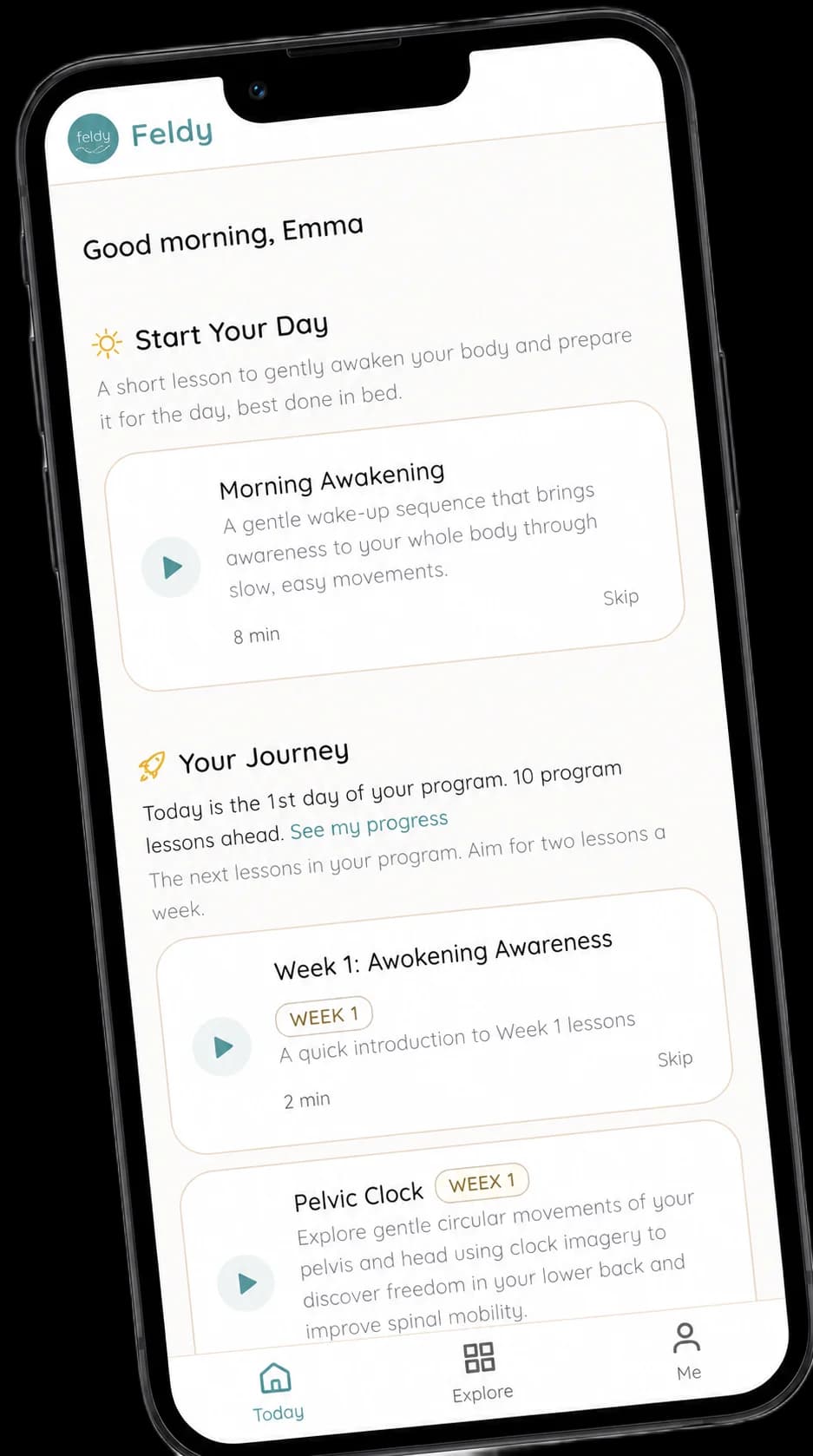
Feldy is a guided online movement program based on the Feldenkrais Method®. Instead of asking you to stretch or strengthen an already sensitive back, it helps retrain how you move, so everyday movement can become easier and more comfortable. Many members notice a difference within their first week.
7 days free. No credit card needed.
Does this sound like your neck and shoulders?
- Your shoulders are at your ears. You forget how they got there.
- By afternoon a band of tightness runs from your shoulder blades to your skull.
- You wake up with a sore neck because you slept tense.
- You avoid movements you used to do without thinking. Turning to reverse the car. Looking up. Carrying a bag on one side.
- The knots come back the day after a massage.
You have not lost a relaxed body. You have lost trust that letting your shoulders down is safe.
For many people, neck and upper back tension is less about weak or tight muscles and more about a nervous-system pattern that keeps them firing. Hours at a screen can teach the body to keep the shoulders raised, the head jutted forward, and the breath shallow. The muscles will not release on a massage table because they are doing exactly what the brain is asking them to do. Feldenkrais speaks to that nervous system directly. When the brain learns the shoulders can come down, the muscles tend to follow on their own.

Why Feldenkrais works for neck and upper back tension
1. Your neck has less to hold when your upper back and ribs join in.
The neck has a hard time staying relaxed if the shoulder blades are locked and the ribs do not move. The whole upper-body chain is meant to share the work of holding your head up. When the chain stops moving, the neck does most of it alone, and the tension follows. The lessons invite movement back across the chain so the neck has support again.
2. Slow, attentive movement can quiet the protective holding.
Stress, deadlines, and screens can train the body into postural guarding. That guarding becomes automatic, even when you have stepped away from the desk. Small, gentle motion tends to teach the nervous system that the threat has passed, and the muscles can let go without you having to talk them down.
3. Change comes from noticing, not forcing.
You will not stretch the neck. You will not pull on it. You will notice small movements in a position where the upper body is supported, and that noticing is what tends to create change you can feel before you stand back up.
From people with neck and upper back tension
“I sit at a desk ten hours a day, and by evening my shoulders felt like a vise. Five minutes of these gentle lessons in the morning, and that tightness is just gone. Soft, enabling, beneficial. That's the practice.”
David R.
Software developer, 54
After yoga, Pilates, and stretching apps, the first thing that stuck.
“I tried yoga, Pilates, stretching apps. Nothing stuck. With Feldy I don't have to decide what to do every morning. Give it more than one lesson; the change comes over a few weeks, not the first day. Before long, I simply felt like myself again.”
James L.
Desk worker, 53
97% of Chava’s students said they would definitely recommend Feldenkrais to a friend.
How this works, in plain terms
- 1
Lie down, on your bed or a rug, wherever the upper body feels supported. No equipment, no setup, nothing to brace against.
- 2
Press play and follow Chava's voice. The movements are small and slow. You never stretch, pull, or force, and if something does not feel good, you simply do not do it.
- 3
Notice the difference. Many people feel the shoulders settle, the breath open, the head balance more easily, by the time the lesson ends.
What you will feel in the first lesson
- 1.Your shoulder blades may start to settle against the surface beneath you, instead of hovering above it the way they usually do.
- 2.Your breath can deepen on its own, especially in the space between your ribs and your collarbones.
- 3.When you stand up afterward, your head may balance on top of your spine without you having to hold it there.
Common Questions about Neck & upper back tension (FAQ)
Will this work if massage, PT, and stretching have not?
Often yes, because the mechanism is different. Massage and stretching work on the muscles in the moment and are useful in their own right, but the brain often keeps firing the habitual tension pattern, and the tightness can come back within a day or two. Feldenkrais works on the pattern itself, and sits alongside what your massage therapist or physiotherapist gave you, not in place of it. When the pattern shifts, the muscles stop receiving the tightening signal and tend to let go for longer. People who have tried many things tend to be the most attuned to their own bodies, and often notice the biggest difference.
Can I do this if I get tension headaches?
Usually yes. The lessons are gentle enough that they rarely provoke a headache, and many people find their headache load eases over the program, along with jaw tension and eye fatigue that travel as part of the same pattern. If you are in an acute migraine, postpone the lesson. For regular tension headaches, the practice tends to be supportive rather than provoking.
I sit at a screen all day. Will this change the cause?
Not on its own. The lessons cannot change your job. What they can change is what happens in your body during and after those hours. Persistent postural guarding is much of what makes screen time costly. When that pattern is no longer running automatically, you can sit at a screen without the body paying the same toll.
How is this different from yoga or stretching?
Different mechanism, very gentle and soft. There is no pose to hold and no stretch to push into. You lie down, you move in small ways, you notice what changes. The work happens in your attention, not in your effort. For neck and upper back tension this matters: aggressive stretching can wind the muscles up tighter, while attentive movement tends to teach them to settle.
What if I do not feel anything in the first lesson?
That is fine and common. The effects can be subtle the first time, and you may not notice them in the lesson itself. The change often shows up after, in how you sleep that night, in how your shoulders feel at the end of the next workday, or by the second or third lesson as the pattern begins to update.
What if it does not help me?
Every subscription starts with a free 7 day trial, no credit card needed. Try the lessons, complete one or two, and see if Feldy is right for you before you subscribe.
Have a question? Write to me at ask-chava@feldy.me. I answer every email personally.
Try the Feldy online movement program free for 7 days. See how your neck and shoulders feel.
No equipment. No forcing. You only go where it feels easy, pleasant, and comfortable.
When your evenings no longer feel like they fully let you go, the program is here. Do less, gain more.
Have a question? Write to me at ask-chava@feldy.me. I answer every email personally.