
For anxiety & a hypervigilant nervous system
Quiet a nervous system on high alert. The gentler way.
Rebuild trust that the body can stand down.
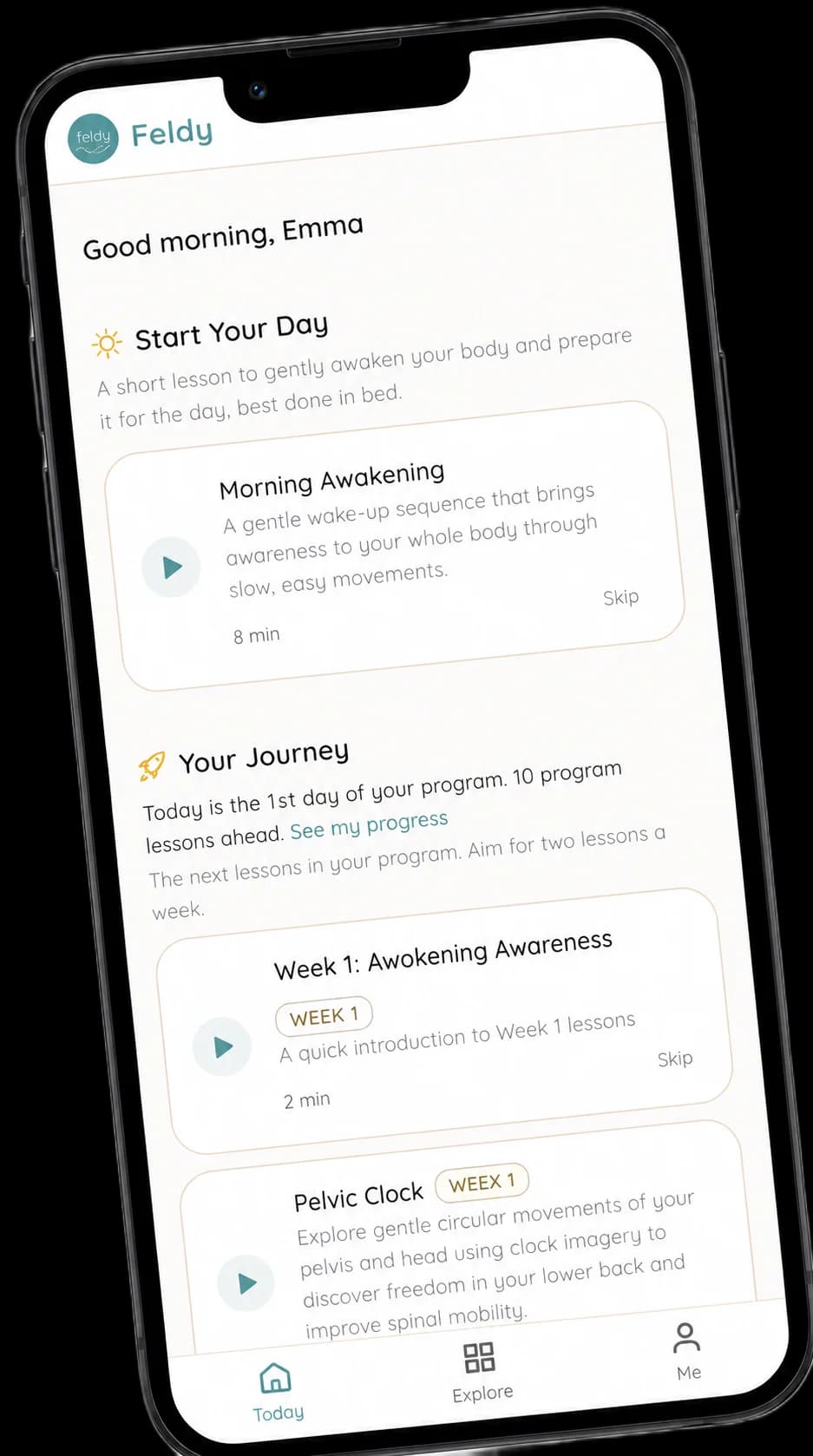
A gentle, intelligent online movement program for anxiety and a hypervigilant nervous system, working with the whole body. Watch the explainer, then try free for 7 days. No card needed.
7 days free. No credit card needed.
For anxiety & a hypervigilant nervous system
Still hurting after stretching, exercises, or physical therapy? Try a gentler approach.
Feldy is a guided online movement program based on the Feldenkrais Method®. Instead of asking you to stretch or strengthen an already sensitive back, it helps retrain how you move, so everyday movement can become easier and more comfortable. Many members notice a difference within their first week.
7 days free. No credit card needed.
Does this sound like your nervous system?
- Your body is braced even when nothing is wrong.
- You startle easily, and it takes a long time to come back down.
- Your shoulders, jaw, and stomach are tight before the day has even started.
- You are scanning for the next problem before this one is over.
- You avoid the things that used to settle you. Sitting still. A long meal. A quiet evening. Nothing seems to dial it down anymore.
- You have been told to just relax, and you cannot find the off switch.
You have not lost calm. You have lost the trust that your body can hold it.
Anxiety and hypervigilance are not only thoughts. They live in the body, as bracing, shallow breath, and a system that stays ready for a threat that never quite arrives. You cannot easily reason your way out of this, because the alert is running underneath thought. But the nervous system reads the body constantly, and that is a door in. When the body sends signals of safety, slow movement, easy breath, weight that settles, the system can begin to stand down. Feldenkrais speaks to that layer directly, from the body inward.

Why Feldenkrais works for anxiety & a hypervigilant nervous system
1. You can calm the mind by changing what the body is telling it.
The brain decides how safe you are partly by reading the body. A braced, shallow-breathing body reports danger, and the mind often stays anxious to match. Feldenkrais can change the report. Slow, comfortable movement and an easier breath give the brain steady evidence of safety, and the alarm can quiet from the bottom up.
2. Very little effort is the point, not a shortcut.
Anxiety already runs the system hard. Practices that demand effort or concentration can ask too much of an exhausted system. Feldenkrais asks for almost nothing. You lie down and notice small movements, and the settling tends to happen on its own, without willpower doing the work.
3. Change comes from noticing, not forcing.
You will not try to relax, and you will not push the feelings away. You will pay gentle attention to small movements in a supported position, and that attention is what tends to let a guarded system loosen its grip.
From people with anxiety & a hypervigilant nervous system
“My body never switched off. Shoulders up, jaw tight, scanning the room before I had even sat down. Talking about it in therapy helped my head but not my body. These lessons reach the part words could not. I lie down, follow the voice, and the bracing loosens on its own. I come back down faster now after something rattles me.”
Erica M.
Nurse, 39
“Meditation always made me feel like I was failing, sitting there more wound up than when I started. The difference here is that I am not trying to calm down. I am just moving slowly and noticing, and the calm shows up as a side effect. For the first time I have something I actually reach for when I feel myself winding up.”
Tom B.
Account manager, 45
97% of Chava’s students said they would definitely recommend Feldenkrais to a friend.
How this works, in plain terms
- 1
Lie down, on your bed or a rug, with as much support as you like. No equipment, no setup, no special clothes.
- 2
Press play and follow Chava's voice. The movements are small and slow, well inside the easy range. You never push or strain, and you can stop or make any motion smaller at any time.
- 3
Notice the difference. Many people stand up after the lesson and feel the room a little quieter, the body a little less on guard.
What you will feel in the first lesson
- 1.Your breath may deepen on its own, without anyone telling you to breathe.
- 2.Your jaw, shoulders, and stomach may release a layer of bracing you did not know you were holding.
- 3.When you stand up afterward, the room may feel a little quieter, and your body a little less on guard.
Common Questions about Anxiety & a hypervigilant nervous system (FAQ)
Is this a treatment for anxiety?
No. Feldenkrais is not a medical or psychological treatment for anxiety disorders, and it does not replace therapy or medication. What it can do is calm the body's side of anxiety, the bracing, the shallow breath, the constant readiness, which for many people is a meaningful part of how anxiety is experienced. Many use it alongside therapy and other care.
I have tried meditation and breathwork. Why would this be different?
Different mechanism, very gentle and soft. For many anxious people, sitting still with the mind is the hardest thing, and breathwork can even feel activating. Feldenkrais gives attention something gentle and physical to rest on: small movements, the weight of the body, the contact with the floor. People who have struggled to meditate often find this is a practice that lets them settle more easily.
Will this help if my anxiety lives in my body more than my thoughts?
This is one of the places Feldenkrais works best. It does not try to talk you out of anything. It works from the body inward, easing the physical bracing and giving the nervous system direct evidence of safety. For people who feel anxiety as tension, restlessness, and a body that will not settle, that bottom-up route is often the one that reaches it.
Can I do this if I feel wound up or on the edge of a panic feeling?
Yes, and many people use it for exactly those moments. The movements are small, slow, and entirely within your control, done lying down where the body is supported. If anything feels like too much, you make it smaller or simply rest. There is nothing to provoke and nothing to push through.
What if I do not feel anything in the first lesson?
That is fine and common. The effects can be subtle the first time. The change often shows up after, in how you sleep, in how quickly you come back down after a stressful moment, or by the second or third lesson as the system learns it is allowed to settle.
What if it does not help me?
Every subscription starts with a free 7 day trial, no credit card needed. Try the lessons, complete one or two, and see if Feldy is right for you before you subscribe.
Have a question? Write to me at ask-chava@feldy.me. I answer every email personally.
Try the Feldy online movement program free for 7 days. See how your nervous system feels.
No equipment. No forcing. You only go where it feels easy, pleasant, and comfortable.
When your body stays braced for a threat that never comes, the program is here. Do less, gain more.
Have a question? Write to me at ask-chava@feldy.me. I answer every email personally.