

Alexander Technique or Feldenkrais? What Each Feels Like From the Inside
What a lesson of each method feels like from the inside, what the research says, and how to choose the one that suits the way you learn.
Most comparisons of the Feldenkrais Method® and Alexander Technique get it wrong. They describe both as "somatic methods that improve posture and reduce pain" and leave you no closer to knowing which one actually suits you.
The truth is these methods share a philosophical ancestor but take fundamentally different paths to get there. One asks you to explore movement on your own. The other asks a teacher to guide you with their hands. One works through discovery. The other works through conscious inhibition. These are not small differences. They shape everything about the experience, the cost, the accessibility, and who benefits most.
Not sure which approach fits your body and goals? Take our 2-minute Movement Match quiz to find out. And if you would rather see the two methods side by side in a table first, our Feldenkrais vs Alexander Technique comparison lays out the differences at a glance.
The Quick Answer
If you are comparing Feldenkrais and Alexander Technique, here are the core differences:
- How you learn: Feldenkrais uses exploratory movement sequences you follow on your own (often lying down). Alexander Technique uses a teacher's hands-on guidance during everyday activities.
- Where change happens: Feldenkrais works through implicit learning, your nervous system discovers better patterns without you consciously directing it. Alexander Technique works through conscious inhibition, you learn to pause and redirect your habitual responses.
- Accessibility: Feldenkrais can be practiced at home with audio guidance. Alexander Technique requires a trained teacher present for the core learning.
- Format: Feldenkrais offers both group/audio lessons and individual sessions. Alexander Technique is primarily one-on-one.
- Research highlights: Both have evidence for chronic pain. Alexander Technique has the landmark ATEAM trial for back pain. Feldenkrais has RCTs showing improvements in pain, function, and interoceptive awareness.
Both are excellent. Neither is universally "better." The right choice depends on how you learn, what you need, and what is practical for your life.
The Deep Comparison
| Feldenkrais Method® | Alexander Technique | |
|---|---|---|
| Learning style | Exploratory, self-directed | Teacher-guided, corrective |
| Nervous system | Implicit learning (discovery) | Conscious control (inhibition) |
| Position | Lying down on floor or mat | Sitting, standing, walking |
| Teacher's role | Verbal guidance or gentle touch | Hands-on guidance throughout |
| Home practice | Excellent (audio-guided) | Limited without a teacher |
| Format | Group, audio, or 1-on-1 | Primarily 1-on-1 |
| Timeline | Benefits from first session | 20-30 lessons recommended |
| Cost | Low to moderate | Moderate to high |
| Best for pain | Chronic, post-injury, nerve pain | Back pain, neck tension, RSI |
| Performance | Athletes, dancers | Musicians, actors, singers |
| Key research | RCTs for pain & body awareness | ATEAM trial (BMJ, 2008) |
How Each Method Actually Works
The Feldenkrais Approach: Learning Through Exploration
A Feldenkrais lesson typically begins with you lying on your back. A teacher's voice (live or recorded) guides you through a series of gentle movements. You might tilt your pelvis, roll your head, explore how your ribs move when you turn.
The movements are small and slow, not because they need to be gentle (though they are), but because the nervous system learns more when the stimulus is smaller. This follows a principle called Weber-Fechner's Law: reduce the effort, and your ability to sense differences increases. You literally notice more when you do less.
Nobody tells you what "correct" movement looks like. Instead, you explore variations and your nervous system picks up the more efficient option on its own. This is implicit learning, the same process that allows a child to learn to walk without being taught the biomechanics of gait.
The result is that changes feel organic. You do not leave a Feldenkrais lesson thinking "I must remember to hold myself this way." You leave and simply move differently, because your nervous system has updated its defaults.
The Alexander Approach: Learning Through Conscious Redirection
An Alexander Technique lesson looks different. You sit in a chair. A teacher stands beside you, placing gentle hands on your neck, back, or head. They ask you to stand up, and as you begin to move, they help you notice, and interrupt, the habitual pattern you bring to that action.
The core concept is inhibition: the deliberate pause between stimulus and response. Before you stand up, you stop. Not freeze, but consciously choose not to do the thing you always do (tighten the neck, brace the back, hold the breath). In that gap, the teacher's hands guide you toward a different organization, one where the head leads the movement and the spine follows with length and ease.
F. Matthias Alexander called the relationship between head, neck, and back the "primary control." When this relationship works well, everything downstream tends to improve. It is a top-down organizing principle, and the teacher's hands help you feel what it is like when it is working, compared to your habitual pattern.
The learning is conscious. You develop the ability to notice your habits in real time and redirect them. Over 20 to 30 lessons, this awareness becomes increasingly automatic, but the process is fundamentally one of conscious engagement.
What the Research Says
Both methods have peer-reviewed evidence, though the research base is different in character.
Alexander Technique: The strongest evidence comes from the ATEAM trial, published in the British Medical Journal in 2008. This was a large, well-designed randomized controlled trial with 579 participants suffering from chronic back pain. Twenty-four Alexander lessons led to significant, lasting reduction in disability at one year. This remains one of the strongest pieces of evidence for any mind-body approach to back pain.
Feldenkrais Method: A 2022 systematic review and meta-analysis of randomized controlled trials found that the Feldenkrais Method produced significant improvements in balance, body image, and pain. A 2020 RCT comparing Feldenkrais to core stability exercises for chronic low back pain found that Feldenkrais produced comparable pain reduction with additional benefits. And a 2017 study found that Feldenkrais participants developed significantly greater interoceptive awareness (the ability to sense what is happening inside the body) compared to a standard back school program, suggesting the method changes not just how you move but how you perceive your own body.
Both approaches produce lasting results because the changes come from genuine learning rather than temporary symptom management.
Who Should Choose Which
Feldenkrais may be the better fit if you:
- Want a daily home practice you can do independently
- Prefer to learn through self-discovery rather than hands-on correction
- Have pain that makes standing or sitting difficult (lessons are done lying down)
- Are looking for an affordable, accessible long-term practice
- Enjoy the process of figuring things out on your own
- Are dealing with chronic pain, sciatica, post-injury recovery, or morning stiffness
Alexander Technique may be the better fit if you:
- Want hands-on, personalized guidance from a teacher
- Are a performer (musician, actor, singer) and want to optimize how you use your body in your craft
- Prefer to learn through conscious awareness and directed attention
- Have a specific daily activity (sitting at a desk, playing an instrument) you want to improve
- Value the precision of one-on-one work and are willing to invest in a lesson series
- Are dealing with neck and shoulder tension or voice-related strain
You might want both if you:
- Want a daily home practice (Feldenkrais) supplemented by periodic hands-on refinement (Alexander)
- Are a performer who wants both the exploratory depth of Feldenkrais and the functional precision of Alexander work
- Have complex, long-standing patterns that benefit from multiple angles of approach
The Honest Truth About Choosing
The most important factor is not which method is theoretically superior. It is which one you will actually do consistently.
A Feldenkrais practice you do every morning for ten minutes will produce far more benefit than Alexander Technique lessons you intend to book but never quite get around to. And an Alexander lesson series you commit to fully will produce more benefit than Feldenkrais audio lessons you play in the background while checking your phone.
Both methods require your attention. Both methods reward consistency. Both methods produce genuine, lasting change in how your body organizes movement. The path you choose matters less than the commitment you bring to it.
FAQ: choosing between Feldenkrais and the Alexander Technique
What is the main difference between the Feldenkrais Method and the Alexander Technique?
The Feldenkrais Method uses guided movement explorations, usually done lying down, to help your nervous system discover more efficient patterns through implicit learning. The Alexander Technique uses hands-on guidance from a teacher during everyday activities like sitting and standing, working through conscious inhibition of habitual tension. Both improve movement quality, but through fundamentally different learning processes.
Which is better for chronic back pain, Feldenkrais or Alexander Technique?
Both have research support for chronic back pain. The Alexander Technique has the landmark ATEAM trial (579 participants, published in BMJ) showing lasting improvement after 24 lessons. Feldenkrais has randomized controlled trials showing improvements in pain, function, and body awareness compared to core stability exercises. The better choice depends on whether you prefer self-guided exploration or hands-on teacher guidance.
Can I learn either method at home without a teacher?
Feldenkrais is well-suited to home practice. Awareness Through Movement® lessons are audio-guided and designed to be done independently. The Alexander Technique is harder to learn at home because it relies heavily on a teacher's hands-on guidance to help you feel the difference between your habitual pattern and a new one. Books and videos can supplement Alexander lessons but usually cannot replace them.
Which method is better for older adults?
Both are gentle and appropriate for older adults. Feldenkrais may have a practical advantage because lessons are done lying down, which removes balance concerns and allows complete relaxation. The Alexander Technique works with standing and sitting activities, which is directly functional but requires a teacher present. For someone who wants a daily home practice, Feldenkrais is typically more accessible.
Do I need to choose one or can I do both?
You can absolutely do both. Many people find the two methods complementary. Feldenkrais lessons done at home build body awareness and restore mobility, while periodic Alexander Technique lessons with a teacher refine how you apply that awareness to daily activities. They share a philosophical foundation and reinforce each other well.
How many sessions does each method require to see results?
Many people notice changes after a single Feldenkrais lesson, though lasting pattern change typically develops over several weeks of regular practice. The Alexander Technique usually recommends a series of 20 to 30 lessons with a teacher. Both methods produce cumulative, lasting results because the changes come from genuine neurological learning rather than temporary relief.
Which is more affordable?
Feldenkrais is generally more affordable for ongoing practice. Group classes and audio-guided lessons (like those offered by Feldy) make it accessible at a fraction of the cost of individual sessions. The Alexander Technique primarily uses one-on-one lessons with a trained teacher, which typically cost more per session. Some Alexander teachers offer group workshops, but the core learning happens in private lessons.
Start your free 7-day trial
Start free trialMore Articles
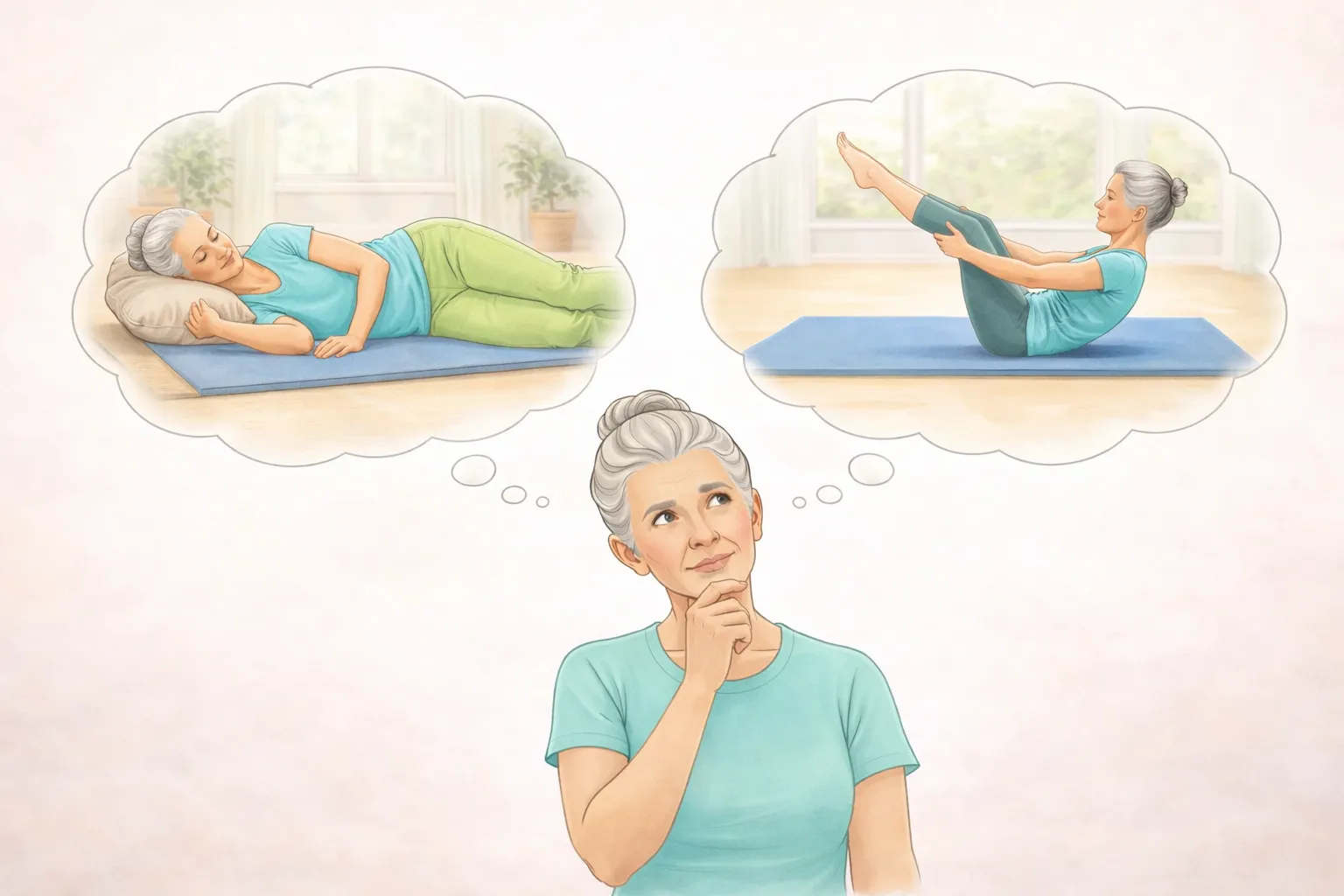
Feldenkrais vs Pilates: How to Choose
A side-by-side comparison of two popular movement methods, how they differ in philosophy and practice, what research says, and how to choose between them.
Apr 17, 2026
Everything Looks Fine on the MRI. So Why Do You Still Hurt?
When imaging comes back normal but the pain is real, the answer might lie in how your body has learned to protect itself, not in what is broken.
Apr 8, 2026
Curiosity: Gentler Than Correction
What changes when the question in your mind shifts from "Am I doing it right?" to "What do I notice?"
Oct 16, 2026Ready to Start Moving Better?
Try your first lesson for free. No credit card required.