
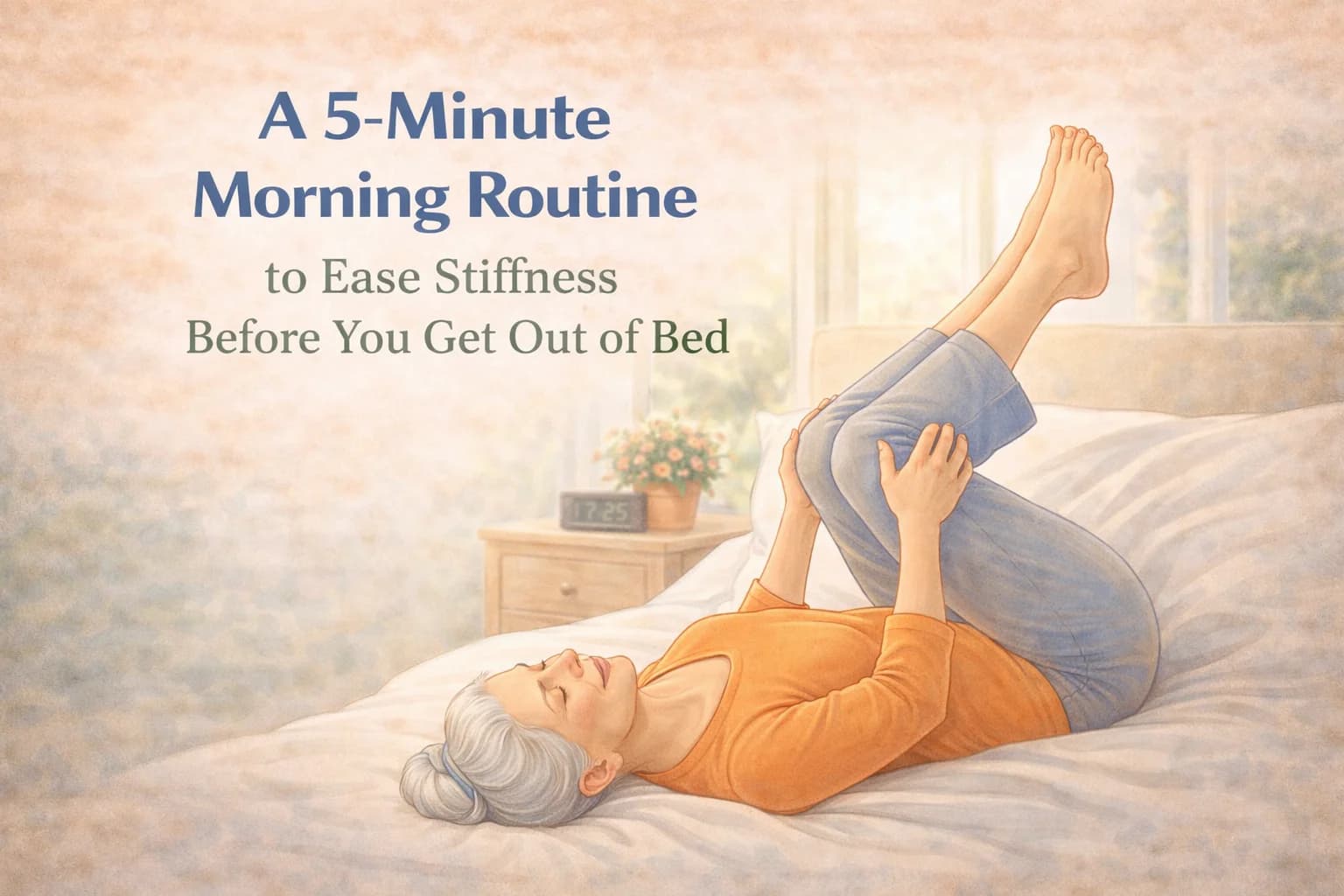
5-Minute Morning Routine to Ease Stiffness in Bed
A gentle Feldenkrais-based morning routine you can do lying in bed - no stretching, no equipment, no effort, just easier movement to ease morning stiffness.
If your mornings start with stiffness, you are not alone. That locked-up feeling in the lower back, the hips that refuse to cooperate, the sense that your body aged ten years overnight, this is one of the most common physical complaints in adults, and it gets more persistent with age.
Most people deal with it by pushing through: shuffling to the bathroom, waiting for the shower to loosen things up, accepting that the first twenty minutes of the day will feel like this. But there is a simpler approach, and it takes about five minutes, done right where you are, before you even get out of bed.
This routine is based on principles from the Feldenkrais Method®, a movement practice that works through gentle awareness rather than stretching or effort. The movements are small, slow, and easy. They work by giving your nervous system the information it needs to release the tension patterns that built up overnight.
You don't need to be flexible. You don't need to be fit. You just need five minutes and the willingness to move slowly. If you'd prefer to be guided through it with audio, you can try a free lesson here.
Before You Begin
Lie on your back with your legs straight and your arms resting at your sides. If you are in bed, that is perfect. A firm surface is ideal but not required.
Take a moment before you move at all. Notice how your body is resting. What parts are pressing into the mattress? What parts feel lifted or suspended? Notice the length of your body from head to feet. Notice your breathing without changing it.
This is not a warmup. It is the beginning of the routine. The noticing itself starts to wake up the connection between your brain and your body.
Step 1: Roll Your Head Side to Side
With your head resting on the pillow or mattress, gently roll it to the right and then to the left. Very slowly. Feel the back of your skull making contact with the surface as it rolls, noticing which part of the back of your head is touching at each point.
Do this five or six times. There is no target to reach. The movement can be tiny. What matters is that you feel it clearly.
Then stop in the center and notice if your neck feels any different than it did a moment ago.
Step 2: Roll Your Feet on Your Heels
With your legs still straight, let both feet roll to the right and then to the left, pivoting on your heels.
As you do this, notice how far up the movement travels. Can you feel it in your ankles? Your knees? Your hip joints? Does the movement reach your pelvis? Some mornings it will, some mornings it won't. Just notice.
Do this for about thirty seconds, easily and without effort.
Step 3: Tilt Your Knees Side to Side
Bend both knees and stand your feet flat, about hip-width apart.
Now let both knees tilt gently to the right, then to the left. They move together, like windshield wipers. Your pelvis will roll naturally with this movement. Let it.
Notice your feet and how they press into the mattress differently as your knees tilt. Notice the movement in your lower back.
After a few repetitions, add your head: as your knees tilt to the right, roll your head gently to the left. Knees right, head left. Knees left, head right. This creates a gentle twist through the whole spine, waking up each segment from tailbone to skull.
Then try the opposite: knees and head tilting to the same side. Notice how different this feels.
Do each variation four or five times, then stop and rest with your legs straight for a moment. Notice what has changed.
Step 4: Reach Toward the Ceiling
Bend your knees again, feet standing. Raise both arms toward the ceiling.
Now reach your right arm a little higher, letting your right shoulder blade lift off the mattress. Then lower it and reach your left arm higher, lifting your left shoulder blade. Alternate, slowly.
Feel how one shoulder blade lifts while the other presses into the bed. This is a gentle mobilization of your upper back and ribcage, an area that often locks up overnight.
Do this six or eight times, then rest your arms at your sides.
Step 5: The Self-Hug Roll
This is the movement that tends to change the most. Place your right hand on your left shoulder and your left hand on your right shoulder, as if hugging yourself. Bend your knees, feet standing.
Now gently lift your left shoulder and roll your chest and head a little to the right. Then back to center. Lift your right shoulder and roll chest and head to the left. Back and forth, gently.
Once this feels comfortable, add the knees: as your chest and head turn to the right, let your knees tilt to the left. Chest and head left, knees right. This creates a spiraling movement through your entire trunk, mobilizing the thoracic spine and ribs in a way that static stretching cannot reach.
Do this four or five times each direction. Then stop, uncross your arms, straighten your legs, and rest.
Step 6: Notice the Difference
Lie still for a moment. You have been moving for about four or five minutes.
Notice how your body is resting now compared to when you started. Are there parts that feel longer, or wider, or heavier against the mattress? Has your breathing changed? Does one side feel different from the other?
This noticing is not optional. It is what makes the routine work. Your nervous system updates its settings based on what you notice, not just what you do.
When you are ready to get up, bend your knees, let them tilt to one side, and come up to sitting through your side rather than crunching straight up. Take a moment sitting on the edge of the bed. Then stand and notice how your feet carry your weight.
Why This Works
This routine is not exercise and it is not stretching. It is a conversation with your nervous system.
During sleep, your body settles into habitual tension patterns. Your muscles contract and hold. Your joints lose their lubrication. Your brain's map of your body goes quiet. When you wake, the stiffness you feel is not damage or deterioration. It is your nervous system still running yesterday's settings.
The small, slow, aware movements in this routine give your brain fresh information. They say: this is where the pelvis can move. This is how the spine can twist. This is how much freedom the shoulders have today. The brain listens, updates its map, and releases tension it no longer needs to hold.
This is why the movements are small and slow. Fast, forceful movement triggers a protective response, the opposite of what you want. Gentle movement with attention triggers a learning response. And learning is what changes the pattern.
If you want to understand more about why your body stiffens overnight and how the Feldenkrais approach works at a deeper level, we wrote about that in detail in Morning Stiffness: How the Feldenkrais Method Helps You Wake Up with Ease.
Prefer to Be Guided Through It?
Feldy's Morning Awakening is a daily audio-guided routine built for exactly this, done lying in bed before you get up.
Try a Free LessonTips for Getting the Most Out of It
Slower is better. If you think you are moving slowly enough, try half that speed. The nervous system needs time to register what is happening.
Smaller is better. Big movements recruit big muscles and trigger effort. Tiny movements allow fine distinctions. The learning happens in the subtlety.
Rest between movements. The pauses are not dead time. They are when your nervous system integrates what it just learned. If you skip the rests, you skip half the benefit.
Do not push through discomfort. If something hurts, make the movement smaller. If it still hurts, skip it entirely and move to the next step. There is no failing here.
Breathe normally. Do not try to coordinate your breathing with the movements. Let your breath do whatever it wants. You may notice it changes on its own as you move. That is the nervous system reorganizing.
FAQ about a 5-Minute Morning Routine for Stiffness
Can I do this routine in bed or do I need to get on the floor?
You can do the entire routine in bed. A firm mattress works best, but any bed will do. The movements are small enough that a soft surface does not interfere. The whole point is that you do this before you even stand up.
How long does this morning routine take?
About five minutes if you move at a comfortable pace. Some mornings you may want to spend longer on a particular movement that feels good. There is no rush. The benefit comes from the quality of attention, not the duration.
Will this help with lower back pain in the morning?
Many people find that their lower back feels noticeably better after this routine. The pelvic tilts and knee rolling movements gently mobilize the lumbar spine and hips, which are the areas most commonly affected by morning stiffness. If your back pain is severe or persistent, see a healthcare provider.
I'm over 60 and very stiff in the morning. Is this routine safe for me?
Yes. Every movement in this routine is done slowly, gently, and within your comfortable range. There is no stretching, no forcing, and no position you need to achieve. If something is uncomfortable, simply do less. Smaller and slower is always better.
How is this different from stretching in the morning?
Stretching tries to lengthen muscles by pulling them. This routine works through the nervous system: small, gentle movements done with attention signal the brain to release habitual tension patterns. The result is often more effective and more lasting than stretching, because the change happens at the level of how your body organizes movement, not just at the level of muscle length.
How often should I do this routine?
Daily is ideal. Morning stiffness is driven by habitual tension patterns that reassert themselves every night. A brief daily practice teaches the nervous system a new default. Most people notice a cumulative improvement over the first two to three weeks.
What if I fall back asleep during the routine?
That is completely fine. It means your nervous system felt safe enough to relax deeply. When you wake again, pick up where you left off or simply notice how your body feels and get up. There is no wrong way to do this.
Start your free 7-day trial
Start free trialMore Articles
Sciatic Pain Management with the Feldenkrais Method
Why sciatica keeps coming back, how your body's protective patterns may be part of the problem, and what gentle movement awareness can do about it.
Apr 1, 2026
Morning Stiffness: How Feldenkrais Helps You Move
Why your body feels locked up when you first get out of bed, and how just a few minutes of mindful movement can change that
Mar 15, 2026
Curiosity: Gentler Than Correction
What changes when the question in your mind shifts from "Am I doing it right?" to "What do I notice?"
Oct 16, 2026Ready to Start Moving Better?
Try your first lesson for free. No credit card required.