
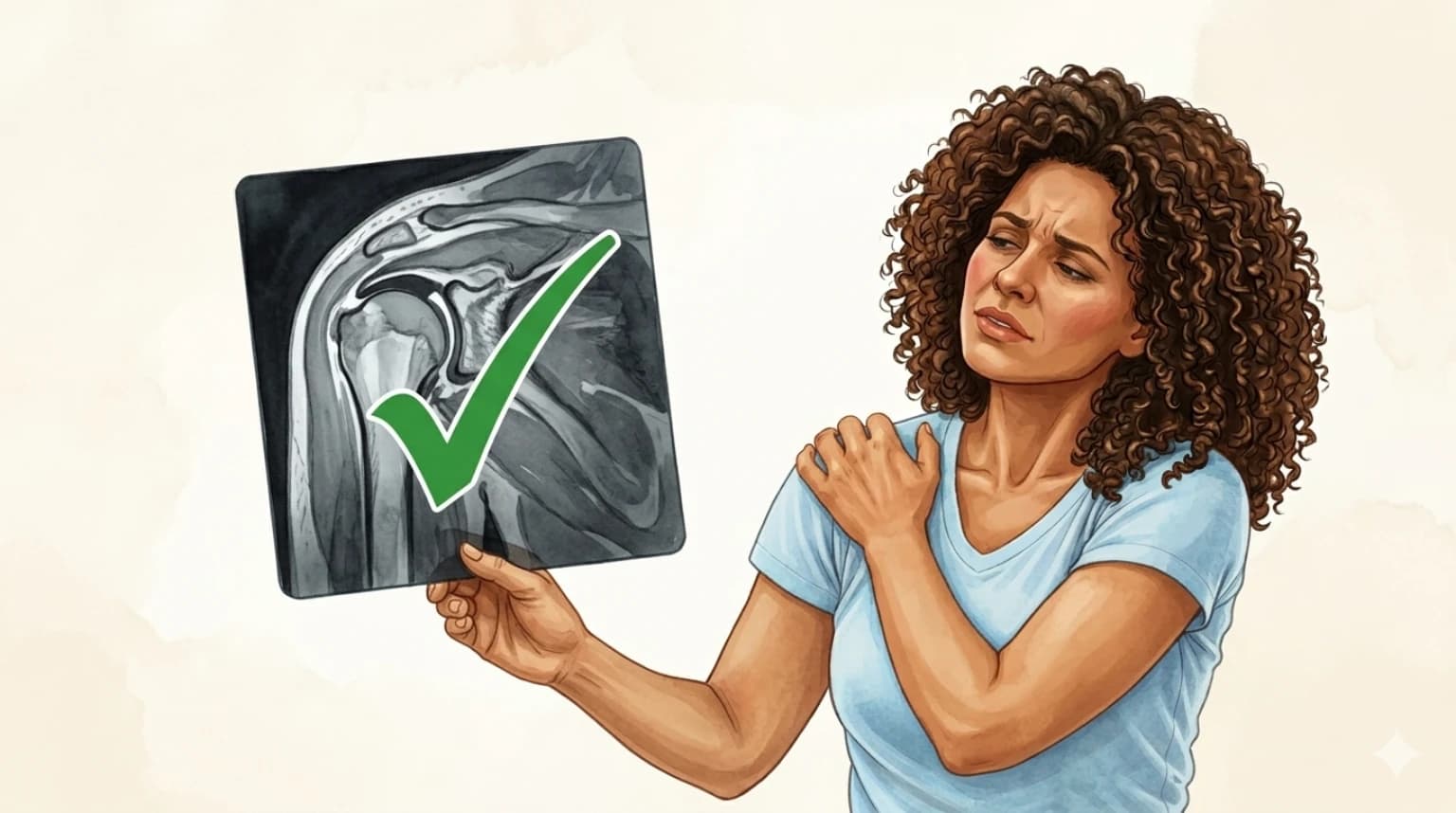
Everything Looks Fine on the MRI. So Why Do You Still Hurt?
When imaging comes back normal but the pain is real, the answer might lie in how your body has learned to protect itself, not in what is broken.
You went to the doctor. You described the pain, the stiffness, the aching, the way it gets worse when you sit or stand for too long. They ordered an MRI. You lay in the machine, listened to the banging, and waited for the results that would finally explain what is wrong.
And then the report came back: everything looks fine.
No herniated disc. No fracture. No tumor. Nothing that explains why you have been hurting for months or years. The doctor may have said something like "mild degenerative changes, normal for your age." Which leaves you with a question that nobody seems able to answer: if nothing is wrong, why does it still hurt?
If you are in this situation, you are not imagining things. You are not being dramatic. And you are far from alone.
The Good News Nobody Explains
A normal MRI is actually good news. It makes the serious things, like fractures, tumors, and significant nerve compression, less likely. That is genuinely important and worth knowing.
But here is what often gets lost in the conversation: a normal MRI does not mean nothing is causing the pain. It means the cause might not be something that shows up on imaging. And many of the most common drivers of chronic back pain do not show up on imaging.
Up to 85% of chronic low back pain is classified as "non-specific," meaning no clear structural cause can be identified on scans. This is not a rare situation. It is the most common one. And it does not mean the pain lacks a physical basis. It means the physical basis might be something MRIs are not designed to see.
Your first priority is to continue working with your doctor. A normal MRI is valuable information, and your healthcare provider can help investigate other potential contributors, refer you to appropriate specialists, and guide your next steps. What follows here is not a replacement for that care. It is context that might help you understand what else could be going on, and what you might explore alongside your medical treatment.
What the MRI Cannot See
An MRI shows structure: bones, discs, nerves, joints. It is very good at this. What it cannot show is how your body moves, how your muscles coordinate (or fail to coordinate), how your nervous system has organized itself around the pain, or what habitual tension patterns have built up over months or years.
Think about it this way: if you took a photograph of a car, you could see whether the body was dented or a tire was flat. But you could not tell from the photograph whether the steering pulls to the left, whether the brakes grab unevenly, or whether the driver has developed a habit of overcompensating in one direction. The photograph shows structure. The problem might be in the function.
For many people with chronic back pain, the problem might be functional. The structures are intact, but the way the body uses them has shifted.
How the Body Learns to Protect, and Then Might Not Stop
When something hurts, your body does something intelligent: it reorganizes to protect the area. Muscles tighten around the painful spot. The pelvis shifts. The way you breathe changes. You start moving differently, more carefully, more guardedly, bracing before you bend, holding your breath before you stand up.
This protective response is helpful in the short term. But the nervous system is a fast learner and a slow forgetter. Even after the original trigger resolves, the guarding patterns might persist. The muscles that braced to protect the lower back keep bracing. The pelvis that stiffened stays stiff. The hips that stopped contributing to movement remain locked.
When the body has been protecting itself from pain for a long time, the muscle system might learn to brace constantly. And this can create a difficult cycle: the bracing itself becomes a source of discomfort, which triggers more bracing. The MRI sees none of this, because structurally, everything looks fine. The problem might be in the pattern.
When Standard Exercises Do Not Seem to Help
If you are working with a physiotherapist, that is a good step. Physiotherapy helps many people with chronic back pain, and a skilled therapist can tailor an approach to your specific situation. But if certain exercises seem to aggravate your pain rather than improve it, that experience is worth paying attention to.
Here is one possible reason: when the body has been protecting itself for a long time, exercises that ask braced muscles to work harder can sometimes reinforce the bracing rather than releasing it. If the nervous system has decided that the lower back needs protecting, and you do exercises that load the lower back, the protective response might intensify.
Similarly, stretching a muscle that is tight because the nervous system is guarding it can sometimes trigger more guarding. The tightness returns within hours because the tightness might not be a muscle length problem. It might be a nervous system strategy.
When exercises regularly make the pain worse, it might be a sign that the approach is working against the nervous system's protective response rather than with it. This does not mean physiotherapy is wrong for you. It might mean that a different type of movement could be a useful addition to your recovery, something that works with the nervous system rather than asking it to override its own protective patterns.
Talk to your physiotherapist about this. A good therapist will want to know which exercises aggravate your symptoms and can adjust accordingly.
A Complementary Approach: Working With the Nervous System
If you have noticed that certain very gentle movements do not aggravate your pain, things like small pelvic tilts, gentle knee rolls, or slow rocking, you have already discovered something important. These movements share a common quality: they are small, exploratory, and require almost no effort.
This is not a coincidence. Small, slow movements are less likely to trigger the protective response. They fly under the nervous system's radar. And in that window of safety, something can begin to change.
The Feldenkrais Method® is built entirely around this principle. It is a form of somatic education that uses very gentle, slow movement to help re-educate the nervous system about how to organize the body. It is not a replacement for medical care or physiotherapy. It is something that some people find helpful alongside those treatments.
A typical lesson is done lying down on a mat or even in bed. A voice guides you through small movements: tilting the pelvis, rolling the knees, exploring how the ribs move when you turn. The movements are deliberately tiny and effortless. There is no stretching, no strengthening, no position you need to achieve. The goal is not to build muscle or increase flexibility. The goal is to give the nervous system new information about how movement can happen without triggering the pain response.
This is a different framework than exercise-based rehabilitation. Rather than targeting individual muscles, it addresses how the entire body is organized. When the pelvis and hips begin to move more freely, the lower back might no longer have to absorb all the movement. When the thoracic spine and ribcage participate more, the load can distribute more evenly. The bracing pattern that might have been contributing to the pain can begin to ease, not because you forced it, but because the nervous system discovered it was no longer necessary.
What the Research Shows
A 2017 study found that people with chronic low back pain who practiced the Feldenkrais Method developed significantly greater interoceptive awareness (the ability to sense what is happening inside the body) compared to a standard back school program. This matters because better body awareness might support better movement choices, which can mean less re-aggravation.
A 2020 randomized controlled trial comparing Feldenkrais to core stability exercises for chronic low back pain found comparable pain reduction, with the Feldenkrais group showing additional improvements in how they moved and used their bodies.
These are not miracle claims. The evidence suggests that for people whose pain might be driven by movement patterns and nervous system organization rather than structural damage, approaches that address those patterns could be a useful complement to standard care.
What This Means for You
If your MRI came back normal and you are still hurting, here is what might be happening: your body learned to protect itself, and it has not yet learned that it can stop. The pain is real, the cause is physical, and it might live in a domain that imaging was never designed to see.
Your first priority is to get back to the doctor, and continue working with her. A normal MRI is valuable information, not the end of the investigation. Your healthcare provider can help determine next steps, whether that is further testing, a referral to a specialist, or a different approach to physiotherapy.
Alongside that care, it might also be worth exploring gentler, slower, more exploratory kinds of movement, the kind that works with the nervous system's protective patterns rather than against them. The Feldenkrais Method is one such approach, and some people with complex or long-standing back pain find it a helpful supplement to their medical treatment and physiotherapy, particularly when standard exercises have not helped or have made things worse. There are also other gentle movement methods worth exploring. It can take trying a few to find what works best for your body.
Not sure which approach might suit you? Take our 2-minute Movement Match quiz to find out.
Try a Gentle Lesson at Home
A free Feldenkrais lesson, done lying down. No equipment needed. Work entirely within your comfortable range.
Try a Free LessonWhen to Seek Further Medical Attention
Most non-specific back pain improves with time and appropriate care. But some signs warrant urgent medical evaluation:
- Pain that is getting progressively worse despite rest and gentle movement
- New weakness in the legs or feet
- Numbness in the groin or inner thigh
- Loss of bladder or bowel control
- Unexplained weight loss alongside the pain
- Pain that wakes you from sleep and does not ease with position changes
These are uncommon but important. Do not wait if you experience them.
FAQ about Back Pain When the MRI Shows Nothing
Why does my back still hurt if my MRI is normal?
Up to 85% of chronic low back pain is classified as non-specific, meaning imaging cannot identify a clear structural cause. A normal MRI is actually good news because it makes serious conditions less likely. But the pain is real. It might be driven by how your nervous system organizes movement and tension, habitual bracing patterns, reduced mobility in the hips and pelvis, or a sensitized pain response. These are real physical processes that simply do not show up on imaging.
What is non-specific back pain?
Non-specific back pain means that no clear structural cause, such as a fracture, tumor, or significant disc herniation, has been identified. It is the most common diagnosis for chronic low back pain. It does not mean the pain is imaginary or psychological. It means the source is likely related to how the body moves, holds tension, and processes pain signals rather than to a specific damaged structure.
Why do stretching and core exercises sometimes make back pain worse?
When the body has been protecting itself from pain for a long time, the muscle system might learn to brace constantly. Exercises that ask those muscles to work harder can sometimes reinforce the bracing rather than releasing it. Stretching a muscle that is tight because the nervous system is guarding it can trigger more guarding. This does not mean exercise is bad. It means the type of exercise matters, and your physiotherapist can help you find approaches that work with your nervous system's protective response rather than against it.
Can the Feldenkrais Method help with back pain when nothing shows on the MRI?
The Feldenkrais Method might be a helpful supplement to your medical care and physiotherapy for non-specific back pain, because it addresses exactly what imaging cannot see: movement patterns, habitual tension, and nervous system organization. Rather than strengthening or stretching specific muscles, it uses very gentle, slow movements to help the nervous system discover new ways of organizing the body. Research shows improvements in pain, function, and body awareness for people with chronic low back pain.
Should I still see a doctor if my MRI is normal but I have pain?
Yes. Your first priority is to continue working with your healthcare provider. A normal MRI makes serious conditions less likely, which is valuable information. Your doctor can help investigate other potential contributors, refer you to appropriate specialists, and monitor your symptoms over time. Approaches like the Feldenkrais Method work alongside medical care and physiotherapy, not instead of them.
What does a Feldenkrais lesson look like for someone with back pain?
You lie on your back or side on a mat or even a bed. A voice guides you through very slow, very small movements, often involving the pelvis, hips, and spine. There is no effort, no stretching, and no position you need to achieve. The movements are deliberately gentle so that the nervous system does not trigger its protective response. Many people find it a useful complement to their physiotherapy and medical care.
How is Feldenkrais different from physical therapy for back pain?
Physical therapy typically focuses on strengthening weak muscles and stretching tight ones, and it is an important part of back pain recovery. The Feldenkrais Method offers something complementary. Rather than targeting individual muscles, it addresses how the entire body is organized around the pain. The goal is to re-educate the nervous system about how to coordinate movement so that the lower back no longer absorbs disproportionate load. Many people find the two approaches work well together.
Start your free 7-day trial
Start free trialMore Articles

Feldenkrais vs Pilates: How to Choose
A side-by-side comparison of two popular movement methods, how they differ in philosophy and practice, what research says, and how to choose between them.
Apr 17, 2026
Alexander Technique or Feldenkrais? What Each Feels Like From the Inside
What a lesson of each method feels like from the inside, what the research says, and how to choose the one that suits the way you learn.
Apr 6, 2026
Curiosity: Gentler Than Correction
What changes when the question in your mind shifts from "Am I doing it right?" to "What do I notice?"
Oct 16, 2026Ready to Start Moving Better?
Try your first lesson for free. No credit card required.