
For stiffness and reduced mobility after 60
Less stiffness after 60. Easier movement. The gentler way.
Rebuild trust in a body that has changed.
A gentle, intelligent online movement program for stiffness after 60. Watch the explainer, then try free for 7 days. No card needed.
Created and guided by Chava Sorani, Guild Certified Feldenkrais Practitioner.
7 days free. No credit card needed.
For stiffness and reduced mobility after 60
Still hurting after stretching, exercises, or physical therapy? Try a gentler approach.
Feldy is a guided online movement program based on the Feldenkrais Method®. Instead of asking you to stretch or strengthen an already sensitive back, it helps retrain how you move, so everyday movement can become easier and more comfortable. Many members notice a difference within their first week.
7 days free. No credit card needed.
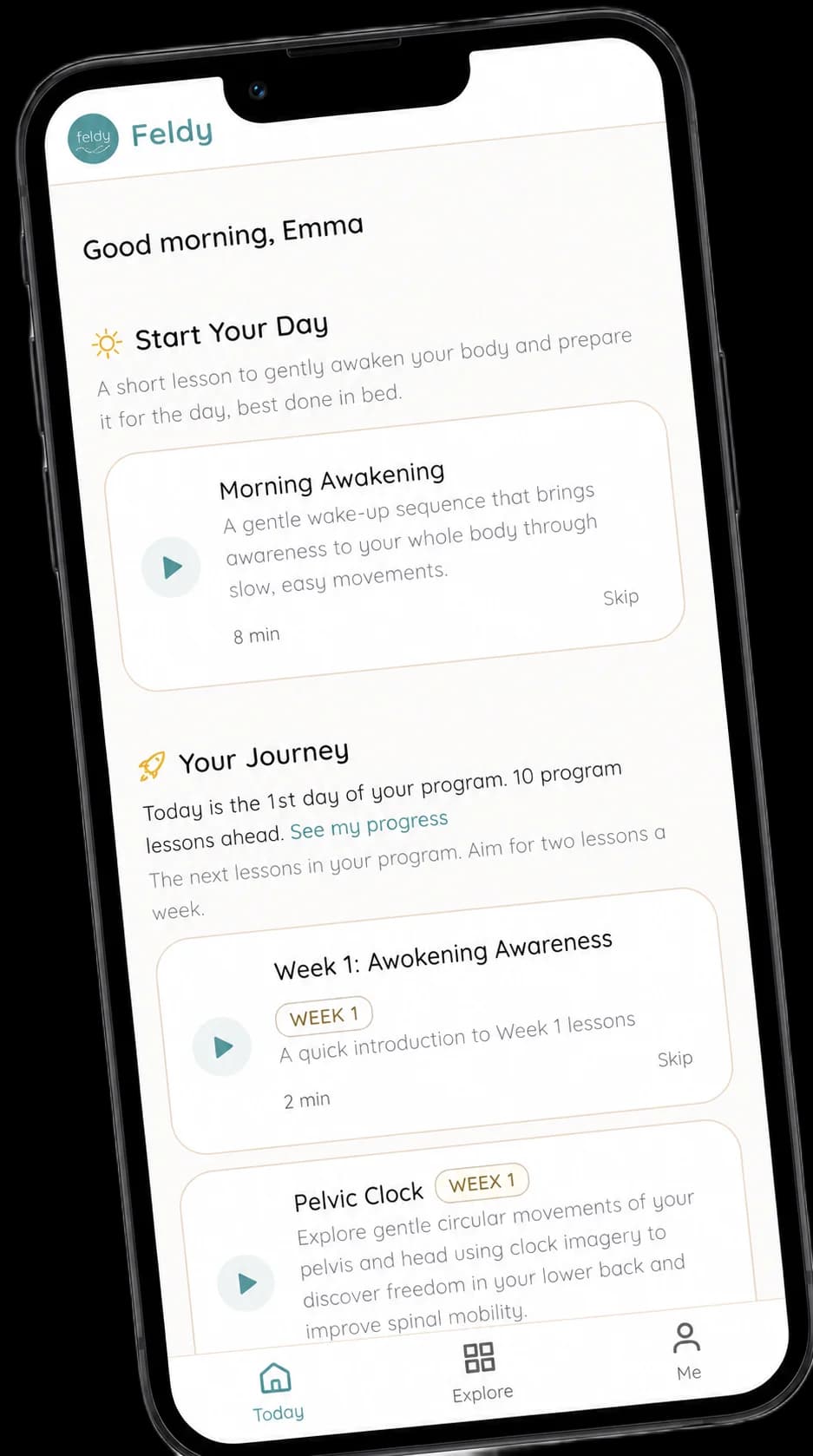
Does this sound like your whole body?
- You take stairs one at a time, and you cannot remember when that started.
- Getting up from the floor is a project.
- Reaching the top shelf has become a calculation.
- You avoid movements you used to do without thinking. Bending down for the dog. Reaching the top shelf. Getting up from the floor.
- You catch yourself avoiding things you used to do without thinking.
You have not lost the movement. You have lost trust that your body can still do it.
For many people, the stiffness that settles in after sixty is less about aging tissue and more about a nervous system that has stopped expecting variety. Years of repeating the same narrow set of movements train the body to forget the rest. Often, more movement is still available than people expect; the body simply stopped reaching for it. Feldenkrais speaks to that nervous system directly. When the brain remembers the movements are still possible, the body often allows them again.
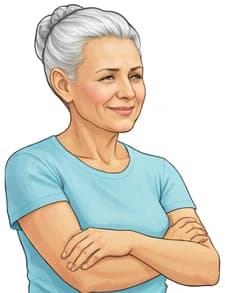
If you have already tried a lot of things
Stretching
eased it for an hour
Walking
still stiff by evening
Supplements
no real change

Heat pads
back once it cooled

None of these were wrong, and most brought a little relief. Stretching, walking, a supplement, a heating pad all soothe the surface of stiffness for a while. What they do not reach is the deeper pattern underneath, the way a nervous system settles into the same narrow movements and stops expecting the rest, so the ease fades and the stiffness finds its way back.
Feldy works on that pattern itself. As your body remembers movements it had quietly filed away, the change holds, and the walking or stretching you already enjoy can start to feel easier and reach further. You do not have to give any of it up. Feldy is the missing piece that makes the rest add up. Do less, gain more.
Why Feldenkrais works for stiffness and reduced mobility after 60
1. Movement intelligence: your range can return when the system stops protecting you from movement.
By 60, the body has often learned to stop reaching for movements that once seemed uncertain. The pattern is protection, not weakness. The lessons invite back the small movements at the base of the chain, in the pelvis, spine, and ribs, so the larger movements can come back without effort.
2. Slow, attentive movement can quiet the assumption that the body has aged out of certain motions.
The nervous system files some movements away as not available anymore. That filing is often reversible. Small, gentle motion tends to teach the system that the movement can be safe, and movement often becomes easier again, without forced stretching.
3. Change comes from noticing, not forcing.
You will not stretch. You will not push. You will pay close attention to small movements in positions where the joints are unloaded, and that attention is what tends to create change you can feel before you stand back up.
From people with stiffness and reduced mobility after 60
More mobile at 78 than at 68.
“I never cared for sports or fitness. But at my age I came to understand my body needs to keep moving. I'm not very technical either, and yet I just open the app, press play, and lie on the floor. The lessons build on each other gently. At 78 I feel more mobile than I did at 68. This is training for life.”
Linda K.
Grandmother of four, 78
Moving with ease again at 77.
“At 77, I'd made my peace with stiffness. I was scared that moving the wrong way would make my back worse, so I'd mostly stopped trying. But this asks so little of you. You lie down, follow Chava's voice, and you get up softer and easier than you came in. Nothing I'd tried before was this gentle, or this kind to a body that's afraid. I feel more like myself again. You should try this.”
Eleanor
Retired, 77
Up off the floor without thinking about it.
“I told myself I was just getting older and I should accept that bending down to tie my shoes was a production. After a month of these lessons I noticed I was getting up from the floor without thinking about it. I had been bracing for that movement for years without knowing it.”
Joan P.
Retired librarian, 67
97% of Chava’s students said they would definitely recommend Feldenkrais to a friend.
You do not have to commit to the program today. Just see what happens after your first lesson.
Selected research
What the research shows
Less afraid of falling, steadier on your feet
In two trials of older adults (average age 75, mostly women), gentle Feldenkrais improved balance and walking while easing the fear of falling.
See the researchUllmann 2010; Vrantsidis 2009
Evidence from 16 clinical trials
Pooling 16 controlled trials, researchers found large improvements in balance and mobility among older adults, with pain relief similar to standard physical therapy.
See the researchBerland and colleagues, systematic review, 2022
More mobility, no strenuous exercise
In a randomized trial, older adults improved mobility, balance, and ease of movement through gentle Feldenkrais, without the need for strenuous exercise.
See the researchRandomized trial, Journal of Bodywork and Movement Therapies, 2015
Feldenkrais is a way of learning easier movement, not a medical treatment.
You do not need to believe this will work.
Just try it.
Many people are skeptical at first, and they should be. If your body has felt a little stiffer every year, you have probably made your peace with it already.
That is the whole point of the free week. You do not have to decide whether Feldy works. You only have to notice whether your body moves a little easier after a lesson.
Why I made Feldy

The people I worked with were not looking for another exercise program. They were tired of negotiating with their bodies every day, of doing everything right and still feeling stuck.
I made Feldy so they could have that same gentle guidance at home, in their own room, at their own pace, whenever they need it. Every lesson is my voice, guiding you the way I would in person.
Chava Sorani, Guild Certified Feldenkrais Practitioner (GCFP)
How this works, in plain terms
- 1
Lie down, on your bed or the floor, wherever is comfortable. No equipment, no setup, no special clothes.
- 2
Press play and follow Chava's voice. The movements are small and slow, and stay well inside the easy range. You never stretch, push, or force, and if something does not feel good, you simply do not do it.
- 3
Notice the difference. Many people stand up after the lesson and feel turning a little easier, the feet a little more grounded. Students often call it meditation in movement: present, unhurried, attention inward. No comparison to anyone else.
What your first week looks like
Seven days, free, no credit card.
- Day one. Your first guided lesson with Chava, about 30 to 45 minutes lying down, helping you notice where your body is bracing against movement it could let go of.
- Through the week. The short morning and bedtime rituals, five to ten minutes each, to carry that ease into ordinary days.
Open it in any web browser, on your phone or computer, with nothing to install. No card to start, and you can stop any time.
What you can expect to feel
In your first lesson
- 1.Your spine may settle into the surface beneath you in a way you had forgotten was possible.
- 2.Your breath can deepen on its own, and your ribs may soften for the first time in years.
- 3.When you stand up afterward, your feet can make fuller contact with the floor, and turning your head may feel a little easier.
The first changes people tend to notice
In the first days, it is usually the small things. Turning to look behind you can take less effort. Getting out of a chair can feel less like a push. You may notice your feet meeting the floor more fully, or a little more room in how you reach overhead. None of this is a dramatic breakthrough. It is your body remembering options it had set aside, and building from there.
Common Questions about Stiff and inactive after 60 (FAQ)
Is this really for someone my age?
Yes. The method was developed by Moshe Feldenkrais after his own knee injury in his fifties, and many practitioners are in their seventies and eighties. The lessons are done lying down, the movements are small and unforced, and the program is designed to meet you where you are now. People in their sixties and seventies often report the strongest changes, because there are more years of stored-up patterns to release.
I have not exercised in years. Will I be able to do this?
Yes. The lessons are not exercise. There is no fitness required, no cardiovascular demand, no muscle to strain. You lie down, you move in small ways, and your attention does the work. Most people are surprised not to feel sore the next day, because the work is done with the nervous system, not against the muscles. People who have been inactive for years often find this is one of the gentlest ways back into movement.
I am stiff in places I did not expect, like my hands and jaw. Can this help those too?
Often, yes. The lessons work on the pattern of how your nervous system organizes movement throughout the whole body, not on a single joint. People often notice changes in places they did not expect, including their hands, their jaw, and their feet, because the same pattern was holding tension everywhere.
I am worried about falling. Can I do this?
Yes. Almost all of the lessons are done lying down on a mattress or the floor, where falling is not a risk. The lessons that involve sitting or standing are introduced gradually and only at the level you can manage. The method is widely used with seniors precisely because it tends to improve balance through awareness, not by challenging it.
Will I really improve, or is this just stretching with extra steps?
Different mechanism, very gentle and soft. There is no stretching in the lessons. The nervous system relearns movements that years of habit have buried. Many people in their sixties and seventies notice changes in the first or second lesson, and the change tends to last because it is a pattern shift, not a tissue change.
What if I do not feel anything in the first lesson?
That is fine and common. The effects can be subtle the first time. The change often shows up after the lesson, in how you get out of a chair, in how you turn to look at someone, or by the second or third lesson as the pattern begins to update. More significant change usually becomes clear over several weeks. Give it five lessons before you decide. Curiosity matters more than sensation here.
What if it does not help me?
Every subscription starts with a free 7 day trial, no credit card needed. Try the lessons, complete one or two, and see if Feldy is right for you before you subscribe.
Have a question? Write to me at ask-chava@feldy.me. I answer every email personally.
Try the Feldy online movement program free for 7 days. See how your whole body feels.
No equipment. No forcing. You only go where it feels easy, pleasant, and comfortable.
When just getting older no longer explains what you feel, the program is here. Do less, gain more.
Have a question? Write to me at ask-chava@feldy.me. I answer every email personally.