
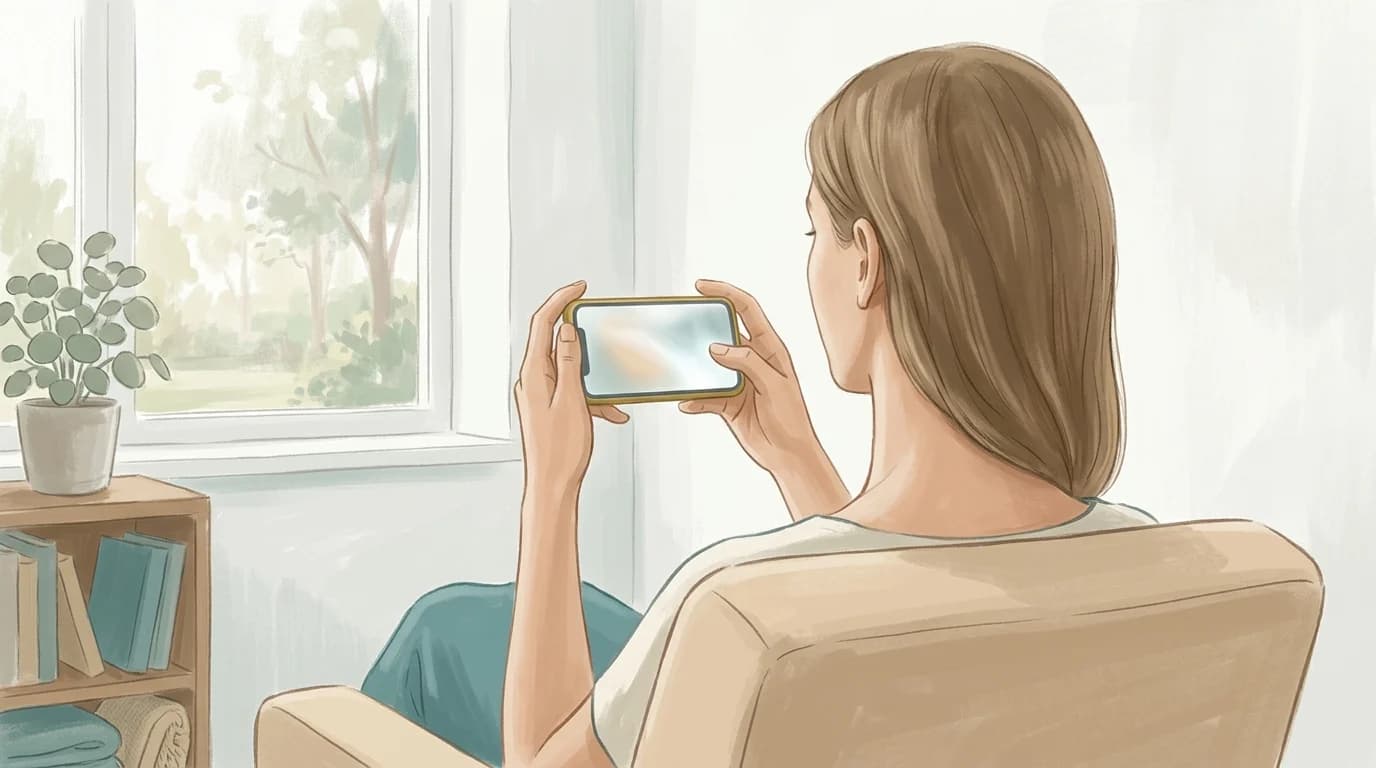
A device coached slumped necks. So can attention.
A July 2026 trial found a device signaling neck slump eased smartphone neck pain, while stretching did not. The signal, you can learn to supply yourself.
Most of us spend hours a day with the head tipped forward over a phone, the neck quietly folding while we scroll. A trial published this month in Applied Psychophysiology and Biofeedback looked at what happens when you give that folded neck a way to notice itself, and the result says something I find myself repeating in almost every session I teach.
The researchers worked with smartphone users who already had chronic neck pain and split them into three groups for six weeks. Two groups wore a small biofeedback device for two hours a day, one tuned to the muscles along the back of the neck, the other to the angle of the head, so that whenever the neck slumped past a certain point the device let them know. The third group did stretching exercises at home. At the end, both biofeedback groups had meaningfully less pain and less disability on a standard neck questionnaire, while the home stretching group did not improve on those measures (Applied Psychophysiology and Biofeedback, 2026).
Read that again, because it is the quiet surprise. Stretching, the thing most of us reach for when the neck aches, did not move the needle here. What helped was a device whose entire job was to make people aware of what their neck was doing in the moment. Where the muscle group was tracked, the researchers even saw a trend toward less muscle activity and a smaller forward head angle during phone use. The active ingredient was not stronger muscles or looser tissue. It was attention, delivered by a gadget.
This matters well beyond the people in the study, because neck pain is one of the most common complaints on earth. A Global Burden of Disease analysis estimated that 203 million people were living with it in 2020, a number projected to reach 269 million by 2050 as populations grow and age (Lancet Rheumatology, 2024). A large share of that load is bound up with the ordinary way we hold ourselves at desks and over screens, which you can read more about in our Feldypedia entry on desk posture and chronic neck pain.
Here is where a practitioner reads the study a little differently. The device helped because it closed a gap most of us carry around all day: the gap between what the neck is actually doing and what we notice it doing. We slump for twenty minutes without registering it, because the sensation has faded into the background. The gadget simply pulls that sensation back into the foreground. This is the exact territory the Feldenkrais Method® has worked in for decades. An Awareness Through Movement® lesson does not push you into a correct posture. It slows you down until you can feel, in fine detail, how much effort you are spending to hold your head, and where some of that effort could quietly drop away.
What I see in the people I work with is rarely a weak neck. It is a neck that has forgotten it has options. Someone arrives sure they must strengthen or stretch their way out of the pain, and what actually shifts things is far smaller: the discovery that the head can balance on top of the spine with a fraction of the gripping they had been using. That discovery cannot be handed over as an instruction. It has to be felt. Once it is felt it tends to repeat itself, because the nervous system reaches for ease when it can find it. You can read more about where that holding tends to settle in our entry on neck and shoulder tension.
The honest question the study raises is whether you need a device to do it. A wearable is one way to borrow attention, and a real one. Learning to supply that attention yourself is another, and it travels wherever you go with no battery required. Neither cancels the other, and if your neck pain is severe or persistent, this kind of sensing practice sits alongside what a physiotherapist or doctor gives you rather than standing in for it.
So try becoming your own biofeedback for a few minutes. The point is not to hold a flawless posture. It is to feel what the neck is doing while you hold a phone, and to let it find an easier arrangement on its own. Go slowly, and only go where it feels easy, pleasant, and comfortable.
A short neck sensing experiment
About 5 minutes. Move slowly, do less than you can, and stay well below any pain. Rest whenever you need to.
- 1
Take a reading. Pick up your phone and hold it exactly the way you usually do, then pause and simply notice your neck. Where is the head sitting. How much of its weight is landing in the muscles at the back of the neck. Is there a low hum of effort you had not registered until now. You are not fixing anything yet, only reading the dial.
- 2
Follow the slump. Let the head drift a little further down toward the screen, the way it drifts when you are absorbed in something. Feel the muscles along the back of the neck quietly take up more load. Then let the head float back up, slowly, and notice the moment the effort eases. You are learning the difference between the two by feel, not by rule.
- 3
Bring the screen to you. Keeping the head easy, lift the phone up toward eye level so the screen comes to you rather than you going down to the screen. Notice how much the neck can let go when it no longer has to reach. There is no perfect height to hold. There is only the arrangement that asks the least of you right now.
- 4
Let the eyes lead. Bring the phone back to a comfortable middle height and this time, instead of dropping the whole head to read the bottom of the screen, let only the eyes travel downward while the head stays balanced. Feel how much looking the eyes can do on their own, and how little the neck actually needs to join in.
- 5
Compare. Set the phone down, let the eyes close for a couple of easy breaths, and notice how the neck feels now compared with the reading you took at the start. You have not stretched anything or held any posture. You have simply spent five minutes feeling what your neck was doing, which is most of the work.
Let Feldy guide you, eyes closed
A calm voice walks you through gentle moves so your attention stays in your body, not on the screen.
Try Feldy Free for 7 daysNo credit card needed.
Notice that nothing here asked you to sit up straight or hold still. The device in the study did not correct anyone by force either. It simply kept handing the neck information until the neck began to use it. You can hand yourself the same information. Whether a wearable, a stretch, or a few minutes of quiet attention is the right tool is a choice for you and your clinician to make. What travels with you, screen or no screen, is the skill of noticing before the ache sets in. You have not lost the knack of carrying your head lightly. You have mostly lost track of when it stops feeling light, and that noticing is a sense you can bring back.
Sources
- Effects of Muscle Biofeedback Versus Posture Biofeedback on Pain and Functional Outcome in Smartphone Users with Chronic Neck Pain— Applied Psychophysiology and Biofeedback (PubMed)
- Global, regional, and national burden of neck pain, 1990 to 2020, and projections to 2050— The Lancet Rheumatology
Movement Pulse is informational, not medical advice. See our editorial policy.
Move better with Feldy
See the programMovement Pulse Weekly
The week's best research, in your inbox Tuesday.
Movement science, gentle-practice ideas, and a practitioner's read on what's new. Free.
More from Movement Pulse

Why neck pain trials keep working on the mid back, and what the pain score misses
Fifty four people, six weeks, and a result that keeps repeating in this literature. The mid back work did not beat neck work on pain, and beat it on almost everything else.
Sep 12, 2026
The best exercise for neck pain may matter less than how often you actually do it
A new analysis pooled 51 trials to compare exercise types for neck pain. Mind body work, resistance, flexibility, and coordination training all landed in much the same place.
Jul 31, 2026
What 25 trials say about a gentle neck nod
A June 2026 meta-analysis of 25 trials found a small, slow neck nod eased chronic neck pain. From a Feldenkrais practitioner's chair, the how matters most.
Jun 26, 2026Ready to start moving better?
Gentle, guided lessons for your body. Try your first one free, no credit card required.