
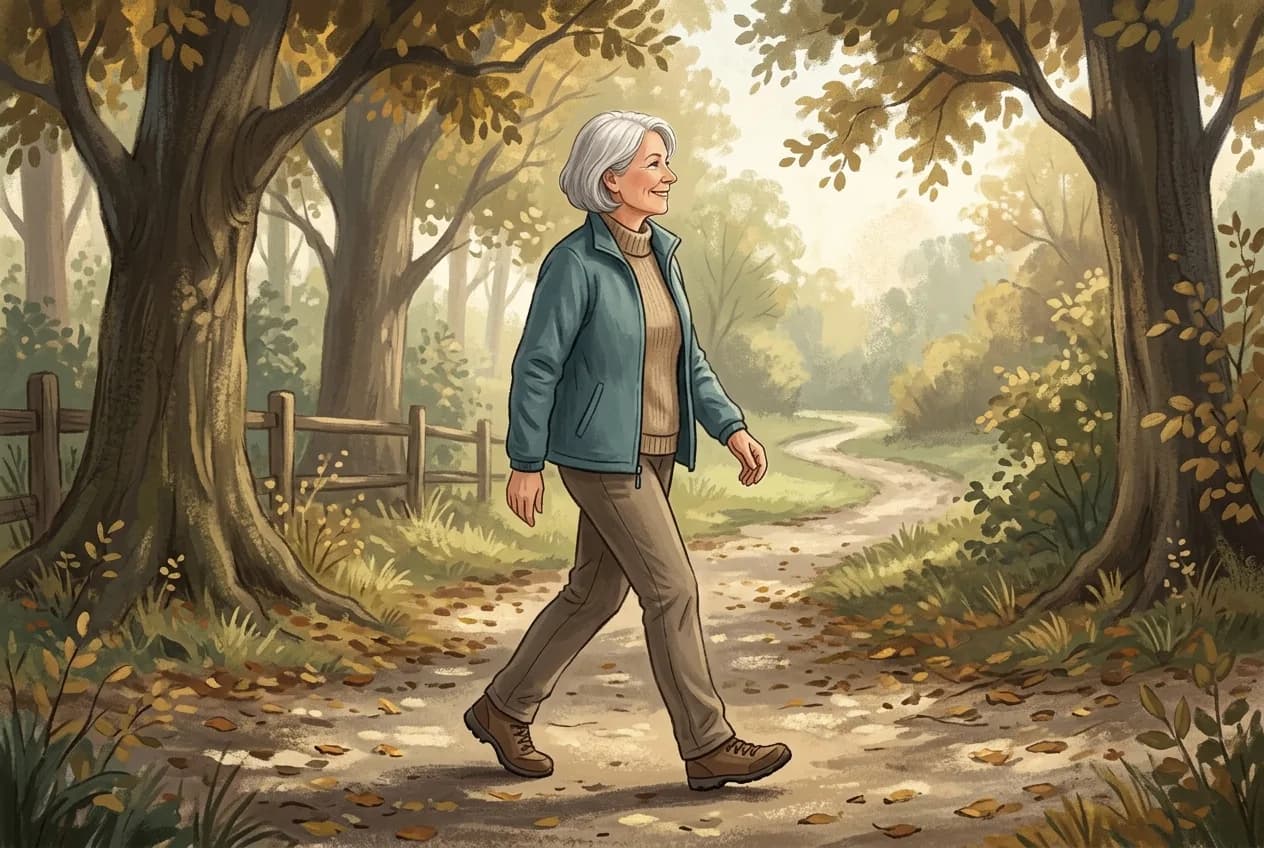
Bending Knees When Walking: A Softer, Easier Gait
Should you bend your knees when walking? A gentle guide to walking with soft, easy knees instead of stiff or locked ones, and why it feels lighter on the joints.
In short
A little bending of the knees when walking is natural and healthy: soft, slightly yielding knees let the leg absorb each step and keep your walk springy and light. Stiff, locked knees jar the joints and tire you out. The aim is not a deep bend, but knees that stay easy and free to move.

Prefer to ease in gently?
See a few gentle exercises for knees and hips to try.
Before you begin. General information, not medical advice. Any change to how you walk should stay small, slow, and comfortable. If a knee is swollen, hot, or very painful, if it locks, gives way, or will not fully bend or straighten, or if pain follows an injury, please see a doctor or physiotherapist before experimenting with your gait.
If you have ever wondered whether you should be bending knees when walking, or noticed that your own knees feel stiff and locked with every step, this is a small change worth exploring. A healthy, easy walk includes a gentle, almost invisible bend at the knee as your weight passes over each leg. That little give is what lets the leg act as a spring, softening the landing and keeping your stride light. Learning to let it happen is a matter of attention rather than effort, which is exactly the kind of learning the Feldenkrais Method® is built on.
Why a little knee bend belongs in every step
Watch an easy, unhurried walker and you will see the knees stay soft and mobile. As the foot meets the ground and the body rolls forward over it, the knee yields just slightly, then lengthens again to carry you into the next step. This small bend spreads the impact of walking through the whole leg, so the joints are cushioned rather than jarred. It also lets the hips and ankles share the work, which is why a springy walk feels lighter and lasts longer before you tire.
Locking the knees straight does the opposite. Each step lands hard, the shock travels up into the knees, hips, and lower back, and walking starts to feel heavy and effortful. Knees are among the hardest working joints in the body, and osteoarthritis, which affected about 528 million people worldwide in 2019, most often settles in the knee (WHO, 2023). Giving the knees room to move well is a kind everyday habit.
Finding softer knees
Stiff, braced knees are usually a habit rather than a fault in the joint, often born of guarding, tension, or simply never having noticed. The way to change a habit is to feel it. Walk a little more slowly than usual and bring your attention to the moment your weight rolls onto each leg. Can you let the knee give just a touch there, rather than snapping it straight and holding it locked? You might first stand still and gently bend and straighten both knees a few times, unhurried, to remind yourself of the feeling, then carry that softness into your walking. There is no target angle. There is only the sense of knees that are free to move. Guarding of this kind does not show up on a scan, which is one reason, as our blog piece explains, that everything looks fine on the MRI for some people who still hurt.
This attentive way of exploring movement is the whole idea behind the Feldy program for knees and hips. You can read more about how walking changes over the years in our Feldypedia guide to gait changes and walking difficulty and our Feldypedia guide to knee stiffness after 60. For related help, see our guides to improving knee flexibility and what causes stiff knees.
Let the whole leg share the work
The point of softer knees is not to fuss over your walking, but to let the joint do its natural job so it is not carrying more than its share. When the ankles, knees, and hips all move a little, no single joint has to brace. Many people find that once they stop holding their knees rigid, their whole walk feels lighter and their legs tire less. A clearer feel for where the knee sits helps here too, and our lesson on knee proprioception exercises is a gentle, guided way to build it. If bending your knees brings pain, or if a knee is swollen, unstable, or will not move freely, please have it looked at rather than pushing on. Comfortable, curious movement is the aim, and a professional can help if something in the joint needs more than gentle attention.
Kinder movement for knees and hips
Understanding the strain is half of it. The Feldy program helps knees and hips carry less of it by reorganising how the whole body moves, through Feldenkrais® lessons. Gentle, guided, and self-paced.
Start my free 7-day trialNo credit card needed.
Common Questions about bending knees when walking (FAQ)
Should you bend your knees when walking?
Yes, a little. A comfortable walking stride includes a small, natural bend at the knee as your weight passes over the leg, which lets the joint act as a spring and soften each step. You are not aiming to walk in a crouch. You are simply letting the knees stay mobile and yielding rather than stiff and locked, which is how an easy, efficient gait works.
Is it bad to walk with locked or stiff knees?
Walking with hard, locked knees is tiring and jarring, because the joint can no longer absorb the impact of each step and the shock travels up into the knees, hips, and back. It is a common habit, often from guarding or tension rather than anything structural. Softening the knees usually makes walking feel lighter, though a knee that cannot bend at all deserves a professional look.
How do I learn to walk with softer knees?
Start slowly and with attention. Walk a little more slowly than usual and notice the moment your weight rolls onto each leg, allowing the knee to give just slightly rather than snapping straight. Imagine the knees staying loose and available. Walking on a slightly soft surface, or gently bending and straightening the knees while standing first, can help you find the feeling before you take it into your stride.
Why do my knees feel stiff when I walk?
Knees can feel stiff from sitting for long stretches, from cool or inactive muscles, from the habit of holding the legs braced, or from age-related joint changes. Often the stiffness eases within a few minutes of easy movement. If a knee is swollen, painful, gives way, locks, or stays stiff no matter how you move, that is worth having assessed rather than working through.
Can gentle movement help my knees when walking?
Yes. Slow, attentive movement helps you feel how you carry your weight and where you might be gripping, so the knees can find an easier, more yielding way to move. Many people discover their walking becomes lighter once the whole leg shares the work rather than the knee bracing alone. This is the heart of the Feldenkrais Method® approach to easier movement.
When should I see a professional about my knees?
Please see a doctor or physiotherapist if a knee is swollen, hot, or very painful, if it locks, gives way, or will not fully bend or straighten, or if pain follows an injury. New or worsening knee pain, especially with instability, deserves assessment. Gentle movement is a good companion to that care, not a replacement for it.
Kinder movement for knees and hips
See the programRelated resources
Hip Hurts When Walking? Gentle Movement That Helps
When your hip hurts when walking, here are the common everyday causes and a gentle, attentive movement lesson that can lighten the load and free up your stride.
Recovery Time From Hip Replacement: A Timeline
The recovery time from hip replacement, stage by stage: the first days on your feet, the six to twelve week milestones, and a year of quiet gains.
Hip Labrum Tear Rehab: A Gentler Movement Approach
Most hip labrum rehab pushes the sore joint. The quieter route calms the hip first, then gives the pelvis and the leg above and below it somewhere else to move.
Ready to start moving better?
Gentle, guided lessons for your body. Try your first one free, no credit card required.