
Awareness: You Cannot Change What You Do Not Notice
You cannot change what you cannot yet feel. In a Feldenkrais lesson, awareness is not a step toward change. It is where change begins.
Part 4 of the At Home in Yourself series, on what actually changes in a Feldenkrais lesson.
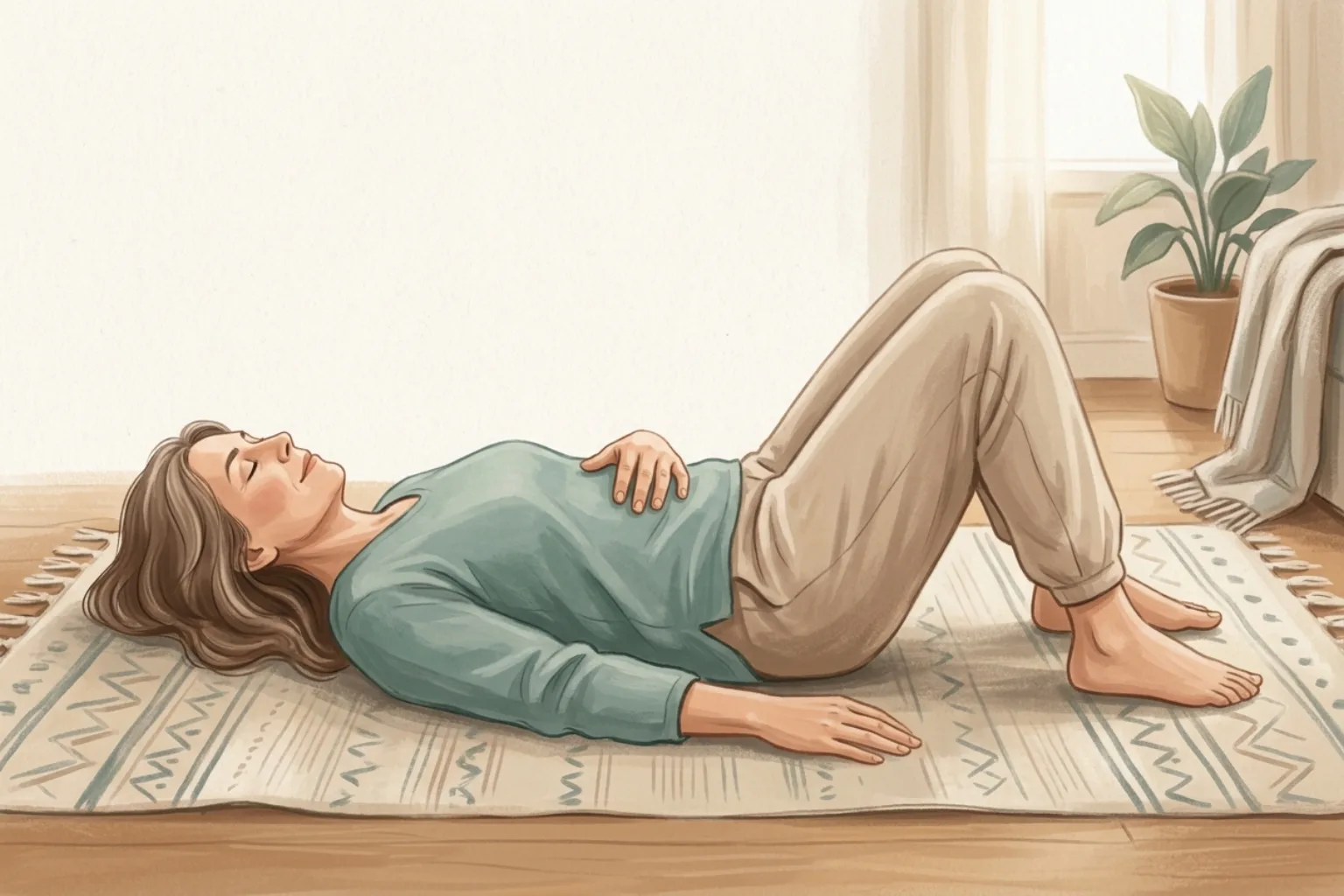
Every Awareness Through Movement® lesson begins in a surprisingly quiet place.
You lie down.
You close your eyes.
And before you are asked to do anything, you are invited to notice how you are already lying.
Where does your back meet the floor?
Where does it meet the floor more clearly, and where is the contact lighter?
How is your weight distributed?
What do your shoulders and shoulder blades feel like against the floor?
Is one side different from the other?
There is nothing to correct.
Nothing to achieve.
You are simply noticing.
And this can be much more interesting than it sounds.
Awareness is not finding what is wrong
We often think of awareness as a preliminary step.
First, become aware of the problem. Then, once you know what is wrong, do something about it.
Awareness is the diagnosis. Change is the treatment.
But this is not quite how awareness works in the Feldenkrais Method®.
The purpose of awareness is not to discover what is wrong with you.
It is to become more familiar with what you actually do.
That distinction matters.
Much of the way we move happens automatically. We do not consciously organize every part of ourselves when we stand up, walk across a room, reach for something, or sit at a computer.
And that is a good thing.
Automatic organization allows us to move through life without having to think about every detail.
But the same automaticity can also make some of our habits difficult to notice.
Something can be happening repeatedly without ever becoming part of our conscious experience.
You can use more effort than you need.
You can hold your breath slightly.
You can tighten your jaw.
You can shift your weight to one side.
You can organize your shoulders in a particular way every time you reach forward.
And because you have done it thousands of times, it may simply feel like the way you are.
What you do not feel is difficult to explore
This is one of the beautiful things about awareness.
The moment you begin to feel something more clearly, you have more information.
And with more information comes the possibility of choice.
Imagine that you always sit with slightly more weight on one side.
You may never have thought about it.
You may not even know that you do it.
But once you notice it, you can become curious.
What happens if the weight shifts slightly?
What does the other side feel like?
Can you find a position that feels different without forcing yourself into it?
You do not have to decide which position is correct.
You are learning about your own organization.
This is very different from being told to "sit up straight" or "relax your shoulders."
Instead of imposing a new position from the outside, you are developing a clearer sense of what you are already doing.
The body is full of things we do not notice
Think about sitting in your car.
Perhaps your hands grip the steering wheel a little more tightly than necessary.
Perhaps one shoulder is slightly more active.
Perhaps your jaw becomes firmer when traffic gets heavy.
Perhaps you lean forward when you are concentrating.
None of this necessarily feels unusual.
It may simply feel like you.
The same thing happens when we work at a computer, carry a bag, walk, exercise, or even stand and wait.
We do not experience every small muscular action separately.
Our nervous system organizes enormous amounts of information automatically.
But when a familiar pattern becomes noticeable, something interesting happens.
You can begin to investigate it.
Try this for sixty seconds
You can experiment with this right now.
Do not change anything.
Just notice.
As you are reading, feel the surface supporting you.
Notice your weight.
Is it evenly distributed, or does one side feel different?
Feel your shoulders.
Is there any unnecessary effort there?
Notice your jaw.
Is it doing anything?
And notice your breathing.
Are you breathing easily, or are you holding your breath a little while concentrating?
There is no right answer.
And there is nothing you need to fix.
If you notice something, resist the temptation to immediately change it.
Stay with the sensation for a moment.
You are not looking for a mistake.
You are becoming acquainted with yourself.
Awareness creates possibilities
Once you can feel something, you can begin to explore it.
You might discover that your shoulder does not always organize itself in exactly the same way.
Your weight can shift.
Your breathing can change.
Your jaw can soften without being told to relax.
A movement that usually feels effortful may have another possibility.
And this is why Feldenkrais lessons contain so much exploration.
Instead of repeating a movement until you perform it correctly, you are invited to notice differences.
What happens when you move more slowly?
What happens when you use less effort?
What happens when you make the movement smaller?
What happens when you involve another part of yourself?
What happens when you stop trying to make the movement happen?
The questions are important.
They direct attention toward experience rather than performance.
And through that experience, the nervous system can discover alternatives.
You do not have to fix yourself
There is something deeply reassuring about this approach.
You do not have to begin by deciding that something is wrong with you.
You do not have to correct every asymmetry.
You do not have to hold yourself in a "better" position.
You do not even have to know what you want to change.
You can begin with curiosity.
What am I doing?
What can I feel?
Is there another possibility?
Sometimes, simply asking these questions changes the way you experience yourself.
And when you experience yourself differently, movement can begin to change too.
It is not only about movement
The same principle can appear outside of movement.
You may notice the tension that arrives before a difficult conversation.
The way you brace when you feel rushed.
The tightening that appears when you are worried.
The particular thought you have whenever something does not go as planned.
These patterns can become so familiar that they feel like part of who we are.
But noticing a pattern creates a little space around it.
You do not have to make it disappear.
You do not have to judge it.
You can simply recognize:
Oh. This is what I do when this happens.
That recognition is meaningful.
You are no longer completely inside the pattern.
You can feel the pattern.
And once you can feel it, you may discover that there are other possibilities.
Feeling comes before choice
We often imagine that change comes from trying harder.
More discipline.
More strength.
More stretching.
More control.
But the Feldenkrais approach offers another possibility.
Sometimes change begins much earlier.
With noticing.
With becoming curious.
With feeling a distinction you could not feel before.
Because if you cannot feel a difference, it is very difficult to choose between two possibilities.
Awareness gives you that difference.
It gives you information.
And information gives the nervous system something new to work with.
That is why awareness is not simply preparation for change.
Awareness is part of the change.
Sometimes the most important thing you can do is not to try to change yourself at all.
Just notice.
Feel what is already happening.
And give yourself enough time to discover that it might not always have to happen that way.
Feel It for Yourself
The easiest way to understand this kind of awareness is to experience it. With Feldy, Chava's gentle voice guides you through short Awareness Through Movement lessons that help you slow down, notice your habits, and sense options you may not have felt before. You are not trying to force better posture or perform a perfect movement, only to recognize what you do and give your nervous system the information it needs to discover something different. Your first 7 days are free, no credit card needed.
Begin your free trialFAQ about body awareness in Feldenkrais
What is body awareness in the Feldenkrais Method?
Body awareness is the ability to sense more clearly what you are actually doing as you move: how you distribute your weight, where you use effort, how different parts of you participate in movement, and how your organization changes from one moment to another. In an Awareness Through Movement lesson, you slow down and pay attention without judging or correcting yourself. This gives you more information about your own movement and more possibilities to explore.
Can you improve body awareness?
Yes. Awareness can become clearer with practice. You do not develop it by trying harder or constantly searching for what is wrong. You develop it by slowing down, moving gently, and becoming curious about what you actually feel. Over time, things that once happened automatically can become easier to notice, and when you can notice more, you have more possibilities to explore, and potentially to change.
← Previous:
Listening: The Body Was Talking All Along
Next →
Sensing: The Difference Between Doing and Feeling
At Home in Yourself is a series on what actually changes in a Feldenkrais lesson, one idea at a time. More are on the way.
Start your free 7-day trial
Start free trialMore Articles

Listening: The Body Was Talking All Along
In a Feldenkrais lesson, change begins with noticing. Listening to your body is not looking for what is wrong, but a gentle curiosity that opens easier movement.
Aug 30, 2026
Attention: Where You Place It, Change Begins
In a Feldenkrais lesson, moving more freely rarely comes from trying harder. It comes from where you place your attention. Here is what that quietly changes.
Aug 2, 2026
Why Does a Feldenkrais Lesson Leave Us Feeling So Peaceful?
Why a Feldenkrais lesson can leave you calmer and more yourself: less about relaxation, and more about the parts of you ending their quiet argument.
Jul 26, 2026Ready to Start Moving Better?
Try your first lesson for free. No credit card required.