
Why Does a Feldenkrais Lesson Leave Us Feeling So Peaceful?
Why a Feldenkrais lesson can leave you calmer and more yourself: less about relaxation, and more about the parts of you ending their quiet argument.
Part 1 of the At Home in Yourself series, on what actually changes in a Feldenkrais lesson.
One of the questions I have often wondered about is this: why do so many people leave a lesson feeling lighter, calmer, and somehow more at home in themselves?
It is tempting to think the answer is relaxation. I do not believe relaxation alone explains it. I suspect something deeper is happening.
I think of a woman who came to a lesson one afternoon carrying the whole day on her shoulders. We did very little. She lay on her back and turned her head slowly from side to side, a small and comfortable movement, again and again, noticing everything that came along for the ride. Twenty minutes later she sat up, paused, and said, "I feel like myself again." Nothing had been stretched or corrected. Something in her had simply stopped arguing with itself.
In everyday life, we often live in fragments. Our thoughts race ahead while our bodies lag behind. We say yes when we mean no. We keep moving even when the body asks us to pause. We ignore quiet sensations because we are busy planning the next thing. Without realizing it, the different parts of ourselves begin speaking different languages.
The Feldenkrais Method® gently invites us back into conversation with ourselves.
During an Awareness Through Movement® lesson, attention slows down. We begin to notice not only how we move, but how we experience moving. Thought, sensation, intention, breath, and action gradually become connected.
Instead of forcing the body to perform, we learn to listen. Instead of correcting ourselves, we grow curious. Instead of trying harder, we discover easier.
Little by little, something changes. Our movements become more consistent with what we actually sense. Our actions become more faithful to our intentions. There is less internal contradiction, and more coherence.
Perhaps this is what the nervous system has been waiting for all along. When awareness and movement come into agreement, the brain no longer has to reconcile competing messages. The body is not resisting the mind, and the mind is not overriding the body. They begin to work together. That kind of harmony may be one of the deepest forms of rest.
Pain, too, is shaped by the nervous system. When the nervous system feels safer, calmer, and more integrated, the experience of pain can change. This may help explain why many people notice greater comfort after a lesson. The lesson does not simply address painful muscles or joints. It creates conditions in which the nervous system can respond differently. It is a learning practice, not medical care, and it sits alongside the treatment your body may need rather than replacing it.
So perhaps what we feel after a Feldenkrais Method® lesson is more than relaxation. It is a subtle lift of spirit, a sense that life has grown a little lighter because the parts of us are no longer pulling in different directions.
Maybe the peace we feel is not something the lesson gives us. Maybe it is something that emerges on its own when we stop fighting ourselves. When awareness, movement, and intention begin to speak the same language, we often find that ease was not something we made. It was there all along, waiting beneath the noise.
Perhaps that is one of the quiet gifts of this work. Not only moving with more efficiency, but living with more congruence. And perhaps that is why we leave not only moving more freely, but also feeling quietly uplifted, more whole, more present, and a little more at peace with ourselves.
If you would like the longer version of the thinking and the science behind it, it lives on our method page.
Feel It for Yourself
Feldy is a gentle online movement program voiced by Chava. Lie down, follow her voice, and notice what settles. Your first 7 days are free, no credit card needed.
See how the free trial worksFAQ about feeling peaceful after Feldenkrais
Why do I feel so calm and peaceful after a Feldenkrais lesson?
Part of it is that your attention slows and your body settles. But many people feel something deeper than rest. During a lesson, thought, sensation, breath, and movement come back into agreement, so the nervous system no longer has to reconcile competing messages. That inner coherence is one of the deepest forms of ease, and it often shows up as a quiet sense of calm.
Is the calm after Feldenkrais just relaxation?
Relaxation is part of it, but it does not seem to be the whole story. What people often describe is feeling more whole, more themselves, and less at war with their own bodies. That points to congruence, the parts of you working together, rather than only a lowered heart rate.
Can the Feldenkrais Method change how pain feels?
Pain is strongly shaped by the nervous system. When the nervous system feels safer, calmer, and more integrated, the experience of pain can change, which may be why some people notice greater comfort after a lesson. This is not a cure and not a substitute for medical care. If you have persistent or worsening pain, please see a professional.
What is the Feldenkrais Method?
It is a gentle way of learning easier, more comfortable movement through slow, attentive exploration rather than effort or stretching. Most people meet it as an Awareness Through Movement lesson, a guided sequence usually done lying down, where you notice how you move rather than push to perform.
Next →
Attention: Where You Place It, Change Begins
This is the opening essay in the At Home in Yourself series, where each piece takes one idea about becoming a more whole person, with Feldenkrais as the lens. More are on the way.
Start your free 7-day trial
Start free trialMore Articles
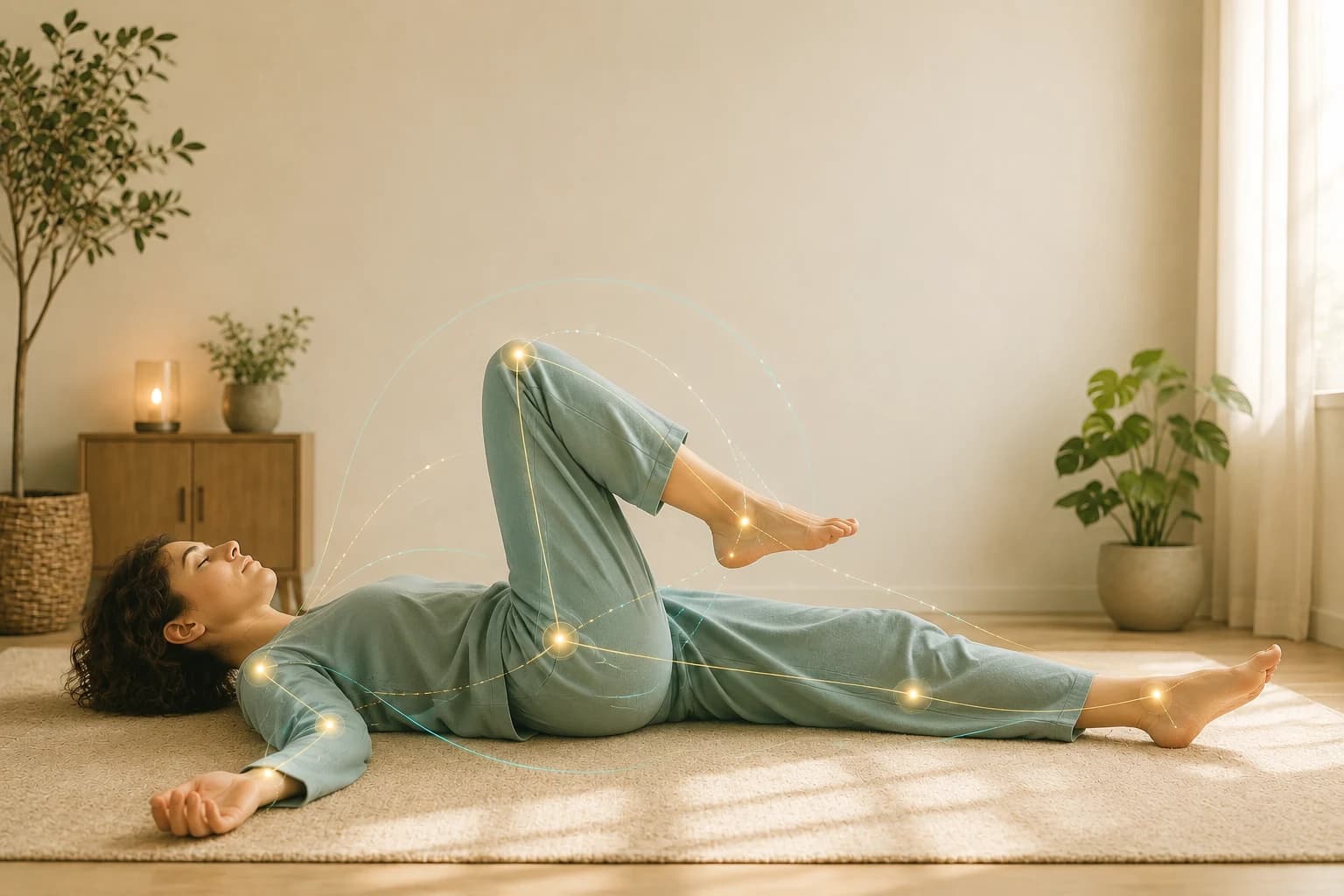
The Feldenkrais Method® Isn't Just Therapy. It's a Philosophy of Human Potential
The science and thinking behind a system built for learning, not treatment: what motion-capture labs and humanist philosophy reveal about how we move.
Jun 18, 2026
Can Feldenkrais Reduce Stress at the Hormonal Level?
New research suggests gentle somatic movement may influence the body's stress response, shifting hormonal markers and improving wellbeing beyond relaxation.
Apr 24, 2026
Four studies on thinking after 60 point to attention, not effort
Slow practice, balance work and unusual walks each gave thinking a lift in recent research. What they share is where the attention goes.
Oct 23, 2026Ready to Start Moving Better?
Try your first lesson for free. No credit card required.