
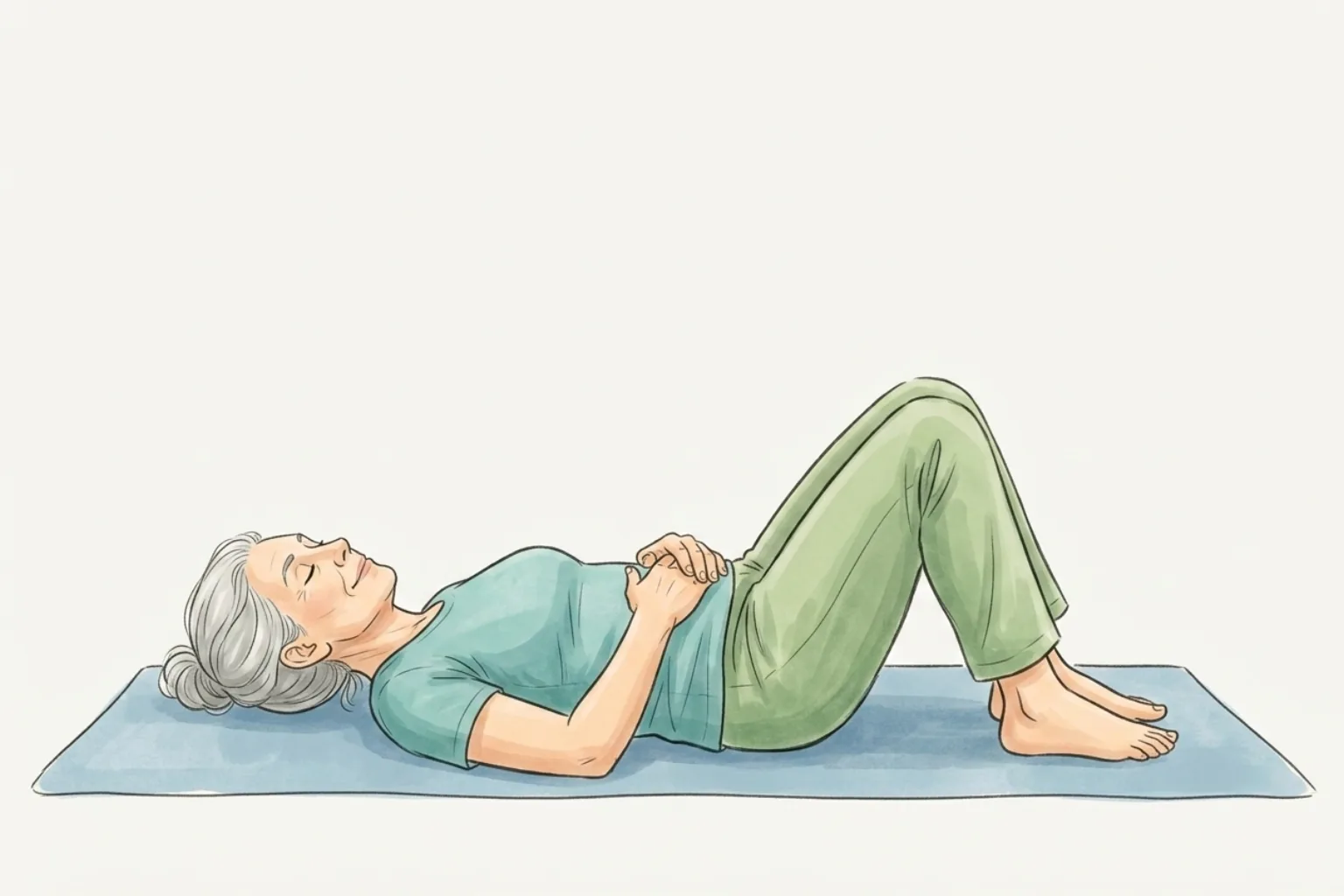
Feldenkrais vs Standard Care for Low Back Pain: The Evidence
Two randomized trials tested the Feldenkrais Method head to head against core stability exercise and back school for chronic low back pain. Here is what they found.
If you live with chronic low back pain, you have probably been handed a familiar prescription: strengthen your core, or sit through a back school class that teaches you the correct way to lift, bend, and hold yourself. Both are standard care. Both genuinely help many people. So a fair question, and a skeptical one, is whether a slow, gentle awareness practice you do lying down could really hold its own against them.
Two randomized controlled trials set out to test exactly that, by putting the Feldenkrais Method® head to head against conventional back care rather than adding it on top. The honest short version: it held its own on pain, and it did something the other approaches did not.
The evidence at a glance
Feldenkrais vs core stability exercise for chronic low back pain. Ahmadi et al., 2020.
The two studies
An earlier trial we covered looked at adding Feldenkrais to an exercise program. These two studies did something different. They compared it directly against the usual approaches.
Ahmadi and colleagues (2020) ran a single-blind randomized controlled trial with 60 adults who had chronic nonspecific low back pain. Half learned the Feldenkrais Method® through supervised Awareness Through Movement® sessions, twice a week. The other half got the standard alternative: a short education session about the back, plus core stability exercises to do at home, the deep abdominal and trunk muscle work commonly prescribed to steady the spine. Both ran for five weeks. It was published in Clinical Rehabilitation.
Paolucci and colleagues (2017) compared the Feldenkrais Method® with Back School in 53 older adults (average age around 61) with chronic low back pain. Back School is a long standing, classroom style approach to back care: people are taught how the spine works and how to sit, stand, lift, and bend in ways that protect it, usually in a group and paired with some exercises. It was also a single-blind randomized controlled trial, published in Disability and Rehabilitation.
What they found
Start with pain, because that is what most people care about most. Both groups cut it sharply. In Ahmadi's trial, the Feldenkrais group's pain scores fell from 15.33 to 3.63, roughly a 76% drop, while the core stability group fell from 13.17 to 4.17, roughly 68%. Statistically that is a tie, no meaningful difference between them (P = 0.16). Paolucci's trial told the same story against Back School: comparable relief on pain and on disability (P = 0.29). So if your only question is whether Feldenkrais lowers pain as much as the standard options, the answer is a clear yes, and by the raw numbers a shade more, even if that difference is too small to be statistically significant.
Where the Feldenkrais group pulled ahead was almost everywhere else. Compared with core stability exercise, it improved significantly more on quality of life (45.51 to 60.49, about a third higher; P = 0.006), nearly halved everyday disability (27.17 to 14.5, roughly 47%; P = 0.021), and posted the largest gap of all on interoceptive awareness, the ability to accurately sense signals from inside your own body (2.74 to 4.06, about 48%; P < 0.001; Ahmadi et al., 2020, PubMed).
Feldenkrais vs core stability exercise
Chronic low back pain · 60 adults · 5 weeks · Ahmadi et al., 2020
Both cut pain sharply. No significant difference between them.
Values are the Feldenkrais group's before to after change. Pain is shown for both groups. Source: Ahmadi et al., 2020, Clinical Rehabilitation.
That awareness measure is the thread running through both studies. In Paolucci's trial, the standout finding was not that one method beat the other on pain. It was that improvements in body awareness tracked with improvements in pain (R = 0.30). The more accurately people came to sense their own bodies, the better their pain scores tended to look.
Why body awareness matters for a sore back
Interoceptive awareness, and its close cousin proprioception, the sense of where your body is and what it is doing, tend to get blurry in long standing pain. When an area hurts, we brace around it and move it less, and over time the nervous system's map of that region becomes fuzzy and protective. Strengthening exercises build the muscle. They do not necessarily sharpen the map.
This is the space the Feldenkrais Method works in. Its slow, curious Awareness Through Movement lessons are less about effort and more about noticing: where am I holding, what happens if I do a little less, what does easier feel like. That offers a plausible reason the trials saw the awareness measures move so clearly, and why body awareness, rather than muscle strength, kept surfacing right alongside the pain relief.
What this means for you
If you live with chronic low back pain, here is the balanced takeaway. Feldenkrais is not a magic answer that outperforms everything your clinician has suggested, and the research does not claim it is. What the studies do show is that it sits in the same league as standard back care for pain, while adding something those programs often leave out: a clearer, calmer relationship with your own body, and better quality of life to go with it.
For a lot of people, especially those who have found strengthening programs too effortful, or who still hurt even though the scan looks normal, that awareness first quality is the piece that has been missing. And there is a quieter advantage that does not show up in any single trial: because the lessons are gentle, slow, and done lying down with no strain, they are easy to keep up, and a practice you actually stay consistent with is the one that adds up over time. Comparable pain relief, a clear edge on function and wellbeing, and something gentle enough to sustain: that combination is what makes Feldenkrais worth trying, and it can sit comfortably alongside whatever else you are doing rather than replacing it.
Research Limitations
These are small studies, and it is worth being plain about that. Ahmadi's trial had 60 participants and Paolucci's had 53. Both looked only at chronic nonspecific low back pain, both were short courses without long term follow-up, and neither is a large, multi centre trial. On pain specifically, neither showed Feldenkrais to be superior, only comparable. The consistent signal across both studies is on the body awareness and quality of life side, and that is the honest place to set your expectations. This is general education about published research, not medical advice, so check with your own clinician about what fits your situation.
Concluding thoughts
Put these two trials next to the earlier study where Feldenkrais was added to an exercise program, which improved back pain outcomes more than exercise alone, and the same picture emerges from two directions. Whether it stands in for standard back care or layers gently on top of it, Feldenkrais matches the usual options on pain, edges ahead on quality of life, everyday function, and body awareness, and stays gentle enough to keep doing week after week. For chronic low back pain, that blend of comparable relief and genuine sustainability is a real place to start. If you want the wider view across the research, we have also weighed what the evidence says about Feldenkrais overall.
Feel the difference for yourself
Try a free Feldenkrais lesson for your lower back, done lying down. Small, slow movements that help you sense and settle, no stretching and no equipment.
Try a Free LessonIf you want to understand the awareness side more deeply, our body awareness program is built entirely around it.
FAQ about Feldenkrais and low back pain
Is Feldenkrais better than exercise for low back pain?
On pain, Feldenkrais holds its own: in a 2020 randomized trial it eased pain as much as a core stability exercise program, and by the raw numbers slightly more, though that difference was not statistically significant. So the fair read is as good, and arguably a little better. What tips it further is everything around the pain. It pulled clearly ahead on quality of life, day to day disability, and body awareness (how accurately you sense your own body). And because the lessons are gentle, slow, and done lying down with no strain, they are easy to keep up, and a practice you actually stay consistent with is the one that adds up. That mix of comparable pain relief, better function and wellbeing, and real sustainability is what makes Feldenkrais worth trying.
What did the Ahmadi 2020 Feldenkrais study find?
Ahmadi and colleagues (2020, Clinical Rehabilitation) ran a single-blind randomized controlled trial with 60 adults who had chronic low back pain, comparing the Feldenkrais Method with a core stability exercise program done at home over five weeks. Both groups reduced their pain with no significant difference between them, but the Feldenkrais group improved significantly more on quality of life, disability, and interoceptive awareness.
Feldenkrais vs Back School: which is better for chronic low back pain?
In Paolucci and colleagues' 2017 trial (Disability and Rehabilitation) of 53 older adults, the Feldenkrais Method had comparable efficacy to Back School for pain and disability. The distinctive finding was that gains in body awareness tracked with gains in pain relief, which points to interoception as part of how the benefit arrives rather than one method simply beating the other.
What is interoceptive awareness and why does it matter for back pain?
Interoceptive awareness is the ability to accurately sense signals from inside your own body. In long standing pain, we tend to brace around the sore area and move it less, and the nervous system's sense of that region grows fuzzy and guarded. Both studies found that Feldenkrais improved this awareness, and in one, more accurate body sensing went hand in hand with less pain.
Is Feldenkrais safe for older adults with back pain?
The research was done in exactly this group: Paolucci's participants averaged around 61 years old, and Ahmadi's were adults with chronic low back pain. Feldenkrais lessons are done with small, slow, gentle movements, often lying down. There is no stretching, no force, and you stay within your comfortable range, which is why it suits people who find strengthening programs too effortful.
Start your free 7-day trial
Start free trialMore Articles
Adding Feldenkrais to Exercise Improves Back Pain Outcomes
A 2025 trial found adding Feldenkrais to stabilization exercise significantly reduced pain and fear of movement in older women with chronic low back pain.
Apr 12, 2026
Everything Looks Fine on the MRI. So Why Do You Still Hurt?
When imaging comes back normal but the pain is real, the answer might lie in how your body has learned to protect itself, not in what is broken.
Apr 8, 2026
Sore After Physical Therapy? What to Do the Next Day
Soreness after physical therapy is often a normal part of the work. What to watch for, and how gentle movement can sit alongside your program.
Oct 4, 2026Ready to Start Moving Better?
Try your first lesson for free. No credit card required.