
For lower back pain & sciatica
Ease back pain and sciatica, the gentler way.
Rebuild trust in a back that has been bracing.
A gentler way to ease back pain and sciatica. Watch the short explainer, then feel it yourself in a 3 minute Feldenkrais Method® lesson, right in your chair.
Created and guided by Chava Sorani, Guild Certified Feldenkrais Practitioner.
7 days free. No credit card needed.
For lower back pain & sciatica
Still hurting after stretching, exercises, or physical therapy? Try a gentler approach.
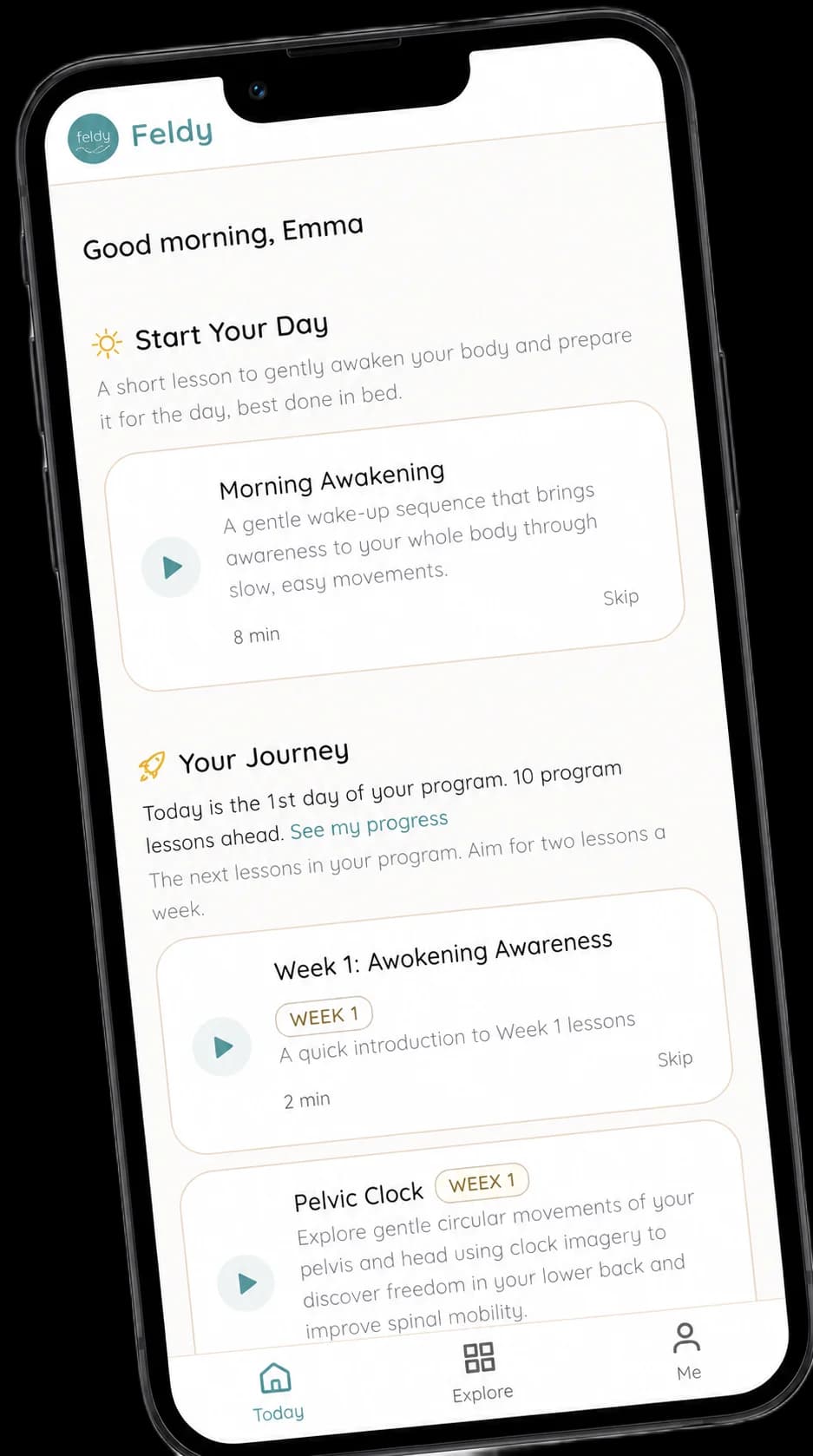
Feldy is a guided online movement program based on the Feldenkrais Method®. Instead of asking you to stretch or strengthen an already sensitive back, it helps retrain how you move, so everyday movement can become easier and more comfortable. Many members notice a difference within their first week.
7 days free. No credit card needed.
Does this sound like your back?
- You brace before you bend.
- You hold your breath when you sit down.
- You check what hurts before you get out of bed.
- You hesitate before getting out of the car.
- You brace before lifting a full kettle.
- Stretching helps for an hour, then the ache comes back.
- Part of you is always waiting for the one wrong move.
You have not lost movement. You have lost trust that movement will help.
After years of pain, part of what your back may be holding is a protective pattern: a grip your nervous system learned and never fully let go of. The Feldenkrais Method® works on exactly that. You make slow, small movements with close attention, and those movements give your brain a chance to discover easier options, so muscles that have guarded for years begin to let go. A pattern that was learned can be relearned.

If you have already tried a lot of things
Stretching
helped for an hour
Massage
lasted a day
Exercises
helped while you kept it up
Walking
fine until the next flare
Stretching, massage, exercise, walking: most of it helped, for a while. Then the relief faded and the ache found its way back. That is not a failure of effort. You were handed tools built for a different job.
Feldy works on the layer you felt in the short lesson above, and it asks you to give nothing up. Keep whatever your doctor or physiotherapist has you doing: Feldy sits alongside clinical care. Keep the stretching and walking you enjoy, too. Those approaches were not wrong. They simply work on a different part of the problem.
Why Feldenkrais works for lower back pain & sciatica
1. Most approaches work on a muscle. This works on the pattern.
Stretching and strengthening target the tight spot. Feldenkrais explores how your ribs, pelvis, hips, and spine share a movement, so your lower back stops doing everyone's job.
2. You feel it as ease, not as theory.
Getting out of a chair takes less effort. Walking smooths out. Turning in bed stops being a project. That is what working on the pattern feels like from the inside.
3. Change comes from noticing, not forcing.
No stretching, no pushing. You move slowly and pay attention. That is why the lessons are called Awareness Through Movement®: the noticing is the method.
From people with lower back pain & sciatica
From dreading mornings to standing up without bracing.
“Some mornings I arrive at the lesson at 40 percent and leave at 100, wanting to hug the world. My lower back used to lock up every morning, and I'd dread getting out of bed. Now I just stand up. No bracing.”
Sarah M.
Retired teacher, 62
Moving with ease again at 77.
“At 77, I'd made my peace with stiffness. I was scared that moving the wrong way would make my back worse, so I'd mostly stopped trying. But this asks so little of you. You lie down, follow Chava's voice, and you get up softer and easier than you came in. Nothing I'd tried before was this gentle, or this kind to a body that's afraid. I feel more like myself again. You should try this.”
Eleanor
Retired, 77
After yoga, Pilates, and stretching apps, the first thing that stuck.
“I tried yoga, Pilates, stretching apps. Nothing stuck. With Feldy I don't have to decide what to do every morning. Give it more than one lesson; the change comes over a few weeks, not the first day. Before long, I simply felt like myself again.”
James L.
Desk worker, 53
97% of Chava’s students said they would definitely recommend Feldenkrais to a friend.
You do not have to commit to the program today. Just see what happens after your first lesson.
Selected research
What the research shows
Reduced back pain by more than half
In a 2025 study, women aged 60 to 80 who added gentle Feldenkrais lessons reduced back pain by more than half, more than exercise did on its own.
See the researchSaki and Ziya, BMC Geriatrics, 2025
Nearly half the everyday disability
In a controlled trial, people with long-lasting back pain who practiced Feldenkrais cut everyday disability nearly in half and improved quality of life by about a third, doing better than a standard exercise program.
See the researchAhmadi and colleagues, Clinical Rehabilitation, 2020
Evidence from 16 clinical trials
Pooling 16 controlled trials, researchers found large improvements in balance and mobility among older adults, with pain relief similar to standard physical therapy.
See the researchBerland and colleagues, systematic review, 2022
Feldenkrais is a way of learning easier movement, not a medical treatment.
You do not need to believe this will work.
Just notice what you felt.
Skepticism is fair. If you have lived with pain for years, you have heard plenty of promises.
That is why the lesson is in the video, not behind a signup. You never have to decide whether this works in theory. You only have to notice whether something felt different in those three minutes. If it did, even slightly, that is worth following. That is exactly what the free trial is for.
Why I made Feldy

The people I worked with were not looking for another exercise program. They were tired of negotiating with their bodies every day, of doing everything right and still feeling stuck.
I made Feldy so they could have that same gentle guidance at home, in their own room, at their own pace, whenever they need it. Every lesson is my voice, guiding you the way I would in person.
Chava Sorani, Guild Certified Feldenkrais Practitioner (GCFP)
How this works, in plain terms
- 1
Lie down on your bed, a rug, or the floor, wherever is comfortable. No special clothes, no equipment, nothing to set up.
- 2
Press play and follow Chava's voice. The movements are small and slow, easy enough to do during a flare. You never stretch, strain, or push, and if something does not feel good, you simply do not do it.
- 3
Notice the difference. Many people feel something settle by the time they stand back up: the back a little quieter, the breath a little easier. Students often call it meditation in movement, present, unhurried, attention turned inward.
What you can expect to feel
In your first lesson
- 1.A connection between your back and your shoulders you did not know was there. The same movement can feel completely different on each side.
- 2.Your breath deepens on its own, with no one telling you to breathe.
- 3.When you stand up afterward, the floor feels different under your feet.
Picture next week
Imagine standing up without bracing for it. Getting out of bed without checking your back first. Turning to reach the back seat without wondering if today is the day it catches. Not a miracle, just a body with easier options. That is the direction this work points, and you have already taken the first three minutes of it.
Common Questions about Lower back pain & sciatica (FAQ)
I have already tried so many things. Why would this be different?
Because the focus is different. Feldenkrais does not work on the sore spot; it works on how your whole body organizes movement, the layer nothing else was built to reach. Keep whatever your physiotherapist or doctor has you doing: Feldy sits alongside clinical care. People who have tried everything notice the most here, because they know their bodies best.
Can I do this during a flare?
Yes, gently. You only ever do what feels easy. If a movement provokes pain, make it smaller, slower, or skip it. Every lesson has a comfortable version for every body.
How is this different from yoga or stretching?
Different mechanism, much gentler. No pose to hold, no stretch to push into. You move in small ways and notice what changes: the work happens in your attention, not your effort. People who find yoga too demanding for their back land here and stay.
Is this just relaxation?
No. Relaxation is a side effect. The goal is to update the movement habits your body runs automatically, which is why the change holds after the lesson instead of fading like a stretch.
What if I do not feel anything in the first lesson?
Common, and fine. The first effects are subtle: how you stand up at the end, how you sleep that night. Give it five lessons before you decide. Curiosity matters more than sensation here.
What if it does not help me?
You do not have to decide that from a page. You just did a short lesson in the video above; the full lessons go deeper in the same gentle way, and the trial lets your back be the judge. The next page shows how it works.
Have a question? Write to me at ask-chava@feldy.me. I answer every email personally.
If three minutes in a chair changed something, your back can still learn. See how the free trial works.
No equipment. No forcing. Nothing beyond what feels easy and comfortable.
When your mornings start with negotiation, the program is here. Do less, gain more.
Have a question? Write to me at ask-chava@feldy.me. I answer every email personally.