
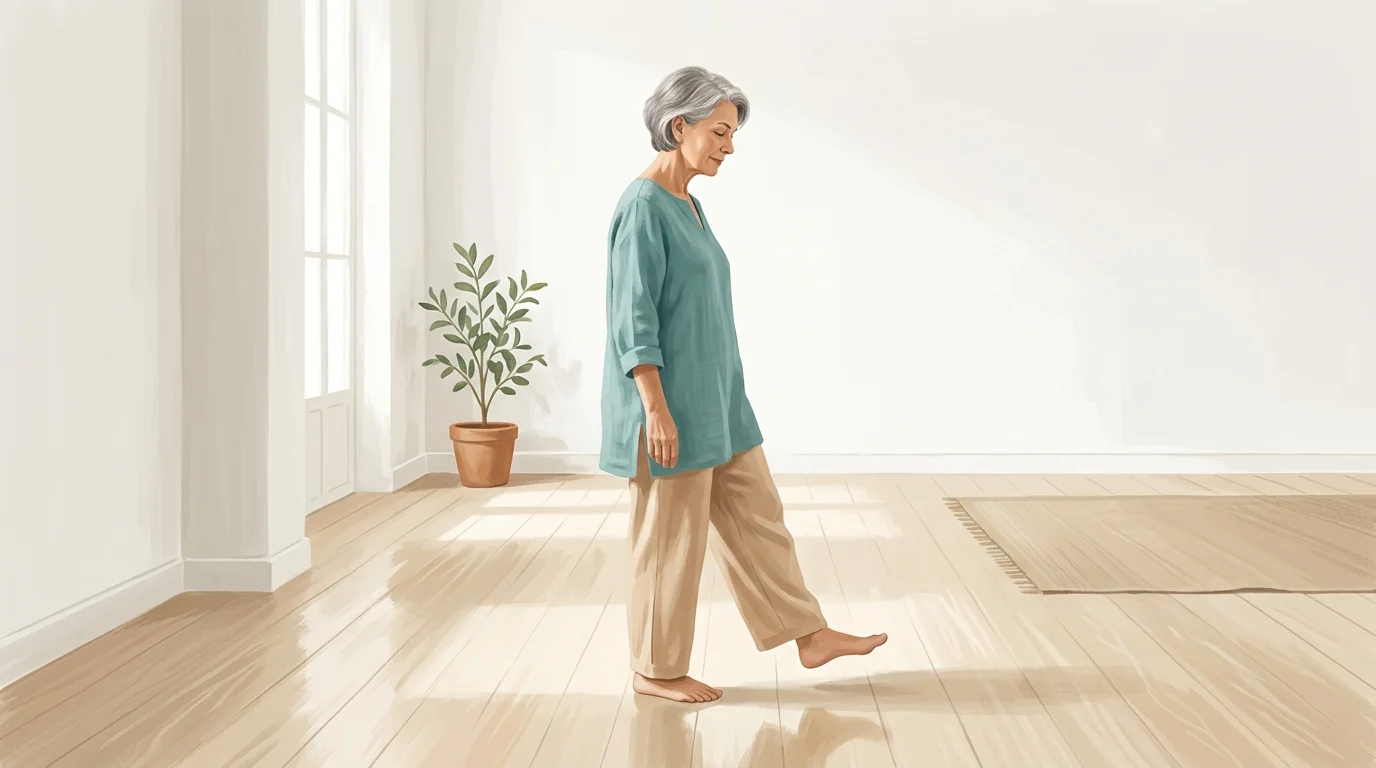
Why gentle practice is what your body keeps
A July 2026 trial found that pain during practice cut how much of a new movement people still had a day later. Comfortable practice is what settles overnight.
There is a quiet assumption behind a great deal of exercise advice: that pushing through discomfort is where the real change happens. A new study on how people learn a walking pattern suggests that, for the part that lasts, the opposite may be closer to the truth.
What the study found
Researchers taught 60 adults, half of them older, a new and deliberately awkward way of walking, then measured how much of it they still had a day later. Half the group learned the pattern while a patch of experimental heat pain was applied to the leg. The other half learned it in comfort. The findings appear in The Journal of Pain (Jackson et al., 2026).
The group that learned in comfort took on the new pattern more strongly right away, and kept noticeably more of it the next day. The group that learned in pain did worse from the start, and by the following day had held onto much less of what it had gained (Jackson et al., 2026). Both the immediate learning and the retention suffered. What the authors emphasize is where the pain group fell furthest behind: not in the minutes right after practice, but a day later, once the movement had a night to settle.
That timing points at something specific. Beyond its cost to the first attempt, pain seemed to interfere with the slower process that files a new movement away so it is there in the morning. The researchers described this as pain disrupting consolidation, the settling that turns a fresh attempt into something the body owns. Both younger and older adults showed the same effect, which the authors note may reduce how well movement retraining works when someone is practicing in pain.
What I see in this
This lands close to home for me. In a Feldenkrais® lesson, the entire method runs on staying under the threshold where a movement starts to feel like effort or strain. You only go where it feels easy, pleasant, and comfortable, and you move slowly enough to actually sense what you are doing. For years the reason we give is that the nervous system learns best when it is not braced against discomfort. It is quietly satisfying to watch a retention study arrive at the same place. Your body even has its own everyday version of this: the slow, unhurried involuntary stretching you do on waking is something nobody forces, and it is a lovely reminder of what easy movement feels like.
The Feldenkrais Method® calls its group lessons Awareness Through Movement®, and the name is really the mechanism. When a movement is gentle and slow, there is enough attention left over to notice the small differences that teach the body a new option. When it hurts, that attention drains away into guarding, and it appears that less of the lesson survives the night. None of this replaces the strengthening or the graded return to activity a physiotherapist might give you. It sits alongside that work, and it may be part of why the comfortable version of an exercise is worth taking seriously rather than treating it as the watered down one.
If you want to feel the difference the study is pointing at, here is a small experiment. It asks nothing of you beyond a few comfortable minutes.
A short movement experiment
About 5 minutes. Move slowly, do less than you can, and stay well below any pain. Rest whenever you need to.
- 1
Standing to begin. Stand with your feet a little apart, arms hanging. Shift your weight from one foot to the other, a small amount, once or twice.
- 2
A first noticing. Pause. How much effort did that take? Where did you feel it: feet, hips, somewhere else?
- 3
Slower and smaller. Shift again, slower and smaller, well inside what feels easy. If it starts to feel like work, make it smaller.
- 4
Standing still. Stop in the middle and stand still. Let your arms hang and breathe for a moment.
- 5
The head joins. Shift once more, and let your head turn a little toward the foot you move onto. Then rest again.
- 6
The shift again. Shift your weight from side to side at your ordinary pace. Compare with the start. What has changed?
Let Feldy guide you, eyes closed
A calm voice walks you through gentle moves so your attention stays in your body, not on the screen.
Try Feldy Free for 7 daysNo credit card needed.
What to take from it
The practical takeaway is gentle, and worth holding loosely. If a movement you are trying to learn, a new way of getting up off the floor, a different way of turning over in bed, consistently hurts while you practice it, you may be building less than the effort suggests. That is not a reason to avoid movement. It is a reason to look for the version you can do in comfort, because that may be the version still there tomorrow. If the movement in question is an exercise a physiotherapist gave you, that discomfort is worth raising with them directly. They can help you find the right amount, and this study is one more reason the comfortable amount is worth finding. This matters all the more as we age, when the way we take on new movement already asks for a little more patience.
It also reframes what a good practice day looks like. Progress is easy to picture as intensity, as the session that left you sore. Research like this keeps nudging the picture somewhere quieter, toward the movement that felt almost too easy while you were doing it. For anyone who has come to distrust movement because it so often hurt, that is a gentler place to begin, and it may be a more lasting one. Our resource on how to fix pelvic tilt takes the same view of a long held pattern, including how long the comfortable version really takes.
Sources
- Acute Pain Impairs Locomotor Learning and Retention in Older Adults— The Journal of Pain (PubMed)
Movement Pulse is informational, not medical advice. See our editorial policy.
Move better with Feldy
See the programMovement Pulse Weekly
The week's best research, in your inbox Tuesday.
Movement science, gentle-practice ideas, and a practitioner's read on what's new. Free.
More from Movement Pulse
The body awareness that fades with age is not the body awareness that predicts function
Four studies across eleven years have quietly taken apart the idea that interoception is one ability sliding down one curve.
Aug 22, 2026
The part of you that learns new movement may not be aging the way you think
Two preregistered experiments compared young and older adults on the same reaching task. The age difference turned up somewhere most people would not expect.
Aug 1, 2026
The science of learning to move, split in two
A new Nature Human Behaviour paper says the study of how we learn to move split into lab and life, and makes the case for putting it back together.
Jul 8, 2026Ready to start moving better?
Gentle, guided lessons for your body. Try your first one free, no credit card required.