
The perimenopause question a third of women can't answer
A new study of 7,640 US women finds a third are unsure of their stage. The biggest driver isn't missing information. It's not knowing what a symptom means.
A third of women over 35 cannot say for certain which reproductive stage they are in. The interesting part of the study that just measured this is not the number. It is the reason.
On July 14, a mixed methods study published in Menopause, the journal of The Menopause Society, surveyed 7,640 US women aged 35 and above and asked something disarmingly simple: do you know where you are? Thirty four percent said they were unsure of their reproductive stage (Menopause, 2026). The uncertainty was not spread evenly. It peaked at 42 percent among women aged 40 to 44, the years when the transition most often begins, and reached 37 percent among women carrying a severe symptom burden. The women with the most to explain were among the least sure what they were explaining.
Then the researchers did something more useful than counting. They read 409 free text answers and sorted the reasons people gave. The largest category, at 56 percent, was symptom confusion and attribution: difficulty interpreting bodily changes and telling perimenopause apart from other causes. Knowledge gaps and information seeking accounted for 28 percent. Barriers to confirmation and care, including dismissive clinical encounters, accounted for 16 percent.
That ordering is the finding. The intuitive story about perimenopause confusion is an information story. Women have not been told enough, so tell them more. This study suggests information is real but secondary. The dominant problem is that the signals themselves are ambiguous. A body produces stiffness, fatigue, a hip that aches at night, and none of it arrives labelled. The authors describe this uncertainty as conceptually distinct from illness focused uncertainty, and that distinction is worth sitting with. This is not a woman wondering whether she is ill. It is a woman wondering what a normal, universal transition is supposed to feel like from the inside, and finding that nobody, including her own body, is saying it clearly. In coverage of the study, the recommendation to clinicians was to stop leaning so heavily on menstrual irregularity as the marker, because symptoms can arrive before the cycle changes (Medical Xpress, 2026).
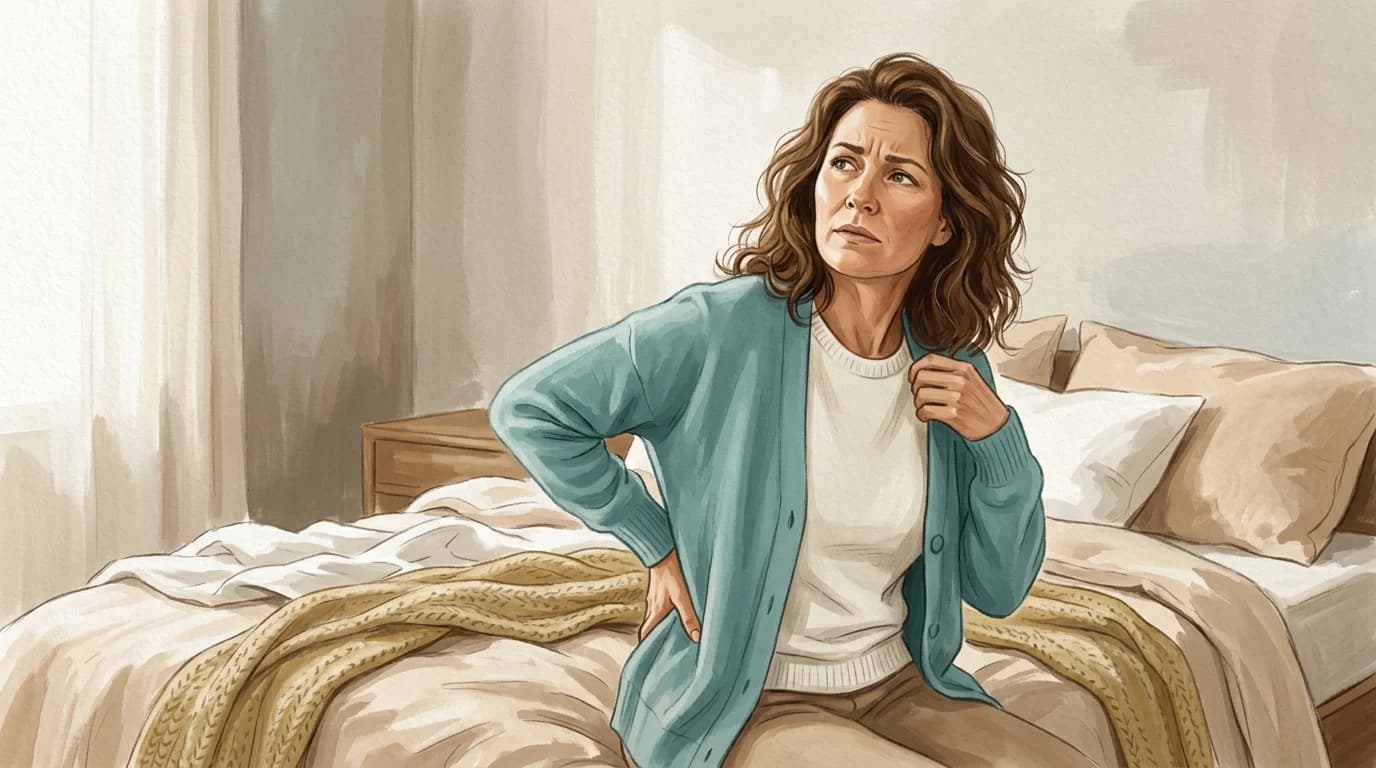
What I see in clients maps onto that 56 percent almost exactly. A woman arrives, describes a symptom, and then, before I have asked anything, she litigates it. The joint aches and stiffness that show up in this transition get presented to me as a case with evidence on both sides. Is this menopause, or is it the desk, or is it that I stopped swimming, or is it just my age. She is trying to settle the attribution before she is willing to do anything about the sensation. That order of operations is what quietly costs her.
Because while the question stays open, the body turns into something to monitor rather than something to live in. Every ache gets checked against a hypothesis instead of felt. Fatigue that movement could address gets filed as evidence rather than treated as a state that might shift. And moving gets postponed until the label arrives, which often it does not, or not for years. You have not lost the signal. You have lost confidence in your ability to read it, and the natural response to a signal you cannot read is to stop listening to it.
Here is how that changes a session. I stop trying to answer the question. I teach the Feldenkrais Method®, I am not a clinician, and whether a given symptom belongs to perimenopause is not mine to settle. This study is a decent argument for taking that question to a doctor who will not wave it off. What I can do is separate two things that tend to get fused: naming a sensation and sensing it. In an Awareness Through Movement® lesson nobody needs to know the cause. You move slowly, you only go where it feels easy, pleasant, and comfortable, and you notice the difference between one side and the other. The skill being trained is discrimination, a finer read of what is actually happening, which is the very capacity those 56 percent are describing themselves as short of. Not a diagnosis. Better resolution.
If there is something practical to take from this study, it is probably permission to stop waiting. The attribution question deserves a real clinician, and this research gives a woman grounds to press for one. That work sits alongside gentle movement rather than being replaced by it. Yoga, Pilates, tai chi, and the Feldenkrais based work I teach each come at the body through a different mechanism, each with its own strengths. What they share is that none of them asks you to have named the cause first. Gentle movement is one of the few things that stays reasonable under uncertainty, precisely because it does not depend on the answer.
So the number worth remembering may not be 34 percent. It is 56: among the women who wrote in to explain their uncertainty, the share who pointed to not being able to read their own body, rather than to not having been told enough. A pamphlet does not fix that. It shifts slowly, through attention, in a body that has been given permission to be curious rather than vigilant. That is what a format like the Feldy online movement program is built for, with short, gentle, audio guided lessons that ask for nothing more than noticing. It will not tell you which stage you are in. It may help you feel more at home in the one you are already in, and find a little more ease while you are there.
Let Feldy guide you, eyes closed
A calm voice walks you through gentle moves so your attention stays in your body, not on the screen.
Try Feldy Free for 7 daysNo credit card needed.
Sources
- Exploring prevalence and drivers of perimenopause uncertainty among US Women: a mixed-methods study— Menopause (The Menopause Society)
- Many women still confused about perimenopause— Medical Xpress
Movement Pulse is informational, not medical advice. See our editorial policy.
Move better with Feldy
See the programMovement Pulse Weekly
The week's best research, in your inbox Tuesday.
Movement science, gentle-practice ideas, and a practitioner's read on what's new. Free.
More from Movement Pulse
Severe symptoms while your cycles still look normal, and what to raise with a doctor
A Climacteric analysis of 1,478 women across twelve countries finds symptom severity and job satisfaction shift before the periods stop, not after.
Sep 20, 2026
Why the movement practice you keep through menopause is usually the one you enjoy
Eighteen women aged 40 to 60 describe building their own menopause toolkits, and what decided which parts they kept was not the evidence.
Sep 1, 2026
What a decade of menopause pain research keeps finding
A review of 115 studies finds movement offers the most consistent benefit across the many forms of menopause pain, and that sleep and stress shape it.
Jul 10, 2026Ready to start moving better?
Gentle, guided lessons for your body. Try your first one free, no credit card required.