
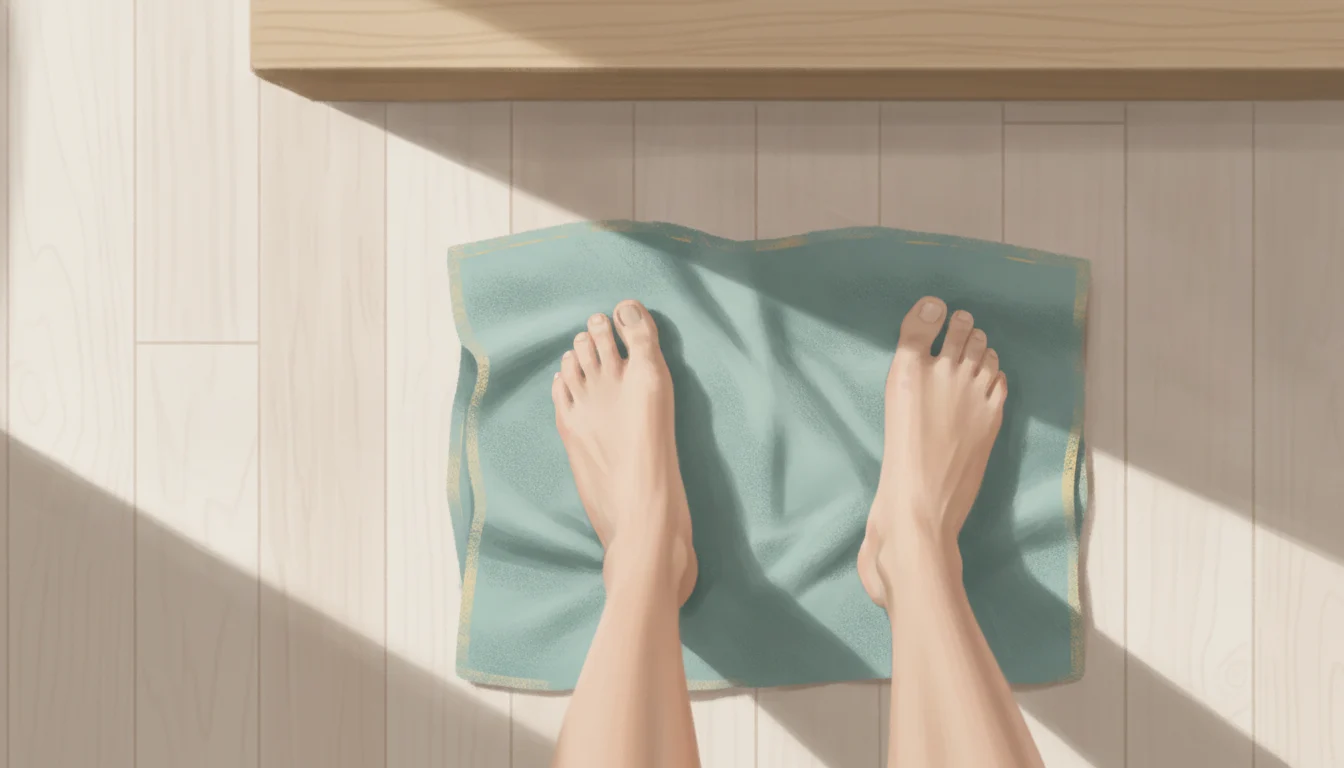
Even strong athletes wobble when the eyes close
A July 2026 study found even competitive weightlifters lost steadiness once the surface softened and the eyes closed. Balance is sensing, not strength.
Balance is not strength. I find myself saying that often to the people I work with, and it still tends to surprise them, because we picture steadiness as something the legs hold us in. A study out this month makes the point more plainly than I can. It took competitive weightlifters, among the strongest and most coordinated movers in their age group, and found that their steadiness wavered the moment it took away their eyes.
The research, an observational study in BMC Sports Science, Medicine and Rehabilitation, tested 104 Masters weightlifters from eleven countries, ranging in age from 35 to 75. Each stood through four balance conditions: a firm surface with eyes open, a firm surface with eyes closed, a foam surface with eyes open, and a foam surface with eyes closed. On firm ground with the eyes open, sway stayed low, as you would expect from strong, well coordinated athletes. On the foam it grew. With the eyes closed it grew more. And when the researchers looked at what actually predicted these athletes' competition results, it was peak power, the raw explosive strength weightlifting is built on, that did the work. Postural stability added only a modest amount (BMC Sports Sci Med Rehabil, 2026).
These are among the strongest, most practiced movers in their age group, and even they wobbled once the floor stopped giving reliable feedback and the eyes were shut. That tells you something about what balance really is. It is not a muscle you can force into steadiness. It is the nervous system quietly stitching together several streams of information at once: pressure and stretch from the feet and joints, the horizon from the eyes, the sense of head position from the inner ear. Take one stream away, or make it unreliable, and you find out how good the stitching is.
This is where the study reaches well past a competition hall. The same stitching that the foam and the closed eyes exposed in these athletes is the stitching that tends to fray as we age. The signal from the feet grows fainter, reactions lengthen, and the margin for a stumble narrows. It matters because falls are not a minor footnote to aging. The World Health Organization notes that among older people who do fall, 20 to 30 percent suffer moderate to severe injuries such as bruises, hip fractures, or head trauma (WHO, 2021). You can read more about how that sensing quietly changes over the years in our Feldypedia entry on proprioception decline with age.
The tempting takeaway is more strength work, and strength certainly has its place. But the study is pointing at something strength did not fix in the athletes themselves. What refines balance is attention to the sensing, not gritting your way through wobble. This is the ground the Feldenkrais Method® has always worked on. In an Awareness Through Movement® lesson, steadiness is not drilled by standing on one leg until you shake. It is grown by noticing, in fine detail, how the weight moves through the feet, how the eyes and the head are involved, how much bracing is actually necessary and how much can quietly drop away.
Here is a short experiment that borrows the study's own trick. It takes a sense away on purpose, so the others have to wake up. Do it near a counter or a wall, and only go where it feels easy, pleasant, and comfortable.
A short balance experiment
About 5 minutes. Move slowly, do less than you can, and stay well below any pain. Rest whenever you need to.
- 1
Take a reading. Stand near a counter or a wall you can touch, feet about hip width apart, and simply notice how standing feels right now. Is there a little sway. Are the toes gripping the floor. Is your weight more toward the heels or the balls of the feet. You are not correcting anything yet, only taking a reading.
- 2
Let the feet report. Keep your eyes open and bring your attention down into the soles. Feel the map of contact under each foot, the parts that press more and the parts that barely touch. Let the ankles stay soft enough to make their own tiny adjustments rather than locking to hold you still.
- 3
Close the eyes for a moment. With a hand hovering near your support, gently close your eyes. Notice how much more the feet and ankles begin to report the instant the eyes go quiet. This is not a test of how long you can last. It is a chance to feel your own sensing wake up. Open your eyes again after a few easy breaths.
- 4
Soften the ground. If that felt comfortable, stand on a folded towel or a firm cushion and repeat, eyes open first, then briefly closed, always within reach of your support. A slightly less reliable surface asks the feet to sense more finely, which is exactly the skill you are giving a little practice.
- 5
Compare. Step back onto firm ground, open your eyes, and stand as you did at the start. Notice whether you feel a little more gathered, a little more informed about where you are in the room. You have not built strength in five minutes. You have given the sensing system a small workout.
Let Feldy guide you, eyes closed
A calm voice walks you through gentle moves so your attention stays in your body, not on the screen.
Try Feldy Free for 7 daysNo credit card needed.
Notice that closing the eyes was never a test to pass. It was a way to feel your own sensing system come online. That is the whole point. Balance grows the way most skills grow, through the nervous system getting more practice at sensing and adjusting, in small and pleasant doses rather than one heroic effort. This kind of practice sits alongside anything a physiotherapist has given you for steadiness rather than replacing it, and if your balance feels genuinely unreliable, that is worth raising with a doctor or physiotherapist first. Tai chi, which so many older adults find steadying, works on some of the same sensing through a different mechanism, gentle and slow in its own way; each approach has its own strengths.
What makes this study worth your attention is not the athletes at all, but the flip side it points to. Even these powerful weightlifters grew less steady once their sensing was challenged, which means steadiness was never only a matter of the legs. And sensing, unlike raw power, stays trainable at any age, quietly, with attention. You have not lost your balance so much as lost some contact with the information that keeps you upright. A few minutes of listening to your own feet is a small way to start getting it back, and you can read more about the fear that unsteadiness can breed, and how movement can ease it, in our entry on balance, instability, and the fear of falling.
Sources
- Postural stability under sensory challenge in Masters weightlifters and its association with weightlifting performance and peak power: a cross-sectional observational study— BMC Sports Science, Medicine and Rehabilitation (PubMed)
- Falls fact sheet— World Health Organization
Movement Pulse is informational, not medical advice. See our editorial policy.
Move better with Feldy
See the programMovement Pulse Weekly
The week's best research, in your inbox Tuesday.
Movement science, gentle-practice ideas, and a practitioner's read on what's new. Free.
More from Movement Pulse
Why the balance exercise that works in a class may not be the one that works at home
A new analysis pooled 423 trials and nearly 34,000 older adults to compare 19 ways of training balance. The ranking changed depending on which kind of balance was being measured.
Aug 16, 2026
Unstable training's edge was confidence, not strength
A July 2026 meta-analysis compared resistance training on unstable surfaces with the same work on solid ground in older adults. Strength matched. Confidence did not.
Jul 21, 2026
The strongest predictor of falls is not strength
A new 2026 study put proprioception, vibration sense, and muscle strength head to head against fall frequency in older women. The sensing variable won.
Jun 20, 2026Ready to start moving better?
Gentle, guided lessons for your body. Try your first one free, no credit card required.