

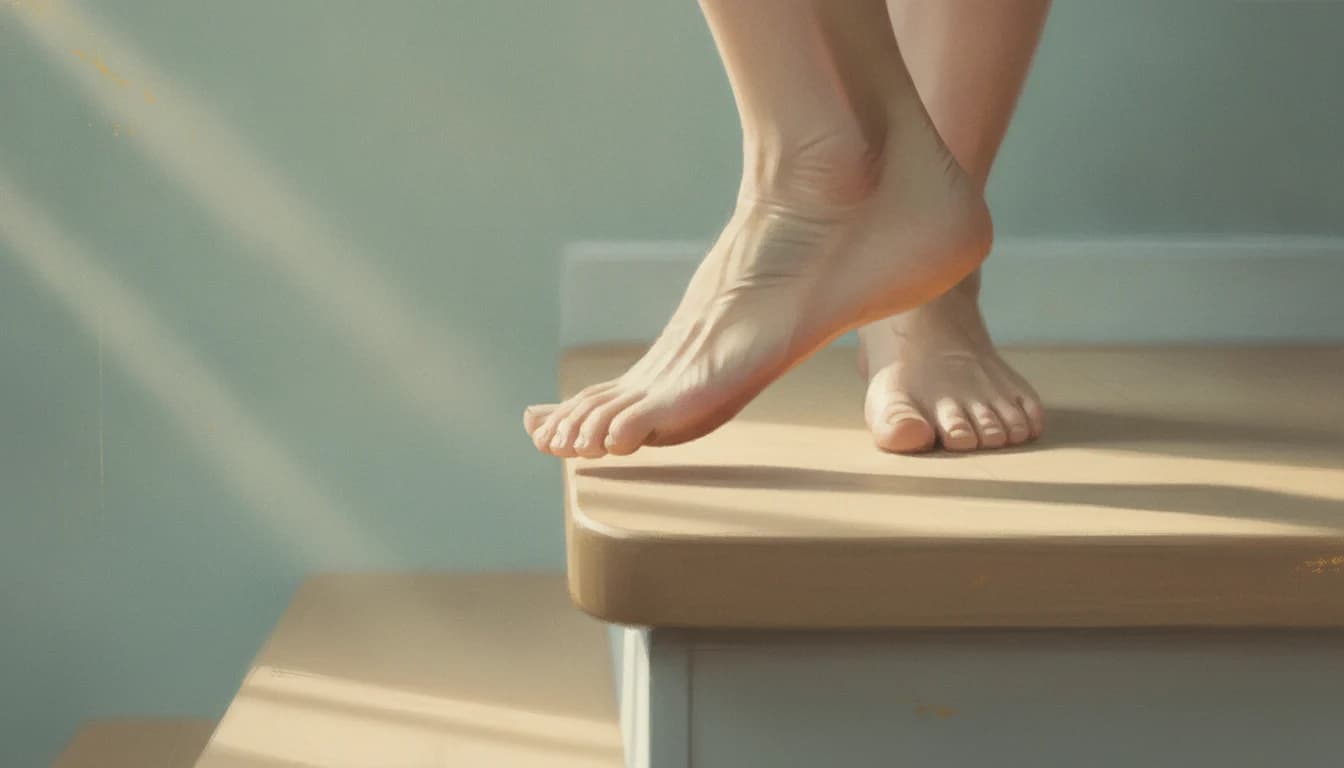
The strongest predictor of falls is not strength
A new 2026 study put proprioception, vibration sense, and muscle strength head to head against fall frequency in older women. The sensing variable won.
For about two decades the falls prevention story has had a clean headline. Build leg strength. Add some balance work. A new 2026 study put six different variables head to head against fall frequency in older women, and the variable that came out on top was none of those. It was a small ankle sensing task.
The study, published in the Journal of Back and Musculoskeletal Rehabilitation, enrolled 92 women aged 65 and over. The researchers measured vibration sense, joint reposition error (a common proprioception test), isometric muscle strength, static balance, reaction time, and postural stability, then ran multiple linear regression with backward stepwise elimination against how often the participants had fallen (Miçooğulları et al., 2026).
The winner was greater plantarflexion joint reposition error, with a standardized coefficient of 0.454 at p less than 0.001. Joint reposition error is a simple task. The examiner moves the ankle to a target angle, lets it return to neutral, and asks the participant to find the same angle again without looking. The size of the miss is the error. The bigger the miss, the more often someone had fallen.
Vibration sense, plantar flexor strength, and plantarflexion reaction time also contributed independently, but the sensing variable carried the largest weight. Strength still mattered. It just was not the headline.
What's been building over the last decade
For most of the last twenty years, falls prevention guidance has leaned on a few main pillars. Tai Chi, sit to stands and resistance work for leg strength, and balance exercises like standing on one leg or walking heel to toe. All of those still work. None of that is going away.
What has been growing quietly underneath is the role of the sensory side. Earlier work had already linked proprioception with balance performance in older adults. The 2025 perturbation based balance training meta analysis showed that unpredictable disturbance training, where the system has to reorganize on the fly, reduced both falls and fall injuries. A 2026 sensorimotor training trial in older women showed that eight weeks of explicitly sensory work moved balance scores and proprioception together.
This new paper is one more data point in that arc. It is unusually clean because of the head to head design. The sensory and the motor variables ran in the same regression. The sensory variable won.
The picture forming is not "strength training was wrong." Strength remains a real contributor. The picture is closer to this: strength gives you the capacity to recover from a disturbance, and sensing reduces the disturbance to begin with. Most programs train one of those well. Few train both.
What this looks like in a body
What does it actually mean when joint reposition error is low? The brain has a current, clear map of where the ankle is right now. When you step down off a curb at dusk with a coffee in your hand, the brain does not think. It uses that map. If the map is fuzzy, the foot lands a moment late, or at an angle the ground did not predict. Sometimes you save it with a counter step. Sometimes you do not.
In the Feldenkrais Method®, a meaningful portion of any Awareness Through Movement® lesson is spent in exactly the kind of slow, attended movement that trains joint reposition accuracy. You move the foot a small amount, pause, notice. You move the pelvis a small amount, pause, notice. You compare one side to the other. The work is gentle but it is highly specific. It is not stretching, and it is not strength training. It is sensing practice with the body itself as the instrument.
What to take from this
I want to be careful here. This is a single cross sectional study in a specific population. It does not show that any one form of sensory work prevents falls. There is no Feldenkrais versus Otago head to head on fall outcomes, and I would not claim there is.
What the study does suggest is that for someone who is already doing strength work, the question worth asking is whether anything in the week is specifically training sensing. Slow ankle and foot work. Eyes closed weight shifting. Attentional movement of any school. If nothing in the week is doing that job, the sensory side is probably underloaded compared to the strength side.
For anyone whose balance has shifted recently, this is also a flag to raise with a physician or physical therapist. Joint reposition testing is not always part of a routine workup, and asking about it is reasonable.
What I'm watching for next
The next study I would want to see is an explicit head to head between a sensory training program and a strength training program on fall outcomes, ideally with a combined arm. That would tell us whether the right move is to add sensing on top of strength, or whether sensing alone gets us further than current guidelines assume.
For now, the most honest reading of this paper is the older one. The body falls when its sense of where it is goes fuzzy. Sharpening that sense is its own kind of training.
Let Feldy guide you, eyes closed
A calm voice walks you through gentle moves so your attention stays in your body, not on the screen.
Try Feldy Free for 7 daysNo credit card needed.
Sources
- Proprioception: The strongest predictor to falls in older females – A cross-sectional study— Journal of Back and Musculoskeletal Rehabilitation
- Perturbation-Based Balance Training Reduces Falls and Fall Injuries in Older People— medRxiv preprint
- The effects of eight weeks of sensorimotor training on balance, proprioception, and hip abductor isometric strength in elderly women with genu varum— BMC Geriatrics
Movement Pulse is informational, not medical advice. See our editorial policy.
Move better with Feldy
See the programMovement Pulse Weekly
The week's best research, in your inbox Tuesday.
Movement science, gentle-practice ideas, and a practitioner's read on what's new. Free.
More from Movement Pulse
Why the balance exercise that works in a class may not be the one that works at home
A new analysis pooled 423 trials and nearly 34,000 older adults to compare 19 ways of training balance. The ranking changed depending on which kind of balance was being measured.
Aug 16, 2026
Even strong athletes wobble when the eyes close
A July 2026 study found even competitive weightlifters lost steadiness once the surface softened and the eyes closed. Balance is sensing, not strength.
Jul 6, 2026
The clinic that watches your bones and the one that watches your balance rarely talk
Seven international organizations published a joint position paper on 10 September saying fall prevention and fracture prevention are still built as separate services. Three questions worth taking to your next appointment.
Sep 14, 2026Ready to start moving better?
Gentle, guided lessons for your body. Try your first one free, no credit card required.