

Gentle Hip Impingement Exercises Within Comfort
Gentle hip impingement exercises that stay in an easy mid-range, never pinch, and avoid deep hip bending, with a short guided floor lesson you can try today.
Before you begin. This is gentle self-care, not medical advice. Hip impingement (FAI) is a structural issue, so avoid deep or forced hip bending that pinches, stay within pain-free range, and have it assessed by a doctor or physical therapist. Stop anything that causes pinching or sharp pain.
The lesson
About 5-10 minutes. Move slowly, do less than you can, and stay well below any pain. Rest whenever you need to.
Prefer to listen than read?
Feldy voices gentle lessons like this for knees and hips, so you can close your eyes and follow along.
- 1
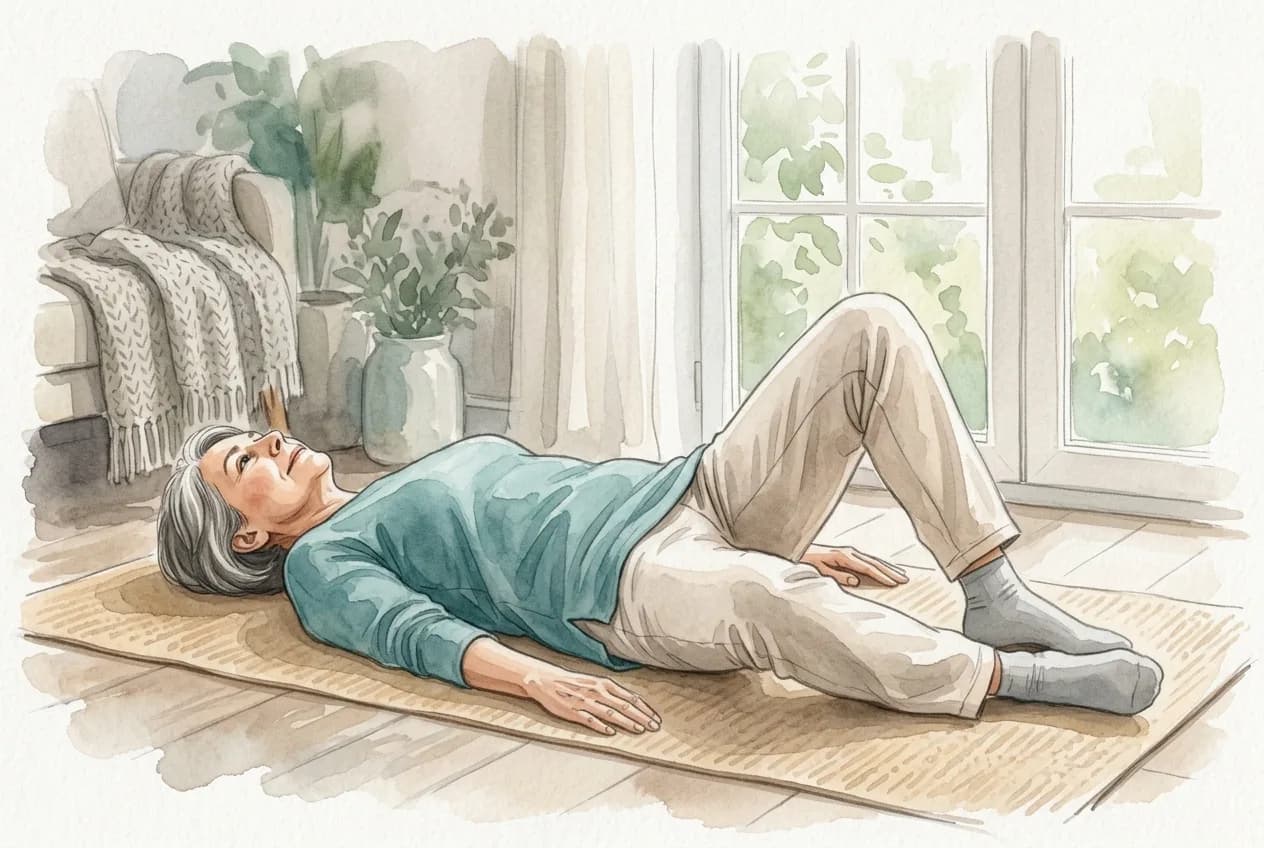
Hips on the floor. Lie on your back with knees bent and feet standing roughly under your hips. Which hip meets the floor more easily today?
- 2
A tiny sway of the knees. Let both knees drift a short way toward one side, then the other, slow and even. Keep the sway small enough that nothing pinches, and rest after a few passes.
- 3
One knee opening part way. Let one bent knee ease slowly out to the side, only part of the way, then guide it home. Stay well short of any catch, rest, then offer the other side the same.
- 4
A quiet middle. Lie still with both feet standing and take a few easy breaths. Let the hips be heavy.
- 5
A partial heel slide. Ease one heel away along the floor, lengthening the leg only part way, then walk it back. Only as far as stays easy, or simply imagine the slide, then rest.
- 6
Long and noticing. Let both legs lengthen and rest. What, if anything, feels different about your hips compared with when you began?
Let Feldy guide you, eyes closed
You just read these steps. In the Feldy program, a calm voice guides you through each gentle move, so your attention can stay in your body instead of on the screen.
Try Feldy Free for 7 daysNo credit card needed.
If a pinch greets you at the front of your hip when you squat deep, fold forward, or draw a knee toward your chest, gentle hip impingement exercises can bring more ease, as long as they stay in a comfortable mid-range and never reach the angle that pinches. Hip impingement, also known as femoroacetabular impingement or FAI, means the rim of the hip socket and the top of the thigh bone bump against each other at deep angles, which can catch or pinch. Slow, attentive movement that stays well inside your easy range, the kind of movement at the heart of the Feldenkrais Method® and related somatic approaches, lets the hip soften instead of provoking that pinch. The short floor lesson above works alongside the hip, not against it.
Hip conditions are widespread. Osteoarthritis, a related hip condition, affects about 595 million people worldwide (WHO, 2023), so countless people are searching for kinder, lower-effort ways to keep moving. Easy movement is one part of that picture; a clear diagnosis is the other.
Why mid-range hip impingement exercises help
When a hip pinches at deep angles, the muscles wrapped around it tend to clench as a kind of defense, and that bracing can leave the joint feeling stiffer and quicker to react. Easy, unforced movement in a range that does not pinch coaxes those muscles to release a little, so the hip can travel more freely within the room it already owns. The goal is not a bigger stretch or a deeper bend. It is comfort, ease, and a calmer pattern around the joint.
This is why every movement in the lesson stays in a relaxed mid-range. Small knee sways, gentle outward rotation of one leg, and easy pelvic tilts all let the hip roll quietly in its socket, far from the deep flexion where impingement bites. You move slowly enough to feel exactly where comfort ends, and you stop well before it.
Positions to avoid with hip impingement
Because FAI is structural, certain shapes tend to provoke the pinch and are best left alone here. Deep squatting, folding the hip sharply, and pulling a knee hard to the chest all drive the hip into the deep flexion where the bones crowd together. Strong inward turning of the thigh can do the same. None of those belong in this practice.
Instead, keep your hip in an open, comfortable range throughout. If a heel slide or a knee drop starts to feel like a catch or a pinch, that is your signal to make the movement smaller or stop. A pinch is not something to push through. It is information, telling you that you have reached the edge of what this hip wants today.
How to practice these hip impingement exercises gently
Everything rests on staying within comfort. Move slowly, because slowing down lets you feel the moment a movement nears its edge. Keep each range small, treating the movement as an invitation rather than a demand, and rest often between rounds so the hip never builds up irritation. If a side feels less free today, give it a smaller range and leave it at that.
You will meet that same patient temperament throughout the Feldy program, where each brief lesson leads slow, comfortable movement that you fit to whatever the day allows. Our Feldypedia guide to hip stiffness and limited mobility explains why gentle attention helps a guarded hip, and the program for knee or hip pain carries this same kind, mid-range approach much further.
For a few more gentle ideas, our exercises for pain in the hip joint and somatic exercises for hips keep the same slow, comfortable feel and bend just as easily to whatever your hip can manage.
A note on care
Treat this as supportive self-care, not a remedy. Hip impingement is a structural issue that deserves a clinician who knows your particular hip, so it is worth checking any new movement with a doctor or physical therapist before you begin. Stay clear of any pinch, keep well inside a pain-free range, never force a deep hip bend, and let your hip, rather than a target, decide how far you go.
Common Questions about hip impingement exercises (FAQ)
Are these exercises safe for hip impingement?
Gentle, slow movement kept in an easy mid-range is usually well tolerated, because it never forces the hip into the deep positions that pinch. The key is to stay within pain-free range and stop at any catch. Since impingement is a structural issue, have it assessed first and treat this as supportive self-care alongside, not instead of, professional guidance.
What movements should I avoid with hip impingement?
Avoid deep hip bending and anything that pinches at the front of the hip. That means no deep squatting, no pulling the knee hard to the chest, and care with strong inward rotation of the thigh. These end-range positions are where impingement tends to bite. Staying in a comfortable mid-range keeps you clear of that pinch.
How often should I do these movements?
A little and often serves you better than one long, occasional effort. A handful of comfortable minutes on most days offers the hips a steady, kind reminder that easy movement is available, without tiring them out. Let the next day be your guide, and skip a session if anything feels irritated.
How is gentle movement different from aggressive stretching?
The forceful kind drags a joint out toward its limit, which is exactly the spot where an impinging hip pinches and clamps down harder in protest. Gentle movement does the opposite: it lets the hip play inside the easy range it already owns, so the surrounding muscles can let go of their guarding. The aim is comfort and ease, not a deeper stretch.
When should I see a professional about hip impingement?
Always have hip impingement assessed by a doctor or physical therapist, since it is a structural issue. See them promptly if you feel sharp or pinching pain, catching or locking in the hip, pain that wakes you at night, or symptoms that worsen. They can confirm what is going on and tailor movement that is safe for your hip.
Does hip impingement always need surgery?
No. Many people find their symptoms settle with activity changes, guided movement, and time, and surgery is usually considered only when symptoms persist despite that kind of care. That decision belongs with an orthopedic specialist who has examined your particular hip. Gentle practice like this can sit comfortably alongside whichever path you and your clinician choose.
Kinder movement for knees and hips
See the programRelated resources
A Gentle Hip Mobility Workout, the Feldenkrais® Way
A slow, attentive hip routine you do lying down. No reps to grind and no pushing, just small easy movements that ask your hips how they like to move.
Hip Mobility Stretches: A Gentle Lying-Down Lesson
Hip mobility stretches that ease stiff, gripping hips through small, slow, comfortable movement, with a short lying-down lesson you can do today.
How to Treat Stiff Knees: What Actually Helps
Why resting a stiff knee usually backfires, which everyday habits change how it feels, and the signs that deserve a clinician's opinion.
Ready to start moving better?
Gentle, guided lessons for your body. Try your first one free, no credit card required.