
Hypermobility Without EDS: What Bendy Joints Usually Mean
Hypermobility without EDS is the most common way to be hypermobile: what separates the everyday trait from HSD and hypermobile Ehlers Danlos syndrome.
In short
Yes, you can have hypermobility without EDS, and most hypermobile people do. Generalized joint hypermobility is a common trait, HSD is the diagnosis when the trait comes with symptoms, and hypermobile Ehlers Danlos syndrome requires formal criteria that only a clinician can apply.

Prefer to ease in gently?
See a few gentle exercises for hypermobility to try.
Before you begin. This page is educational and cannot tell you whether you have hypermobility spectrum disorder or any type of Ehlers Danlos syndrome. A formal assessment belongs with a clinician, usually a rheumatologist or a clinical geneticist, who weighs criteria, history, and examination together. In a hypermobile body the useful goal is steadiness rather than extra flexibility, so please do not stretch into the far ends of your range. Symptoms such as frequent dislocations, marked fatigue, dizziness on standing, or widespread pain deserve a proper medical review.
Hypermobility without EDS is not only possible, it is by far the most common way to be hypermobile. If your fingers bend further than your friends' fingers, your elbows travel past straight, or someone once called you double jointed, the odds favor a simple inherited trait over a connective tissue disorder. This page untangles the three terms that collide in this search, generalized joint hypermobility, hypermobility spectrum disorder, and hypermobile Ehlers Danlos syndrome, and explains why bendy joints on their own tell a clinician very little. It also describes what a hypermobile body tends to want from movement, which is the ground the Feldenkrais Method® works on: not more range, but a clearer feel for the range you already own.
Hypermobility without EDS: the common trait behind bendy joints
Generalized joint hypermobility means several of your joints move beyond the range most bodies allow, because the connective tissue around them gives a little more. When this arrives with no pain, no instability, and no other complaints, the formal name is asymptomatic generalized joint hypermobility, and it calls for no treatment whatsoever. The trait shows up more often in women than in men, more often in children and younger adults, and more often in some ethnic groups than others. Plenty of dancers, gymnasts, swimmers, and musicians carry it through entire careers and would file it under advantages. It is also anything but rare. One study that screened university students found generalized joint hypermobility in about 12.5 percent of them under a strict Beighton cutoff (PeerJ, 2019). That number describes one group of young adults in one study rather than a worldwide rate, but the point stands: bendy joints are common, and connective tissue disorders are not.
A word about the screen itself. The Beighton score, the nine point check most people encounter first, was built to flag this trait and only this trait. It counts how many of your joints pass certain range markers, and that is where its authority ends. A high Beighton score says your joints travel a long way. It does not say why, and it certainly does not hand you a syndrome. If you have never run the screen, our walkthrough of how to tell if you are hypermobile covers it gently, step by step.
When hypermobility without EDS still deserves a name: HSD
Sometimes the trait does cause trouble. Joints ache after ordinary days, ankles roll too easily, a shoulder feels unreliable, fatigue hangs around. When symptoms like these persist and a clinician confirms that the full criteria for hypermobile Ehlers Danlos syndrome are not met, the diagnosis is hypermobility spectrum disorder, or HSD. Two things matter here. First, HSD is a genuine diagnosis, not a runner up prize, and its symptoms can be just as demanding as those of hEDS. Second, HSD is considerably more common than hEDS, so even among hypermobile people whose joints complain, most will land outside the EDS category. Being taken seriously does not require the rarer label.
What hypermobile Ehlers Danlos syndrome actually requires
Hypermobile Ehlers Danlos syndrome, hEDS, is a specific inherited connective tissue condition with formal international criteria published in 2017. Meeting them takes far more than a bendy screen: clinicians look for particular skin qualities, certain body proportions, findings in other systems, a relevant family history, and a pattern of joint symptoms, all weighed together. No blood test currently confirms this type, so the judgment belongs to an experienced clinician, most often a rheumatologist or a clinical geneticist. That is exactly why nobody, including this page, can sort you into a category from a description of your fingers. For a fuller side by side of the trio, our comparison of EDS vs hypermobility lays the map out in one table. And none of this is meant to shrink hEDS. It is a real condition deserving proper care. The statistical reassurance is simply that most hypermobile people never meet its criteria.
What a hypermobile body wants, whichever label fits
Here is the thread that runs underneath every category on this page. Hypermobile bodies often receive fuzzier information about joint position, so a knee or an elbow can drift all the way to its limit without the drift ever being felt. Many people quietly compensate by gripping muscles hard all day, trading looseness for exhausting tension. Awareness work speaks to exactly this gap: practicing, slowly and comfortably, the skill of feeling where you are in space, and discovering support that does not come from hanging on the ends of the joints.
Let me be plain about the limits too. Awareness work does not change connective tissue, and it is not a treatment for HSD, for hEDS, or for anything else on this page. If you carry a diagnosis, your medical team leads, and movement education keeps its own separate seat beside that care. The Feldypedia entry on hypermobility and joint instability explains why lax joints answer well to slow sensing practice. When you want to feel what this looks like on the floor, start with our guided lesson of exercises for hypermobility, browse the wider roundup of exercises for hypermobility syndrome, then explore the full hypermobility program. Trying a Feldy lesson costs nothing for the first 7 days, and the only thing it asks of your joints is to stay comfortable.
Stability without gripping
Now for stability that does not rely on gripping. The Feldy program builds a clearer sense of where the body rests, so steadiness grows from awareness, through Feldenkrais® lessons. Gentle, guided, and self-paced.
Start my free 7-day trialNo credit card needed.
Common Questions about hypermobility without EDS (FAQ)
What does the Beighton score tell you, and what does it not?
The Beighton score counts how many of nine joint movements travel beyond typical range, producing a number from zero to nine. It screens for generalized joint hypermobility and nothing more. It cannot diagnose hypermobile Ehlers Danlos syndrome, because that diagnosis rests on things the score never touches: skin findings, family history, and symptoms across the body. A high score with no symptoms is simply a description of your joints.
What is the difference between HSD and hypermobile EDS?
Both involve hypermobile joints together with genuine symptoms such as pain, instability, or fatigue. The dividing line is a checklist: hypermobile Ehlers Danlos syndrome requires the 2017 diagnostic criteria to be met, including features beyond the joints, while hypermobility spectrum disorder is the diagnosis when those criteria are not fully satisfied. HSD is not milder by definition, and it is considerably more common than hEDS.
Does hypermobility get worse with age?
For range itself, usually the opposite: connective tissue stiffens gradually over the decades, and many bendy people lose their party tricks by midlife. Symptoms follow their own course. Pain or instability can appear, settle, or shift at different points in life, which is one reason a very bendy childhood does not predict trouble later on.
When should I seek a formal assessment, and from whom?
Book an assessment when hypermobility arrives with company: dislocations or joints that keep slipping, pain that refuses to settle, marked fatigue, dizziness on standing, unusually stretchy or fragile skin, or a family history of connective tissue disease. A family doctor is the sensible first stop and can refer you onward. Formal diagnosis of hEDS or HSD usually sits with a rheumatologist or a clinical geneticist.
What kinds of movement suit a hypermobile body?
Movement that builds control and clear sensing inside a comfortable range tends to serve lax joints well: slow, light, attentive practice rather than forceful repetition. Gentle strength work in mid range helps many people. Yoga can suit a hypermobile body when it is practiced away from the far ends of range. Pilates approaches the same territory by building support around the center. Awareness based work such as the Feldenkrais Method concentrates on feeling where your joints are, so you stop drifting to their limits without noticing.
What should I avoid if I am hypermobile without an EDS diagnosis?
Avoid stretching into the far end of your range, hanging passively on your joints while standing or sitting, and demonstrating extreme positions on request, because extra range was never the missing ingredient. Avoid ignoring a joint that keeps giving way, since recurring instability deserves professional eyes. And avoid deciding the label yourself in either direction: bendy joints alone do not mean EDS, and persistent symptoms deserve assessment rather than self diagnosis.
Stability without gripping
See the programRelated resources
EDS vs Hypermobility: Trait, Spectrum, or Syndrome?
EDS vs hypermobility: joint hypermobility is a common trait, HSD adds persistent symptoms, and hypermobile Ehlers Danlos syndrome is a clinical diagnosis.
How to Tell If You Are Hypermobile vs Just Flexible
How to tell if you are hypermobile: a simple Beighton-style self-check, what counts as hypermobile versus just flexible, and why a self-check is not a diagnosis.
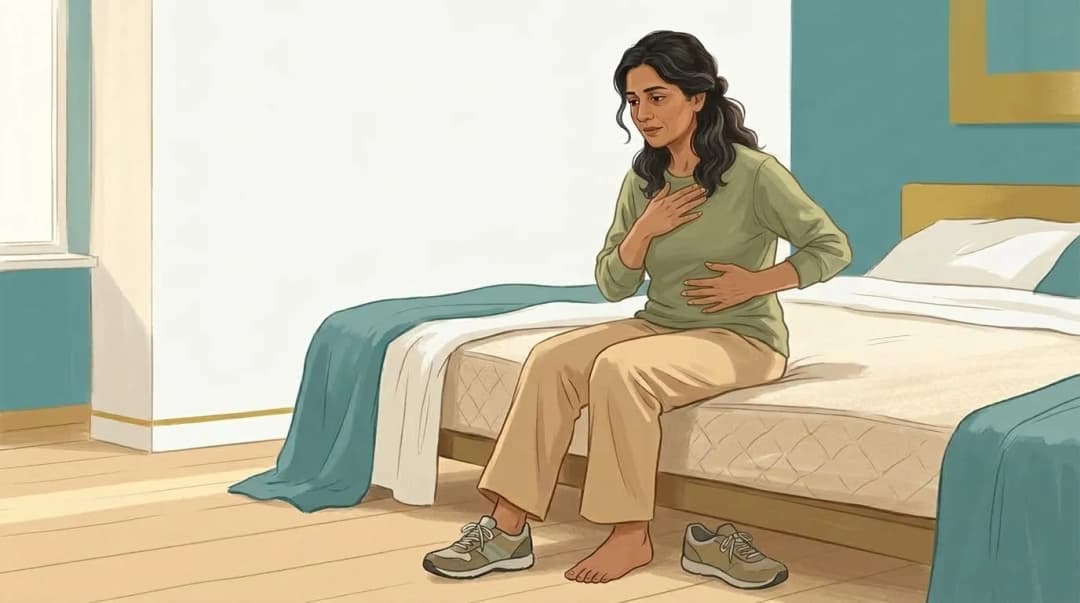
Getting out of breath may be the hypermobility symptom that quietly shrinks your day
Ready to start moving better?
Gentle, guided lessons for your body. Try your first one free, no credit card required.