

Getting out of breath may be the hypermobility symptom that quietly shrinks your day
A Toronto clinic gave forty seven hypermobile adults questionnaires, a Fitbit and a long interview. The breathing complaint nobody asks about tracked almost everything else.
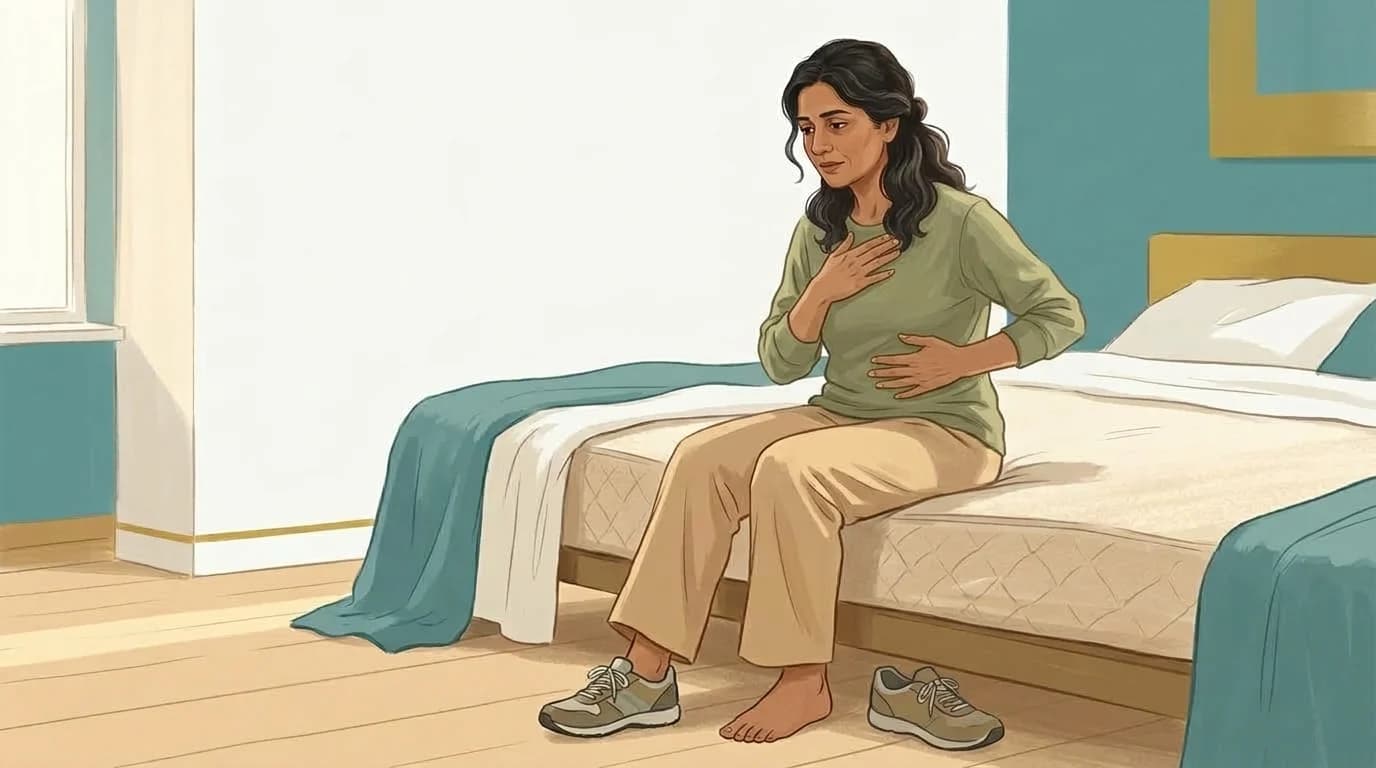
Ask someone with hypermobility what actually bothers them and the answers arrive in a fairly reliable order. The joints that slide. The fatigue that no amount of sleep touches. The neck that has given up by lunchtime. Getting out of breath halfway up a flight of stairs sits much further down the list, if it appears at all, and when it does appear most people file it under being out of shape and move on.
A paper published in Respiratory Medicine on 10 September suggests that filing may be wrong.
The work came out of the GoodHope Ehlers-Danlos Syndrome Program at University Health Network in Toronto (Respiratory Medicine, 2026). Forty seven adults with Ehlers-Danlos syndrome or generalized hypermobility spectrum disorders took part, all of them people who had already told the clinic about some breathing symptom. The team handed out questionnaires, put a Fitbit on them so the week could be counted rather than remembered, and then sat a subset down for long interviews about what the breathlessness was actually costing them.
Thirty five of the forty seven rated their breathlessness as moderate or worse on the scale respiratory doctors use for it. Those thirty five scored around seventeen points lower on the physical side of a hundred point quality of life questionnaire than the others in the room, reported noticeably more fatigue, and rated their own capacity for ordinary tasks, stairs, shopping, a few blocks on foot, well below the rest. The wrist data agreed. Of the twenty one people with usable activity records, twelve were averaging fewer than 5,000 steps a day, which is the point where the word sedentary stops being a judgement and starts being a measurement.
Then the interviews, which are the part I have not been able to put down. People described what the authors name a cycle of inactivity, and reading their accounts you can watch the loop close: breathing feels like work, so the walk gets shortened, so the capacity for walking quietly drops, so the next walk feels like more work than the last one did, and somewhere in that sequence a person stops accepting invitations that involve stairs without ever once deciding to.
What this study does not say
It does not say that three in four hypermobile people are breathless. Everybody here was recruited because they already had a breathing complaint, which is the right way to study what such complaints do and the wrong way to estimate how common they are. The honest version is narrower and still worth knowing: among hypermobile adults who do get short of breath, that symptom travels with lower function, more fatigue and fewer steps, and it is rarely the thing being asked about in the appointment.
The authors' own conclusion is that respiratory symptoms in this group deserve proper assessment rather than assumption. That is the right first move and it is not mine to make. Breathlessness has causes that need naming, from asthma to the blood pressure and heart rate problems that keep company with hypermobility, and the movement work I do belongs after that conversation, not instead of it.
What I keep seeing in class
The pattern I run into again and again with hypermobile students is that the breath has been quietly conscripted into the job of holding the body together. When a joint does not offer much of its own stability, something has to supply it, and the rib cage is a convenient place to borrow from. The chest stays a little inflated. The lower ribs stop travelling. The shoulders get recruited for a task that ought to belong to the diaphragm, and over years that arrangement becomes so familiar it reads from the inside as simply how breathing feels. It is the same borrowing that turns up around the shoulder blades, which is part of why so many hypermobile people end up reading about a hypermobile scapula when the thing recruiting those muscles in the first place was the breath.
People often arrive able to describe their shoulders in great detail and unable to say whether their back ribs move at all. Not a deficit of effort. A gap in the map.
Ten quiet breaths, and what your ribs are doing during them
About 6 minutes. Move slowly, do less than you can, and stay well below any pain. Rest whenever you need to.
- 1
Lie on your back with your knees bent and your feet standing on the floor, or sit back in a chair if lying down is not comfortable today. Rest one hand low on your belly and the other flat on the side of your rib cage, just under the armpit. Change nothing about your breathing. Let five or six breaths pass and simply notice which hand gets moved, and whether the two of them move at the same moment or one lags behind the other.
- 2
Now follow one breath out all the way to its ordinary end, and then wait. Do not hold, do not squeeze anything, do not decide when the next one starts. Just leave a small gap and let the breath in arrive by itself. Do that three or four times. For a lot of people this is the first moment they notice how much of their breathing they have been doing on purpose.
- 3
Leave your hands where they are and let your head roll a little way to the right as you breathe out, then back to the middle as the next breath comes in. Small. Half the range you think you can do. What you are listening for is not the neck but the hand on your ribs, and whether the ribs under it soften, stiffen or simply stop when the head turns. Then try four of those to the left.
- 4
Put both arms down, stop organising anything, and let the breathing go back to whatever it wants to do. Compare the two sides of your back against the floor or the chair. You only go where it feels easy, pleasant, and comfortable, so if any of this made you feel short of breath or lightheaded, make it smaller next time, or do it only in imagination, which works better than most people expect.
Let Feldy guide you, eyes closed
A calm voice walks you through gentle moves so your attention stays in your body, not on the screen.
Try Feldy Free for 7 daysNo credit card needed.
The Feldenkrais Method® spends a lot of its time on exactly this kind of question, because breathing is where habitual effort shows up first and argues least. A Feldenkrais® lesson does not train you to breathe correctly. It gives the nervous system enough information about what it is currently doing that the unnecessary parts of the effort tend to drop out on their own, which is a slower route and a more durable one. The lessons in the Feldy online movement program work this way throughout, and for anyone already under a respirologist or a physiotherapist, that sits alongside their work rather than replacing it. Yoga, Pilates and Tai Chi approach the breath through a different mechanism, and each has its own strengths.
None of this is a treatment for breathlessness, and anyone who tells you otherwise is selling something. What it may do is interrupt the loop at a different point. The Toronto cycle runs through capacity, and capacity is hard to rebuild when every attempt starts with a symptom. Attention is available earlier and costs almost nothing, and a person who can feel their own rib movement and the effort hiding in it has at least one more place to put a hand on the wheel.
What stayed with me from that paper was not the numbers. It was how many of those forty seven had apparently been carrying this for years in a clinic full of specialists, waiting for somebody to ask.
Sources
Movement Pulse is informational, not medical advice. See our editorial policy.
Move better with Feldy
See the programMovement Pulse Weekly
The week's best research, in your inbox Tuesday.
Movement science, gentle-practice ideas, and a practitioner's read on what's new. Free.
More from Movement Pulse

When hypermobility hides behind a Chiari diagnosis
A July 2026 study of 354 patients found that when Chiari runs in families, three times as many people also have unusually flexible joints. Often, no one has named it.
Jul 22, 2026
Nobody asked about your joints at the headache appointment, and that may matter
A narrative review published on 25 August says naming joint hypermobility widens the differential for headache. Three questions worth taking with you.
Aug 31, 2026
Why your neck can hurt more when you already have more range and more strength
A study of 555 adults found women with hypermobile joints reported more neck pain, and tested with greater range and greater strength.
Aug 3, 2026Ready to start moving better?
Gentle, guided lessons for your body. Try your first one free, no credit card required.