
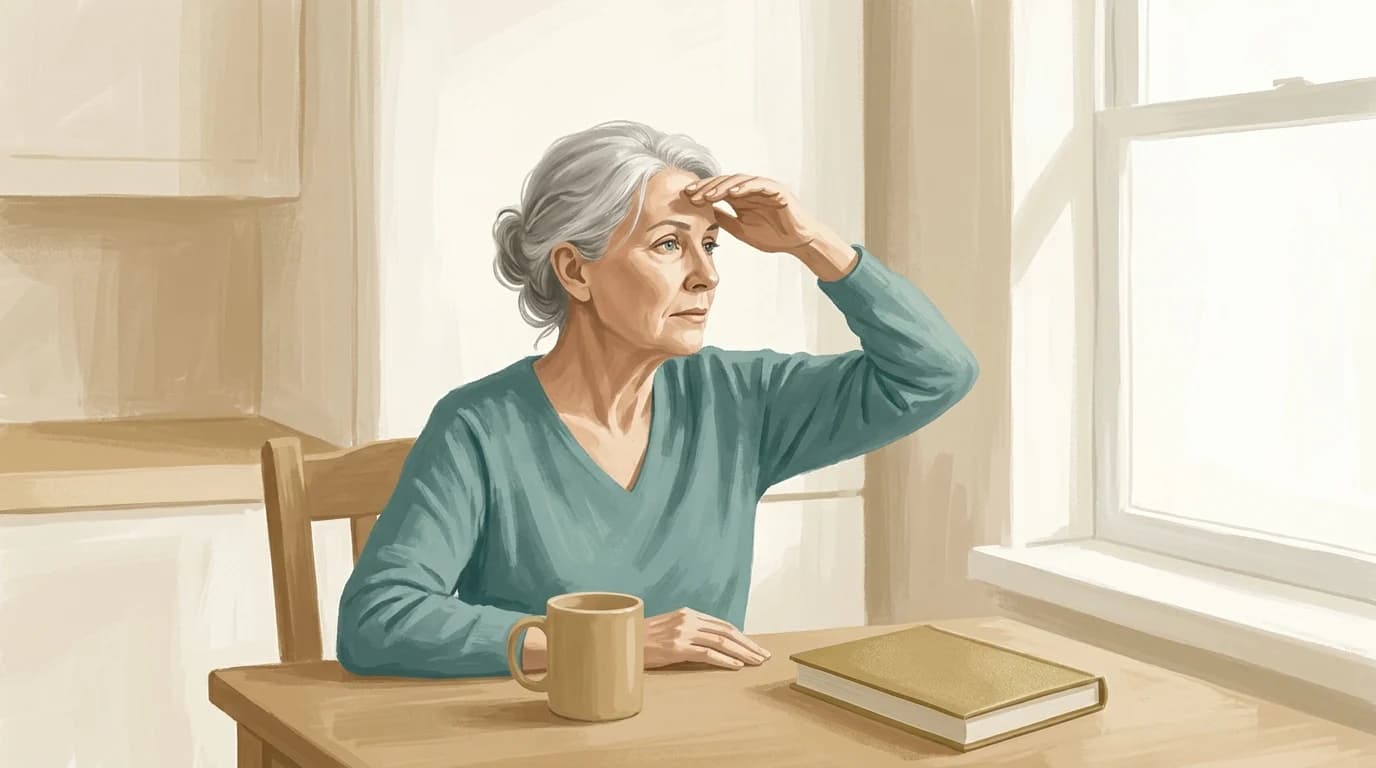
Why the pain score they ask for said the least about how the fibromyalgia week went
Two studies published a day apart counted the symptoms nobody scores. In both of them, the pain rating was not the number carrying the information.
A research team in Kutahya asked 65 people with fibromyalgia to say out loud every way their bodies were overreacting to the world. Pressure. Movement, sound, light, touch. Trouble thinking, fatigue, sleep that breaks apart in the small hours. The length of each person's list said a great deal about how they were doing. Their pain score, zero to ten, said almost nothing.
That study appeared in Pain Management on 28 August (Pain Manag, 2026), from a team at Kutahya Health Sciences University and Pamukkale University in Turkiye, registered as NCT05941780. One day earlier, a much larger study out of Texas and Ohio had landed in a different journal with a compatible result. Read together, they make one claim that anyone living with this condition already suspects: a single pain rating is a poor summary of a fibromyalgia week.
The Turkish team set each person's symptom count against four measures: pain intensity, disease severity, quality of life, and pain catastrophising. The count moved with three of the four. Its link to disease severity was the strongest of the set, quality of life came next, catastrophising after that, and all three held up after the researchers adjusted for everything else they had measured. Against pain intensity, nothing. How many kinds of ordinary input a nervous system was amplifying said a lot about how the condition was going, and nothing about how much it hurt.
The larger sample, one day earlier
On 27 August, a group at Dell Medical School in Austin, working with colleagues at Ohio State, published in the Journal of Affective Disorders using a harmonised cohort of 820 adults, all meeting the 2016 American College of Rheumatology criteria (J Affect Disord, 2026). Instead of a spoken list they used the Central Sensitization Inventory, a scored questionnaire covering much the same ground: sensitivity, fatigue, sleep, concentration. Higher scores went with worse physical functioning, less energy, and worse general health. Moderate associations, every one, and far too consistent across 820 people to be chance.
One detail keeps the story from getting too tidy. Symptom burden was also linked to the pain section of the quality of life questionnaire, and that was the strongest association in the whole paper. Pain has not stopped mattering. What both papers question is whether one number, asked once, can stand in for the rest.
What a headline would get wrong here
"Fibromyalgia isn't really about pain" is the headline this invites, and neither paper earns it. Both are cross sectional. Photographs, not films. Sixty five people is a small room, and small rooms produce loud coincidences. The Turkish symptom tally was a count taken in conversation, a rougher instrument than the scored inventory the larger cohort used. And the catastrophising link runs in whichever direction you want it to: a person whose body has treated lamplight as a threat for ten years has earned her dark expectations, and a snapshot cannot say whether the dread arrived before the symptoms or because of them.
None of this is a fringe concern. About 2 percent of American adults live with fibromyalgia, most of them women (American Academy of Family Physicians, 2023). In July I wrote about the review that placed the condition in the category of altered central pain processing rather than tissue damage. These two studies are what that reframing looks like once somebody starts counting.
What I see in the room
I am a Feldenkrais® practitioner, and this gap between the number and the week walks into my room all the time. In April, a woman of about fifty seven told me her pain had held at a four all week, a good stretch by her standards, and in the same breath mentioned that she had not finished a page of a book since the previous Sunday and had started eating dinner with the kitchen light off. On the only measure anyone was recording, she was having a good week.
The tells in a lesson are smaller. Someone asks me to dim the room lights before we begin. Someone shifts on the floor because the surface under one shoulder blade has become too much information, not too much pressure. That is precisely what the Kutahya team was counting, and there is no box for it on an intake form.
Work based on the Feldenkrais Method® does not aim at the pain number. The movements stay small, the pace stays slow, and you only go where it feels easy, pleasant, and comfortable, which for a nervous system already flooded with input may be most of the point. If a rheumatologist or a physiotherapist is managing your fibromyalgia, this kind of practice sits alongside what they have given you, never in place of it. Yoga, Pilates, Tai Chi, and qigong come at the same body through different mechanisms, each with its own strengths. If you want that slow kind of practice guided at home, our guide to the best exercise app for fibromyalgia looks at which apps can be used on a bad day without paying for it tomorrow.
What might be worth writing down
Plenty of people with fibromyalgia keep a record, and both papers quietly suggest the pain column is not the one doing the work. Try different columns for a month. How the light felt. Whether sound was bearable by evening. Hours slept, and things actually finished. That is closer to what moved with severity and function in both cohorts, and closer to what the widespread sensitivity of this condition consists of on an ordinary Tuesday. The fatigue that keeps showing up deserves a column of its own. So might walking, since fibromyalgia and walking difficulties often come from fatigue, foggy thinking, and stiffness as much as from pain.
That is not a treatment plan, and I would not hand it to anyone as one. It is a different set of columns, kept for your own eyes first.
What I keep wondering is what happens when somebody brings a list like that to an appointment. The four fits in a box. The dark kitchen does not, and the appointment is eleven minutes.
Let Feldy guide you, eyes closed
A calm voice walks you through gentle moves so your attention stays in your body, not on the screen.
Try Feldy Free for 7 daysNo credit card needed.
Sources
- Clinical impact of nociplastic symptom burden in individuals with fibromyalgia syndrome— Pain Management
- Elevated central sensitization inventory symptom burden and depressive symptoms define a clinical vulnerability phenotype in fibromyalgia— Journal of Affective Disorders
- Fibromyalgia: Diagnosis and Management— American Academy of Family Physicians
Movement Pulse is informational, not medical advice. See our editorial policy.
Move better with Feldy
See the programMovement Pulse Weekly
The week's best research, in your inbox Tuesday.
Movement science, gentle-practice ideas, and a practitioner's read on what's new. Free.
More from Movement Pulse

Why fibromyalgia pain is real even when your scans and blood tests look normal
For years the tests came back normal. A major new review explains why the pain is real, and what to ask your doctor now.
Jul 27, 2026
If fibromyalgia is autoimmune, removing the antibodies should have helped more than this
A drug that clears antibodies out of the blood was the cleanest test yet of the idea that fibromyalgia is autoimmune. The group result came in small.
Sep 18, 2026
What the fibromyalgia propranolol study actually found
A double blind trial tested a PTSD drug protocol on fibromyalgia pain. It was a 24 person feasibility study, and the pain benefit faded by follow up.
Jul 15, 2026Ready to start moving better?
Gentle, guided lessons for your body. Try your first one free, no credit card required.