
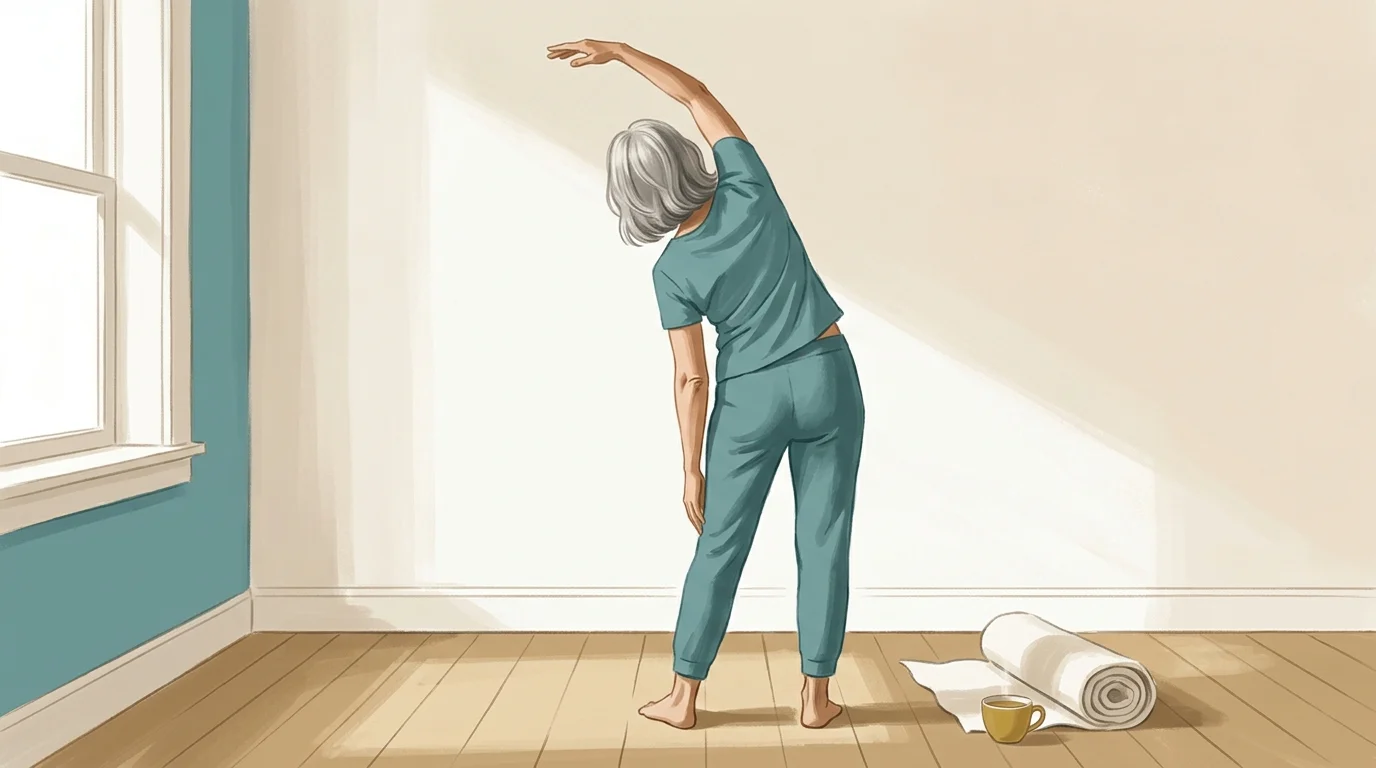
What a decade of menopause pain research keeps finding
A review of 115 studies finds movement offers the most consistent benefit across the many forms of menopause pain, and that sleep and stress shape it.
Menopause pain rarely arrives as one clear problem. A new review that read a decade of research at once found that the most reliable help across its many forms is also the quietest: movement a person can keep doing.
On July 7, a review published in Menopause, the journal of The Menopause Society, gathered 115 peer reviewed studies from 2014 to 2024 and looked at menopause associated pain as a whole rather than one symptom at a time (Menopause, 2026). It sorted the pain into five families: musculoskeletal, urogenital, gastrointestinal, oral and orofacial, and multisite pain that turns up in more than one place at once. Musculoskeletal and urogenital pain were the most studied, and severity tended to peak in early menopause before easing somewhat in the years after.
Two findings stand out for anyone trying to decide what to actually do. The first is about what helps. The review reports that exercise based approaches showed the most consistent functional benefit across these different kinds of pain, while the evidence for hormone therapy and for various complementary approaches was more variable and depended heavily on the individual. The second is that the pain was rarely only about tissue. Psychological distress, sleep disturbance, body mass, and social circumstances consistently shaped how much a given pain was felt and how much it got in the way of ordinary life.
That second finding is the one I recognise most. When women in the transition come to me, the story is often the same. The joint aches and stiffness that arrive with menopause settle into a hip that never used to complain, sleep has gone shallow, and the body that used to be dependable suddenly is not. The natural response is to brace against it and move less, and the bracing quietly becomes a second layer of the problem. The trouble is often not only that the body has new limits, but that it no longer feels trustworthy, so movement turns into something to be careful around rather than a way back in.
I teach the Feldenkrais Method®, which is slow and gentle on purpose. In an Awareness Through Movement® lesson you only go where it feels easy, pleasant, and comfortable, and the attention matters as much as the motion. For a system already stirred up by broken sleep and a stressful stretch of life, that combination does something useful. It is not more effort. It is small, repeatable movement done with enough attention that the nervous system gathers its own evidence that motion is safe. The review's list of pain modifiers, sleep and distress high among them, is a fair description of exactly the territory this kind of practice works in. Do less, and often you gain more.
If you translate the review into a plan, it reads more like permission than prescription. Because the pain tends to peak early and rides on sleep and stress, the most valuable thing is usually not the most ambitious program but the one a woman will actually keep up on a rough week. Mode can follow preference. Someone who likes the floor, or water, or a short morning routine has already told you which option she will stay with, and that consistency is doing more of the work than any single technique. If you would rather have an app guide you through it, our comparison of the best exercise app for women over 50 looks at which options stay gentle enough to keep up.
The kinds of movement worth naming fall into two groups, and it helps to keep them apart. Hormone therapy, physiotherapy, and any care a clinician gives you sit alongside gentle movement rather than being replaced by it. If hormone therapy is on the table, that is a decision for a woman and her doctor, and the review is honest that its pain evidence depends on the person. The self practiced movement methods are a different comparison. Yoga, Pilates, tai chi, and the Feldenkrais based work I do each come at the body through a different mechanism, each with its own strengths, and none of them is a ranked winner over the others.
None of this points to a dramatic fix, which is much of the point. Menopause pain comes in more forms than most of us expect, its intensity is bound up with sleep and stress, and the thread that runs most reliably through all of it is movement a person can sustain. That is also where a format like the Feldy online movement program is meant to help, with short, gentle, audio guided lessons that hold up on the days no one is watching. It does not settle the hormone question and it does not stand in for clinical care. It is a way to keep the gentle, repeatable movement going, and to find a little more ease in a body that is asking for a different kind of attention than it used to.
Let Feldy guide you, eyes closed
A calm voice walks you through gentle moves so your attention stays in your body, not on the screen.
Try Feldy Free for 7 daysNo credit card needed.
Sources
- Menopause-associated pain: a decade review of patterns, determinants, and research priorities— Menopause (The Menopause Society)
Movement Pulse is informational, not medical advice. See our editorial policy.
Move better with Feldy
See the programMovement Pulse Weekly
The week's best research, in your inbox Tuesday.
Movement science, gentle-practice ideas, and a practitioner's read on what's new. Free.
More from Movement Pulse
Severe symptoms while your cycles still look normal, and what to raise with a doctor
A Climacteric analysis of 1,478 women across twelve countries finds symptom severity and job satisfaction shift before the periods stop, not after.
Sep 20, 2026
Why the movement practice you keep through menopause is usually the one you enjoy
Eighteen women aged 40 to 60 describe building their own menopause toolkits, and what decided which parts they kept was not the evidence.
Sep 1, 2026
The perimenopause question a third of women can't answer
A new study of 7,640 US women finds a third are unsure of their stage. The biggest driver isn't missing information. It's not knowing what a symptom means.
Jul 16, 2026Ready to start moving better?
Gentle, guided lessons for your body. Try your first one free, no credit card required.