
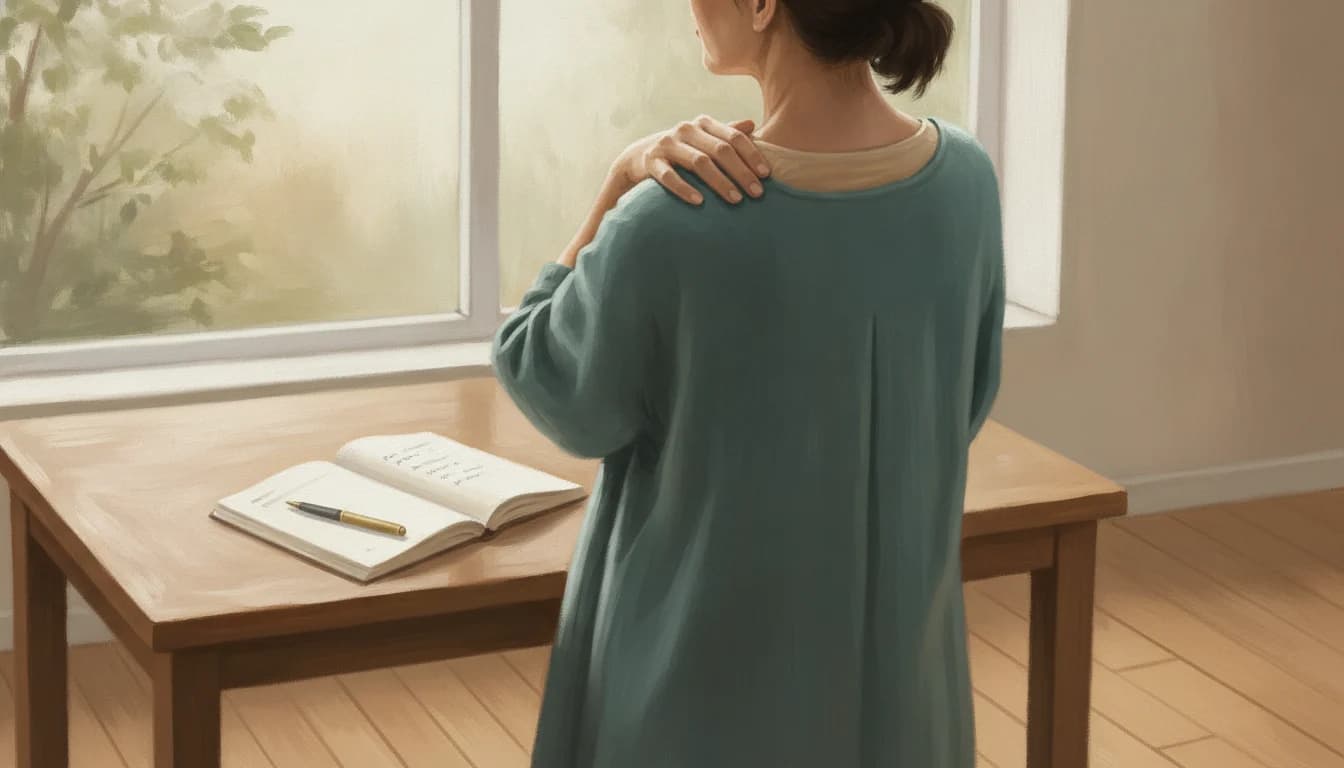
Menopause aches now have a name. What to ask your doctor
A growing wave of research is naming the joint aches and stiffness of perimenopause. A 93,000-woman analysis maps where it climbs, and what is worth asking.
For years, the joint aches, the morning stiffness, and the sense that your body suddenly feels a decade older have been filed under one unhelpful heading. Just getting older. A growing wave of research says that heading was hiding something, and the cluster of symptoms now has a name.
The term is the musculoskeletal syndrome of menopause, and it has moved quickly from a single 2024 paper into the mainstream. Harvard Women's Health Watch covered it this month, describing widespread joint and muscle pain, stiffness, and fatigue that tends to arrive as estrogen falls (Harvard Health, 2026). The reach is large. By their estimate the syndrome touches around 70 percent of women during perimenopause and menopause, and is genuinely debilitating for close to a quarter of them. The mechanism is not mysterious. Estrogen receptors sit throughout the joints, ligaments, tendons, and bones, so when the hormone drops at midlife, the whole musculoskeletal system feels it at once.
The numbers behind the name are now sturdier than a single paper. A systematic review published in JBJS Open Access in January pooled 37 studies and 93,021 women across 22 countries, and tracked how common muscle or joint pain is at each menopausal stage (JBJS Open Access, 2026). It rose from 40 percent of premenopausal women to 57 percent in perimenopause, then sat at 59 percent after menopause. Two things stand out in that arc. The jump happens at the transition, not slowly over the decades that follow, and the perimenopausal and postmenopausal rates are nearly the same. In plain terms, the ache does not creep in. It arrives.
This matters because the old framing left a lot of women undertreated and quietly discouraged. If the stiffness is "just age," there is nothing to do. If it is a recognized syndrome with a hormonal driver and a movement response, the conversation changes. The American Academy of Orthopaedic Surgeons now lists it on its patient site, flagging accelerated bone loss, more joint inflammation, and a higher chance of frozen shoulder among the consequences worth taking seriously (OrthoInfo, AAOS).
So if any of this sounds like your last two years, here are three things worth raising at your next appointment, written to help you get a real answer rather than a shrug.
First, ask whether what you are feeling fits the musculoskeletal syndrome of menopause, or whether something else should be ruled out first. Widespread aches and fatigue overlap with thyroid problems, inflammatory arthritis, and low vitamin D, and those have their own treatments. Naming the syndrome is useful only after those other causes have been considered. A clear answer here tells you what you are actually working with.
Second, ask where hormone therapy fits for you specifically. This is a decision for you and your clinician, made against your own history and risk profile, not something to settle from an article. What is worth knowing going in is that hormone therapy is one of the levers on the table for these symptoms, and that whether or not it is right for you, it does not replace the movement and loading your bones and muscles need. Ask your doctor to walk you through how that lever interacts with everything else.
Third, ask what your bones and muscles actually need by way of loading right now, and whether a bone density scan makes sense. The orthopaedic guidance leans on strength work and weight bearing for a reason. If movement currently hurts, that is not a reason to skip it. It is a reason to ask how to build toward it gradually, so the loading happens without flaring the very joints you are trying to protect.
That last point is where I spend most of my time. I teach the Feldenkrais Method®, and the women who come to me in this stage are rarely unwilling to move. They have usually tried, found that the obvious exercise left them sorer, and concluded their body simply cannot do this anymore. Almost always, what is missing is not effort. It is a way of moving that the body reads as safe. When a shoulder has started to stiffen, as it often does in this window, forcing range tends to backfire, while attentive, unforced movement can coax it back. The same is true for the hips and the spine. You can read more in our Feldypedia entries on the physical changes of menopause and on frozen shoulder.
Whatever you and your doctor decide about hormones, the body still has to be moved, and moved often, for the rest of this to work. Strength training builds the muscle that supports an aching joint. Walking and gentle, curious movement keep the tissue supple and keep you willing to come back tomorrow. The research is finally taking these aches seriously. The quiet good news underneath the new name is that the most powerful response is also the most ordinary one. Move in a way that feels good enough that you keep doing it, and let the consistency do the work that the hormones used to do on their own.
Let Feldy guide you, eyes closed
A calm voice walks you through gentle moves so your attention stays in your body, not on the screen.
Try Feldy Free for 7 daysNo credit card needed.
Sources
- Musculoskeletal syndrome of menopause: When menopause makes you ache all over— Harvard Health (Harvard Women's Health Watch)
- Musculoskeletal Manifestations of Perimenopause: A Systematic Review and Meta-Analysis of 93,021 Women— JBJS Open Access
- Musculoskeletal Syndrome of Menopause (MSM)— OrthoInfo, AAOS
Movement Pulse is informational, not medical advice. See our editorial policy.
Move better with Feldy
See the programMovement Pulse Weekly
The week's best research, in your inbox Tuesday.
Movement science, gentle-practice ideas, and a practitioner's read on what's new. Free.
More from Movement Pulse
Why the movement practice you keep through menopause is usually the one you enjoy
Eighteen women aged 40 to 60 describe building their own menopause toolkits, and what decided which parts they kept was not the evidence.
Sep 1, 2026
Severe symptoms while your cycles still look normal, and what to raise with a doctor
A Climacteric analysis of 1,478 women across twelve countries finds symptom severity and job satisfaction shift before the periods stop, not after.
Sep 20, 2026
The perimenopause question a third of women can't answer
A new study of 7,640 US women finds a third are unsure of their stage. The biggest driver isn't missing information. It's not knowing what a symptom means.
Jul 16, 2026Ready to start moving better?
Gentle, guided lessons for your body. Try your first one free, no credit card required.