

Gentle Exercises for Psoriatic Arthritis
Gentle exercises for psoriatic arthritis that keep commonly affected joints moving with slow, pain-free range of motion, plus pacing and flare-aware tips you can scale to the day.
Before you begin. This is gentle self-care, not medical advice or a treatment for psoriatic arthritis. Psoriatic arthritis is an autoimmune condition best managed with a rheumatologist; movement supports comfort and mobility but does not replace medical care. During an active flare, rest and follow your clinician's guidance, and stop any movement that increases pain or swelling.
The lesson
About 5-10 minutes. Move slowly, do less than you can, and stay well below any pain. Rest whenever you need to.
Prefer to listen than read?
Feldy voices gentle lessons like this for body awareness, so you can close your eyes and follow along.
- 1
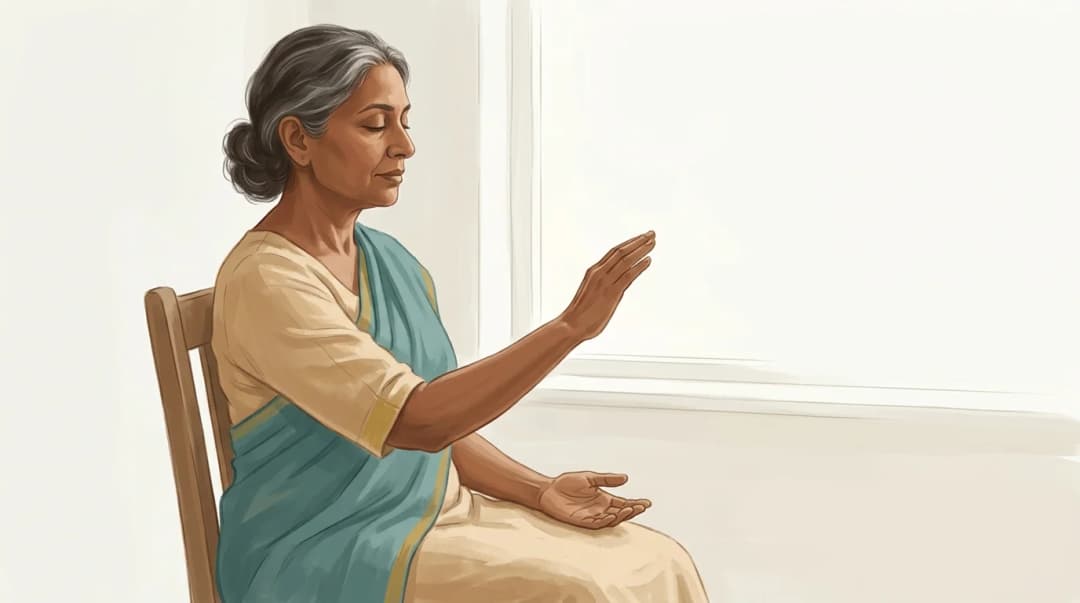
A comfortable start. Sit or lie down with as much support as you like. Let yourself arrive, knowing any movement here can be made smaller or simply imagined.
- 2
A quiet reading. Let your attention drift through your hands, knees, and ankles without changing anything. How does each one feel right now?
- 3
Slow finger curls. Let your fingers curl loosely toward your palm, then lengthen and spread, only as far as feels easy today. Rest your hands after a few rounds.
- 4
Easy ankle circles. Draw a small, slow circle with one foot, then the other, staying well within comfort. If a joint would rather not move today, picture the circle instead. Then pause and rest.
- 5
A resting breath. Sit or lie quietly and follow a few breaths in and out. There is nothing to do here, only noticing.
- 6
Closing check. Let your attention travel through the same joints one more time. What, if anything, feels different from when you began?
Let Feldy guide you, eyes closed
You just read these steps. In the Feldy program, a calm voice guides you through each gentle move, so your attention can stay in your body instead of on the screen.
Try Feldy Free for 7 daysNo credit card needed.
Living with psoriatic arthritis asks for a thoughtful relationship with movement, and gentle exercises for psoriatic arthritis are built around exactly that. Psoriatic arthritis is an autoimmune, inflammatory condition, so the management of the disease itself belongs with a rheumatologist. Alongside that medical care, slow and small movement can help keep commonly affected joints mobile and quiet some of the stiffness during the calmer stretches between flares. The usual urge to work hard and stretch deep tends to irritate sensitive joints, so a kinder path is unforced range of motion that stops well short of any strain and adjusts to whatever feels possible on a given day. The Feldenkrais Method® and related somatic practices are made for this: attentive, slow, and without any end-range pulling.
Joint and muscle conditions are widespread around the world. The World Health Organization reports that musculoskeletal conditions affect roughly 1.71 billion people worldwide (WHO, 2022). Whoever you are, if hard exercise has left a joint sore or swollen for days afterward, scaling things right down is not a defeat. It is simply the wise way to start.
Why gentle exercises for psoriatic arthritis help between flares
Because psoriatic arthritis is driven by inflammation, joints can swell, heat up, and grow tender, and a flare can arrive with little warning. Gentle movement does not act on the disease itself, and it is no substitute for the medication and monitoring your rheumatologist provides. What it can offer is comfort: a stiff joint that is invited through its comfortable range each day tends to feel a little freer and less braced than one that is left still.
A handful of simple cues follow from that. Go slowly. Keep your range small. Treat every movement as an offer to a joint to travel through the room it already has, rather than a demand for more. Pressing an inflamed joint toward its limit can leave it more tender by morning, whereas settling into a soft, comfortable range tends to feel calming.
How to pace movement and respect a flare
So much depends on pacing. Try to do noticeably less than you feel able to, then watch how the following day turns out. A flare, with its heat, swelling, and climbing pain, tells you plainly to rest a joint or stop altogether and to lean on your clinician's guidance. Save movement for the quieter days between flares, not for powering through one.
That same patient spirit runs through the Feldy program, where short lessons lead slow, easy movement and let you match the effort to how your joints feel that morning. Our Feldypedia guide to osteoarthritis and joint discomfort lays out the reasoning behind moving softly with sore joints, and the body awareness program takes that paced, attentive approach a good deal further.
How to start very small
The lesson above keeps things small on purpose, and none of its movements wander past easy comfort. Do even less if that is what the day asks. There is no quota to hit and nothing to force your way through. Finishing after a single movement is still a complete session, and with psoriatic arthritis, opting to do less on a tender day is often the smarter choice. If a joint is hot or swollen, leave it be and let it rest.
When you would like a few more gentle options to lean on, our low impact exercises for arthritis share the same slow, joint-kind feel and flex just as readily to whatever you have in you that day.
A note on care
Treat all of this as supportive self-care, never as a cure. Psoriatic arthritis deserves a rheumatologist who knows your history and can manage the condition with you, and any new movement is worth checking with your care team first, especially if you take medication or live with other conditions too. Keep away from pain, never drive a joint into strain, rest while a flare is active, and let your body, rather than a target, set the pace.
Common Questions about exercises for psoriatic arthritis (FAQ)
Is exercise safe with psoriatic arthritis?
Gentle, well-within-comfort movement is widely considered helpful for keeping joints mobile and easing stiffness between flares, and many people find it soothing. The key is to stay slow, keep the range small, and stop short of pain or swelling. Because psoriatic arthritis is an autoimmune condition, your rheumatologist is the right person to confirm what is safe for your particular case before you begin.
What should I do during a psoriatic arthritis flare?
During an active flare, rest is usually the kindest response, and you should follow your clinician's guidance. Heat, swelling, and rising pain in a joint are signals to do far less or pause that joint entirely. If you move at all, keep it tiny and pain-free, and stop the moment anything increases. Movement is for the calmer stretches between flares, not for pushing through one.
How often should I do these exercises?
Brief and regular usually treats stiff joints more kindly than one long push. A few quiet minutes on most days, sized to whatever energy you have, tends to suit you better than overdoing it when you feel good and regretting it the next morning. Let your own rhythm and your rheumatologist's advice guide you instead of a set timetable, and skip the days a flare asks you to rest.
How is gentle movement different from intense exercise for psoriatic arthritis?
Intense or end-range work can irritate inflamed, sensitive joints and tip a calm day toward a flare. Gentle movement stays slow, small, and well shy of any strain, inviting a joint to move through comfortable range rather than forcing it. The goal is comfort and easy mobility, not effort or burn, so you finish feeling settled rather than sore.
Can these exercises cure or treat my psoriatic arthritis?
No. Psoriatic arthritis is an autoimmune, inflammatory condition, and gentle movement neither treats nor cures it. Many people find it a helpful form of supportive self-care that keeps joints mobile and eases stiffness, yet the management of the disease itself belongs with a rheumatologist who can shape a full medical plan with you.
When should I see a professional about psoriatic arthritis?
Psoriatic arthritis is best managed with a rheumatologist, so see one for diagnosis and ongoing care, and reach out promptly if symptoms are new, climbing, or hard to handle, if a joint is hot or swelling, or before starting any new routine. A doctor or physical therapist can also tailor movement that is safe for your situation.
Learn to listen to your body
See the programRelated resources
Flexibility vs Mobility: What's the Difference?
Flexibility vs mobility: flexibility is how far a joint can be moved, mobility is how well you can control that range yourself. Here is the difference and which to focus on.
Signs of Tight Hamstrings, and What Tightness Actually Means
Most of the signs people look for tell you how far your leg goes, not why it stops there. The difference changes what is worth doing about it.
Your balance got better, but did your sense of where your body is get better too
Ready to start moving better?
Gentle, guided lessons for your body. Try your first one free, no credit card required.