

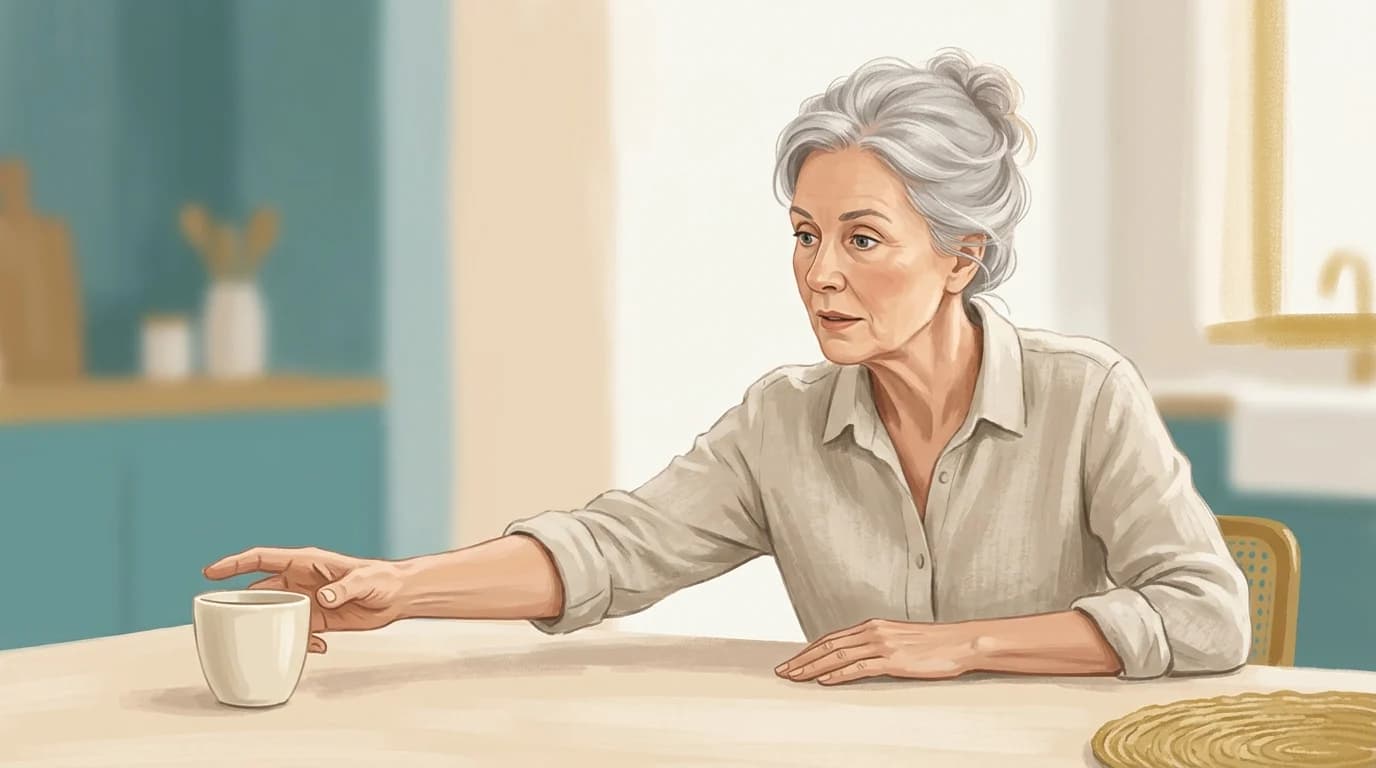
The part of you that learns new movement may not be aging the way you think
Two preregistered experiments compared young and older adults on the same reaching task. The age difference turned up somewhere most people would not expect.
A paper landed in GeroScience this week with a title that does most of the arguing for it. "Mistakes matter, age doesn't." A team across KU Leuven and the University of São Paulo asked whether an older nervous system responds differently to a movement that misses its target. Across two preregistered experiments, the answer was no. The more interesting part is where the difference between younger and older participants did show up.
The starting point is a finding motor learning researchers have leaned on for years. Implicit adaptation, the automatic recalibration your arm makes when what you see fails to match what you predicted, holds up remarkably well with age (GeroScience, 2026). You reach, the result lands slightly off from what your brain expected, and the next reach quietly corrects itself. None of that asks you to notice, decide, or try harder. Because that machinery stays largely intact in later life, the researchers could use it as a stable base for a sharper question. Does the outcome of an attempt, hitting the target or missing it, drive that automatic correction harder in older adults than in younger ones?
There was good reason to think it might. In studies of learning driven by reward, older adults have been shown to react more strongly to a miss than to a hit. If that asymmetry carried across into movement, it would mean an older body was being pushed around more forcefully by its own failures. So alongside the reaching experiments the team added a motor task where the only feedback was whether an attempt counted as a hit or a miss, and a decision task in the cognitive domain built around reward. In the cognitive task, the effects of age appeared much as the earlier literature predicted. In the movement tasks they did not. There was no consistent effect of age on how a missed target shaped the direction of the next reach, or on the amount of adaptation that followed. The authors call the pattern domain specific. Whatever shifts with age in how outcomes get weighed, it does not appear to shift the same way for movement (GeroScience, 2026).
What this changes in a session
I am a Feldenkrais® practitioner rather than a physiotherapist, so read this as a translation rather than a treatment plan. What strikes me is that it draws a clean line between two routes into a new movement pattern, and tells us which one ages better.
The explicit route runs through instruction. You give someone a correction, they hold it in mind, they judge their own performance against it, and they stay with the plan because the results feel worth it. The implicit route runs underneath all of that. The body senses a mismatch between what it expected and what happened, and recalibrates without asking permission. This study suggests the implicit route is the one that stays steady across the decades, while the machinery that weighs outcomes and rewards is where age leaves its mark.
That has a practical edge for anyone sending an older adult home with movement to practise. Homework that depends on remembering a cue, assessing your own form, and staying motivated by visible progress leans heavily on the channel that does change with age. Homework that simply puts the body in a position where it can feel the difference between one attempt and the next leans on the channel that appears not to.
What I see in the people I work with fits that shape. Someone arrives at sixty five or seventy assuming they are past the point of learning a new way to move. Almost always, the learning itself is fine. What has worn away is the willingness to make the attempt at all, usually after a few years in which movement mostly delivered soreness or worry. You have not lost the movement. You have lost trust that movement will help. This paper is a quiet argument that the underlying equipment is still there waiting.
The part I would not overstate
This was healthy volunteers doing laboratory reaching, not people managing pain, and not a clinical outcome anyone would feel in their week. A null result on an interaction is also not proof that no difference exists anywhere. And a mistake in this setting means a cursor missing a target on a screen, which carries none of the weight a real misstep carries for a person who has started to worry about falling. The fear that surrounds an error, rather than the error itself, is often what decides whether an older adult attempts something again. That variable was not in this study, and it is frequently the one that matters most in a room.
None of this competes with clinical care. It sits alongside what a physiotherapist gives you, and it may help explain why the between session part of their plan sticks for some people and quietly evaporates for others.
Awareness Through Movement® lessons happen to run almost entirely through the implicit channel. Small movements, done slowly, repeated with variation, your attention on the difference between one repetition and the next. No target to miss, no score to keep, nothing to be graded on. You only go where it feels easy, pleasant, and comfortable. That is doing less in order to gain more, and it is not a stylistic preference so much as a way of feeding the learning system what this research suggests it can still use. If you would rather feel what that channel asks than read about it, these 10 Feldenkrais exercises are a fair place to begin, and none of them involves hitting a target.
If you have quietly concluded that your capacity to learn movement declined with age, the evidence keeps pointing elsewhere. The daily rituals inside the Feldy online movement program are built for that kind of practice, brief and undemanding enough that you can return to them without deciding whether they are working yet. Which, given what this study found, is probably the point.
Let Feldy guide you, eyes closed
A calm voice walks you through gentle moves so your attention stays in your body, not on the screen.
Try Feldy Free for 7 daysNo credit card needed.
Sources
Movement Pulse is informational, not medical advice. See our editorial policy.
Move better with Feldy
See the programMovement Pulse Weekly
The week's best research, in your inbox Tuesday.
Movement science, gentle-practice ideas, and a practitioner's read on what's new. Free.
More from Movement Pulse
The body awareness that fades with age is not the body awareness that predicts function
Four studies across eleven years have quietly taken apart the idea that interoception is one ability sliding down one curve.
Aug 22, 2026
Why gentle practice is what your body keeps
A July 2026 trial found that pain during practice cut how much of a new movement people still had a day later. Comfortable practice is what settles overnight.
Jul 19, 2026
The science of learning to move, split in two
A new Nature Human Behaviour paper says the study of how we learn to move split into lab and life, and makes the case for putting it back together.
Jul 8, 2026Ready to start moving better?
Gentle, guided lessons for your body. Try your first one free, no credit card required.