
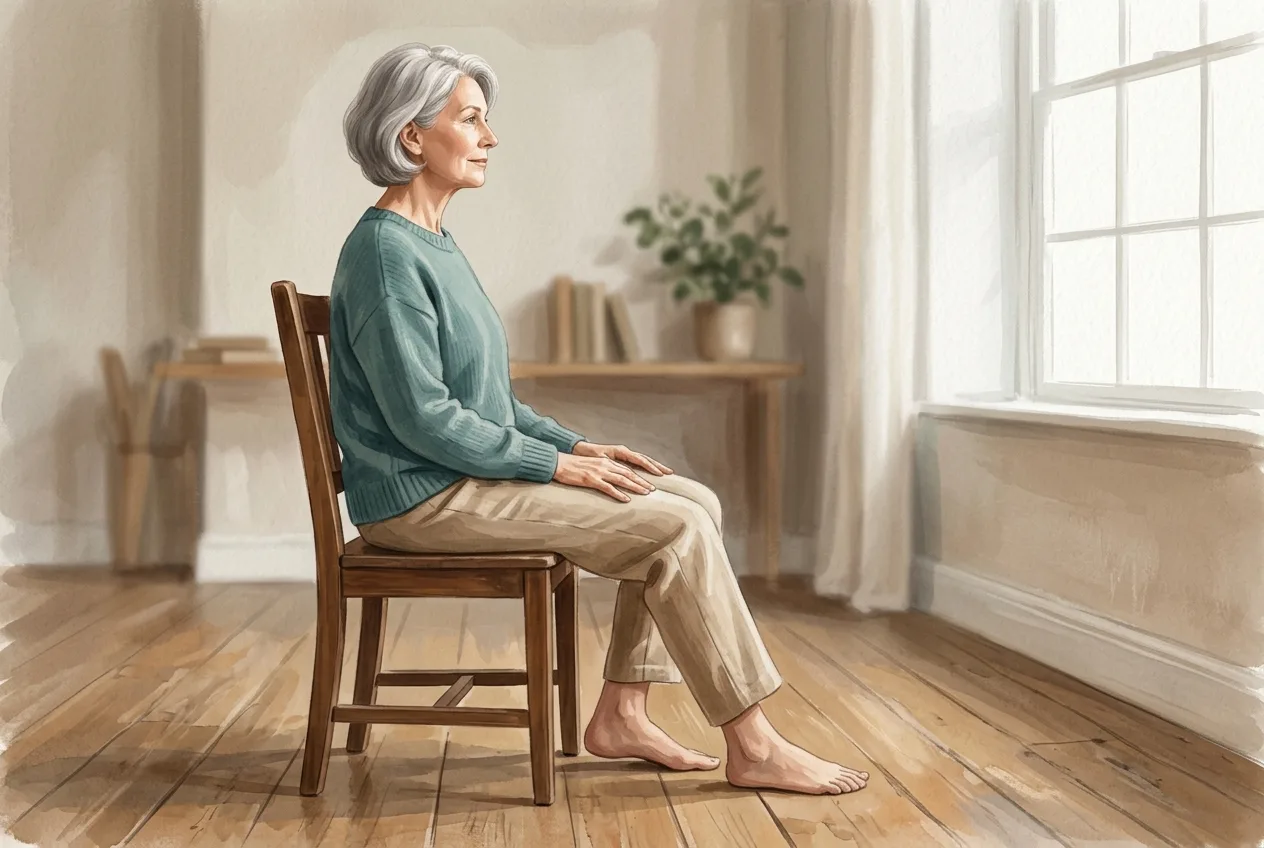
Hypermobility Knee Exercises: Steady in the Easy Middle
Gentle hypermobility knee exercises for calmer, steadier knees: a short seated lesson in easy control, with nothing locked back and nothing stretched.
Before you begin. This page offers gentle self care, not medical advice. With hypermobile knees the aim is steady control in an easy middle range, never locking the knee back into hyperextension and never stretching for more range. If your knees give way, feel unstable often, or you suspect a connective tissue condition such as Ehlers-Danlos syndrome, please work with a doctor or physiotherapist before trying these movements.
The lesson
About 5 to 10 minutes. Move slowly, do less than you can, and stay well below any pain. Rest whenever you need to.
Prefer to listen than read?
Feldy voices gentle lessons like this for hypermobility, so you can close your eyes and follow along.
- 1
Feet on the floor. Sit toward the front of a firm chair, both feet flat. Where does the weight fall through each foot?
- 2
One foot sliding forward. Slide your right foot slowly forward along the floor, so the knee travels toward straight. Stop well before it would lock.
- 3
Back again. Glide the foot back under the knee, small and smooth. Notice what the thigh does on the way. A few times, then rest.
- 4
A pause. Let both feet rest flat and breathe easily. Does the right knee feel any different from the left?
- 5
The other knee. Now slide your left foot forward and back the same way, unhurried. Smaller, or only imagined, if the knee feels unsure. Then rest.
- 6
Both feet, lighter. Please slide each foot forward and back once more, lighter than before. How little effort does the sliding need? Then rest.
- 7
A quiet comparison. Sit still and notice both knees resting under you. Compared with when you began, what, if anything, feels different?
Let Feldy guide you, eyes closed
You just read these steps. In the Feldy program, a calm voice guides you through each gentle move, so your attention can stay in your body instead of on the screen.
Try Feldy Free for 7 daysNo credit card needed.
If your knees bend back further than most knees do and never quite feel dependable, the most helpful hypermobility knee exercises are quieter than you might expect. The short lesson above asks for no stretching at all. Instead, it invites your knees to spend a few unhurried minutes in their easy middle. That is the soft, slightly bent place where nothing is locked and nothing is strained. Spend time there and steadiness has a chance to become familiar. The lesson draws on the Feldenkrais Method®, a way of learning through slow, attentive movement. It takes five to ten minutes in a chair, with an optional minute of supported standing near a counter.
Bendy knees have plenty of company. When researchers screened a large group of university students against a strict Beighton cutoff, the standard scoring test for joint hypermobility, about 12.5 percent met the threshold for generalized joint hypermobility (PeerJ, 2019), and for many of those people the knees are among the joints that drift past a typical range. If that sounds like you, our guide to hypermobile knees explores the pattern in more depth, and our Feldypedia entry on hypermobility and joint instability sketches the wider picture.
Why hypermobility knee exercises lean on control, not stretch
A hypermobile knee already travels past the point where most knees pause, so range is rarely what is missing. What often goes quiet instead is the sense of the territory in between. Standing with the knee pushed all the way back can feel restful, because the joint hangs on its own structure and the muscles get to switch off, and over years that resting place can become the only one the knee really knows.
The lesson above turns that habit into a gentle question. Each slow slide of the foot, and each pause in the soft middle, gives your nervous system another chance to feel the difference between hanging at the very end of range and resting somewhere supported. Nothing is forced and nothing is held. In Feldenkrais® work, this kind of easy, curious repetition is how a new option becomes available, not through willpower but through familiarity. Gym strengthening approaches the same knee from another direction, loading muscle to build capacity, and the two mechanisms are simply different: many people happily let them share a week.
What to notice during these hypermobility knee exercises
The interesting part is never how far your foot slides. It is how the journey feels. You might notice whether the knee travels evenly or in small jumps, whether one side glides more smoothly than the other, or how the weight shifts through your heel and toes as the leg lengthens. The moment just before the knee would settle into its locked position is especially worth savoring: slowing down there, and choosing to pause, is the heart of the whole lesson. Feldenkrais® lessons treat these small observations as the actual substance of the practice, and if you are curious about where that idea comes from, our entry on the Feldenkrais Method tells the story. If you would like more of these slow slides, a free week of Feldy lets your knees get used to resting in that supported middle.
Before you begin
Please keep everything comfortably below any pain, and well short of the locked position, since with hypermobile knees the last few degrees are exactly the territory we are choosing to leave alone. Smaller is genuinely better here. If a knee has been buckling, catching, or swelling, if there has been a recent injury, or if a connective tissue condition such as hypermobile Ehlers-Danlos syndrome is a possibility, please begin with a doctor or physiotherapist and treat this page as something that sits alongside their care rather than replacing it.
If this quiet way of moving suits you, the Feldy program for hypermobility continues in the same spirit, with short guided audio lessons that stay small, slow, and far from any end of range. And when your whole body wants the same attention your knees just received, our gentle exercises for hypermobility carry the identical contained feel across other joints.
Common Questions about hypermobility knee exercises (FAQ)
Are these movements safe for hypermobile knees, and who might skip them?
The lesson is seated, slow, and stays well away from the locked position, which suits most bendy knees. Even so, it is not the first step for everyone. If your kneecap has dislocated, if the knee buckles underneath you, if there is swelling or a recent injury, or if a connective tissue condition such as hypermobile Ehlers-Danlos syndrome is suspected, meet with a doctor or physiotherapist first and let this lesson sit alongside their guidance. If any moment of a movement feels sharp or unsteady, make it smaller or leave it out entirely.
Is stretching a good idea for hypermobile knees?
Extra length is the one thing a hypermobile knee already has in abundance. The hamstrings and calves around a bendy knee can feel tight, yet that sensation is often the body working hard around a very mobile joint rather than genuine shortness. Chasing more range tends to add wobble where you least want it, so most people with hypermobile knees find their practice time better spent on slow, contained movement through the middle of the range. If a muscle truly asks for lengthening, keep it mild and brief, far from the knee's end position.
How often is it worth practising these hypermobility knee exercises?
A few quiet minutes on most days does more than one long session a week. Because the lesson asks so little, it can happen at a desk, while a kettle heats, or as part of winding down in the evening. Familiarity is the whole idea: the more often your knees visit their easy middle, the more ordinary that place becomes, and steadiness grows out of ordinariness rather than out of effort.
How long until my knees feel steadier?
Some people notice a small shift within the first sitting, often a clearer sense of where the knee is or a softer landing of the foot on the floor. A more dependable feeling in standing and walking usually arrives over weeks of easy repetition. Hypermobility itself is a lasting trait, so think of this as gradually teaching your knees a comfortable habit rather than waiting for one dramatic turning point.
How is this different from strengthening work at the gym?
Gym strengthening loads the muscles around the knee so they can produce more force, and for many hypermobile people that capacity is genuinely useful. This lesson works through a different mechanism: attention. It refines your sense of where the knee is and how it moves, which is information that any strength eventually relies on. Neither approach replaces the other, and plenty of people pair a gentle awareness practice like this one with resistance training guided by a professional.
Which knee symptoms are worth a professional's opinion?
Please reach out if a knee gives way, catches, or dislocates, if there is swelling, night pain, or pain that keeps building, or if hypermobility shows up across many joints together with fatigue or easy bruising, which can point toward a condition such as hypermobile Ehlers-Danlos syndrome. A doctor or physiotherapist who knows hypermobile bodies can assess your knees properly, and everything on this page is meant to sit alongside that kind of care, never to stand in for it.
Stability without gripping
See the programRelated resources
Yoga and Hypermobility: A Gentler Way to Practise
Yoga and hypermobility can fit together, but a bendy body needs control inside an easy range, not deeper poses. Here is how to practise kindly.
Hypermobility Hip Exercises: Quiet Control for Loose Hips
Gentle hypermobility hip exercises done lying on your back: tiny knee sways, short foot slides, and small circles that let loose hips find quiet, easy control.
Getting out of breath may be the hypermobility symptom that quietly shrinks your day
Ready to start moving better?
Gentle, guided lessons for your body. Try your first one free, no credit card required.