

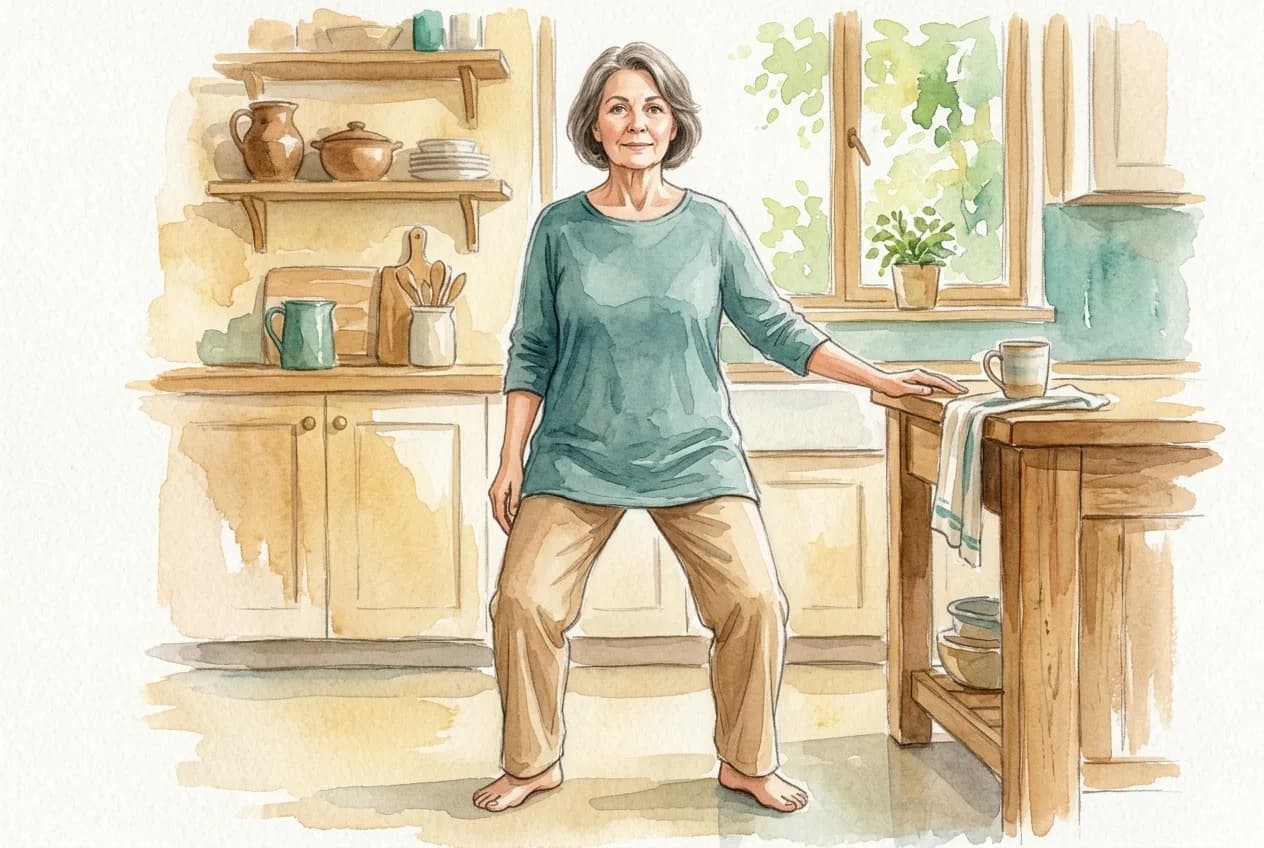
Knee Proprioception Exercises: Gentle Sense and Control
Knee proprioception exercises use slow weight shifts and small controlled mini-bends to sharpen your knee's sense of where it is, for steadier, more confident standing and walking.
Before you begin. This is gentle self-care, not medical advice. If your knee is swollen, gives way, locks, or is painful after an injury, see a doctor or physical therapist first. Practice near a sturdy support and stop if anything sharpens.
The lesson
About 5-10 minutes. Move slowly, do less than you can, and stay well below any pain. Rest whenever you need to.
Prefer to listen than read?
Feldy voices gentle lessons like this for knees and hips, so you can close your eyes and follow along.
- 1
Standing and listening. Stand near a counter with a hand resting lightly on it. How does each knee feel carrying you right now, and is your weight even between the legs?
- 2
Weight traveling sideways. With both feet on the floor, let your weight drift slowly from one leg to the other and back. Notice the supporting knee receiving the load, then pause and rest.
- 3
The smallest bend. Bend both knees a tiny amount and slowly straighten, moving slowly enough that you could stop anywhere along the way. A few soft rounds, then rest by your support.
- 4
A standing pause. Be still for a few breaths with your hand near the counter. What are the knees doing to keep you quiet and upright?
- 5
Weight drifting forward and back. Ease your weight gently toward the balls of your feet and back toward your heels, small and unhurried. Make it smaller or imagine it if a knee objects, then rest.
- 6
Sensing with eyes closed. If it feels comfortable, keep a hand on your support and let your eyes close while your weight drifts a little from side to side. Open them whenever you like, then rest.
- 7
How standing feels now. Stand easily with both feet down. What, if anything, feels different about how your knees hold you compared with when you began?
Let Feldy guide you, eyes closed
You just read these steps. In the Feldy program, a calm voice guides you through each gentle move, so your attention can stay in your body instead of on the screen.
Try Feldy Free for 7 daysNo credit card needed.
If your knee feels unsure underfoot, or you find yourself watching the ground when you walk, knee proprioception exercises offer a gentle way to rebuild trust in the joint. Proprioception is your body's sense of where a joint sits and how it is moving, drawn from signals in the muscles, ligaments, and knee itself. When that sense is sharp, your knee quietly adjusts to keep you steady without you ever thinking about it. The Feldenkrais Method® brings an attentive, unforced spirit to this kind of work, where you sense movement rather than force it, and let comfort lead the way.
What knee proprioception is and why it matters
Every step you take asks your knee to know where it is. As you cross a curb, turn in the kitchen, or shift your weight on an uneven path, the joint reads its own position and makes tiny corrections faster than thought. That quiet stream of information is proprioception. When it stays sharp, standing and walking feel secure. When it dulls, the same surfaces can feel unpredictable, and a knee may wobble or give a small lurch that knocks your confidence.
Position sense can fade for many reasons, among them stiffness, less varied daily movement, and arthritis. Osteoarthritis, which can dull a joint's position sense, affected about 528 million people worldwide in 2019 (WHO, 2023). The encouraging part is that proprioception responds to gentle, attentive practice. By moving slowly and noticing what the knee is doing, you give your nervous system clearer information to work with.
How knee proprioception exercises sharpen sense and control
The lesson above works through slow weight shifts and small controlled mini-bends, each one an invitation to feel the knee rather than push it. When you ease your weight from one leg to the other, the supporting knee senses the load arriving and adjusts to hold you. When you bend a tiny amount and stop exactly where you choose, you practise sensing and controlling the joint's travel. Closing your eyes for a moment of weight sensing, always near a sturdy support, asks the knee's own sense of position to do more of the work, which is precisely what sharpens it.
None of this needs effort or end-range. Small, slow, and pain-free is the whole approach. You are not testing the knee or chasing a deeper bend; you are giving it clearer information so it can keep you steady with less conscious watching.
Keeping knee proprioception exercises safe and gentle
A few simple habits keep this practice kind to your knee. Stay close to a counter, rail, or sturdy chair, with a hand resting on it for safety, especially during the eyes-closed step. Move slowly, because slowness is what lets you notice and control the joint clearly. Keep every shift and bend small, well short of any ache, and leave deep squats and end-range entirely out of it. If anything sharpens, ease off and stop.
This kind of position-sense work also tends to fade naturally as we age, which our Feldypedia note on coordination decline with age describes in fuller terms. Gentle proprioception practice is one quiet way to keep that sense awake. It is self-care, not a treatment for what may be causing knee pain, so let comfort guide every choice.
Letting proprioception and easy movement work together
Sensing and steadying the knee sits naturally alongside other gentle movement around the legs and hips. As your knee feels more sure of itself, you may find that small, comfortable movement elsewhere feels welcome too, the kind that explores easy range rather than loading it. For more in that same slow, unforced spirit, our somatic exercises for hips and these exercises for pain in the hip joint keep to the same comfortable feel.
Whatever you choose, there is no quota to meet and nothing to push through. A shift that stays small and a bend that stays comfortable are both doing their quiet work. With the knee, doing a little, slowly and attentively, is usually the wiser and steadier call.
Common Questions about knee proprioception exercises (FAQ)
What is knee proprioception?
Proprioception is your body's sense of where a joint is in space without looking, built from signals in the muscles, ligaments, and joint itself. Knee proprioception is your knee's quiet awareness of its own position and movement. It is what lets you walk on uneven ground, catch a wobble, and trust your leg to hold you, all without watching your feet.
Who benefits from knee proprioception exercises?
Many people do: those whose knees feel unsteady or unsure underfoot, anyone whose position sense has dulled with stiffness, arthritis, or simply less varied movement, and people easing back after a knee injury once a professional has cleared them. If steadier, more confident standing and walking appeals to you, gentle proprioception work is worth exploring.
How often should I practice?
A short, calm session most days tends to serve a knee better than rare long ones. Five to ten minutes of slow weight shifts and small controlled bends is plenty. Because the work is about attention rather than effort, you can fold it into daily moments, like waiting by the kitchen counter. Stop while it still feels easy.
How is this different from strengthening exercises?
Strengthening asks a muscle to work harder against load. Proprioception work asks your nervous system to sense and control position more clearly, through slow, attentive movement rather than effort. The two complement each other, but here the goal is awareness and steadiness, not building force, so everything stays gentle, small, and well within a comfortable range.
When should I check with a professional first?
Get advice from a doctor or physiotherapist before practicing if your knee is swollen, locks, gives way, or has hurt since an injury or surgery, and if pain is fresh, worsening, or these gentle movements keep aggravating it. They can find the cause and guide you toward movement that suits your particular knee.
Kinder movement for knees and hips
See the programRelated resources
Hip Stability Exercises Without Bands, Burn, or Bracing
Hip stability is mostly timing, not force. A short lesson that starts on the floor and finishes standing, so you can feel what your pelvis does the moment weight arrives.
Gluteus Medius Exercises: A Gentle Lesson for Steady Hips
Gluteus medius exercises done slowly and with attention, so the side of your hip learns to carry weight easily instead of gripping to hold you up.
The High Knee Exercise, Made Gentle: Slow Mindful Marching
A gentle take on the high knee exercise: slow, supported marching with attention, where the knee floats only as far as feels easy, no cardio required.
Ready to start moving better?
Gentle, guided lessons for your body. Try your first one free, no credit card required.