
Feldenkrais® for Neck Tension: Gentle Lessons That Help
Feldenkrais for neck tension uses slow, attentive movement to ease the holding patterns behind a stiff neck. Here is how it works, plus a short lesson to try.
The lesson
About 8-10 minutes. Move slowly, do less than you can, and stay well below any pain. Rest whenever you need to.
Prefer to listen than read?
Feldy voices gentle lessons like this for neck and upper back, so you can close your eyes and follow along.
- 1
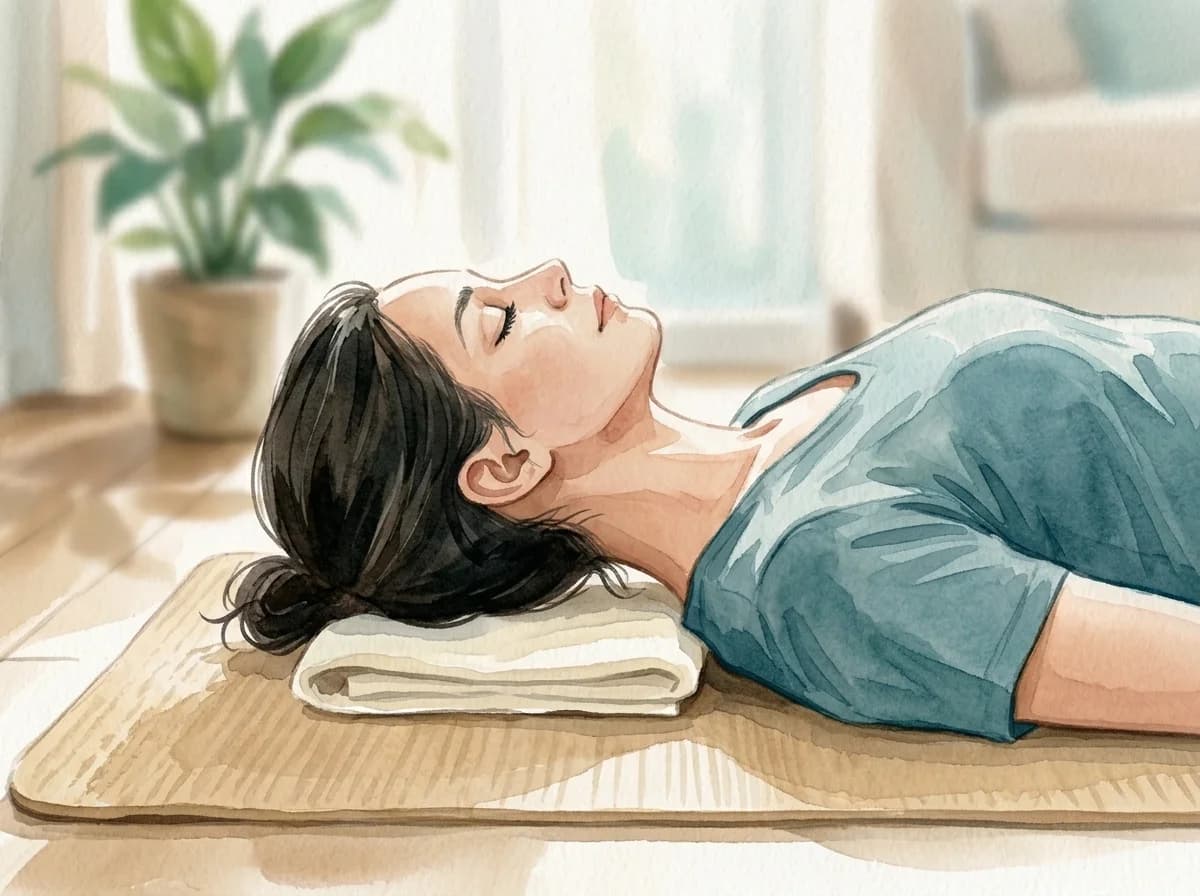
Head on the floor. Lie on your back, knees pointing up, feet on the floor, arms resting at your sides.
- 2
Working while still. Which parts of your neck seem to be working, even now? And how heavy is your head on the floor?
- 3
A tiny circle. Let the back of your head trace a tiny circle on the floor, a few times one way. So small an observer would miss it.
- 4
A heavy rest. Stop and rest. Does your head press into the floor differently than before?
- 5
The other way around. Trace the circle the other way, just as small. Imagining it entirely is welcome. Is one direction smoother?
- 6
The breath. Rest in the middle and follow a few breaths. Let the out breath take its time.
- 7
Up and noticing. Come up to standing slowly and walk around a little. What do you notice in your neck and shoulders?
Let Feldy guide you, eyes closed
You just read these steps. In the Feldy program, a calm voice guides you through each gentle move, so your attention can stay in your body instead of on the screen.
Try Feldy Free for 7 daysNo credit card needed.
Feldenkrais® for neck tension offers a different path than stretching harder if your neck feels tight by the end of the day, or you wake with a stiff neck that makes turning your head a chore. The Feldenkrais Method® works through attention and small, slow movement rather than force. Instead of trying to pull a tight muscle longer, it gives your nervous system a chance to release the habit of holding.
Neck tension is common. Roughly 60 to 80 percent of people experience neck pain at some point in life, and for many it returns again and again (GBD analysis, 2025). Part of the reason is that the neck quietly carries the weight of the head all day, often while we lean toward a screen. Over time the muscles learn to brace, and that bracing starts to feel normal.
Why neck tension builds in the first place
The head is heavy, roughly the weight of a bowling ball, and it balances on a slender stack of vertebrae. When you spend hours looking down or holding still, the small muscles at the base of the skull stay switched on. They do not get a clear signal that the task is over, so they keep working. This is a habitual pattern, not a fault. Your body found a way to manage a long day. The trouble is that the holding becomes invisible to you, which is exactly why simply telling yourself to relax rarely works.
How Feldenkrais® helps with neck tension
A Feldenkrais® lesson interrupts that loop through awareness. By moving slowly and paying attention to how a movement feels, you give the brain new information about what the neck is doing. When a movement is small and easy, the nervous system can recognize that it is safe to do less. The bracing eases because it is no longer needed, not because you forced it to.
This is the principle behind the whole Feldy program. Each lesson uses slow, guided movement to help the body find an easier option rather than chasing a stretch. You can read more about the method in our Feldypedia guide to the Feldenkrais Method, and if neck and upper back tension is your main concern, the neck and upper back program walks through it in more depth.
Before you begin
Find a quiet few minutes and a comfortable place to lie down. The goal is not to achieve anything. It is to notice. Move slowly, do less than you can, and stop to rest often. If any movement brings on pain, make it smaller or skip it. The lesson on this page is one gentle way to start, and you can return to it whenever your neck asks for a little care. If long screen hours are part of your story, our gentle forward head posture exercises pair well with this lesson, and the guide to tight shoulders and neck looks at the wider pattern the two share. Whenever you would like someone to guide your tight neck through a slow lesson like this each day, you can try Feldy free for seven days and simply follow along from the floor.
Common Questions about Feldenkrais for neck tension (FAQ)
Is the Feldenkrais Method® safe for neck tension?
It is one of the gentler movement approaches, since the movements are small, slow, and stay well below any pain. If your neck pain followed an injury or comes with numbness, dizziness, or arm symptoms, check with a healthcare professional first.
How is this different from neck stretches?
Stretching tries to lengthen a muscle by force. A Feldenkrais lesson works through attention and small movement, so the nervous system can let go of a holding pattern on its own. There is no pushing or holding a position.
How often should I practice?
A few short sessions a week is plenty to start. Many people find that a brief lesson before bed or after long hours at a screen is the most useful timing.
How soon might I notice a change?
Some people feel their neck move more freely by the end of a single lesson, while a lasting change usually builds over several weeks of gentle practice. Everyone is different.
Can I do this if my stiff neck comes and goes?
Yes, gentle movement is often well suited to a neck that is sensitive or unpredictable, because you stay in a small, comfortable range. Stop and rest any time something does not feel right.
Do I need any equipment?
No. You only need a comfortable place to lie down. A thin folded towel under your head is fine if that feels more pleasant for your neck.
Can I do Feldenkrais for neck tension sitting at my desk?
Yes, once the lying version feels familiar. Sit back in your chair so the backrest carries some of your weight, and try the tiny yes and no movements with the same slowness, making them even smaller than on the floor. A minute of this between tasks is a useful way to catch the neck before it braces for the whole afternoon. Lying down stays the easiest place to learn, because the floor carries the weight of the head for you.
A softer neck, a freer upper back
See the programRelated resources
Forward Head Posture Exercises: Gentle Movement to Try
Forward head posture exercises that use slow, attentive movement to ease the neck and invite the head to rest more lightly over the shoulders.
Tight Shoulders and Neck: Gentle Tension Relief
Tight shoulders and neck are usually a holding habit driven by stress and posture. Here is how gentle awareness eases the load, plus a short lesson to try at home.
With neck pain, the shoulder blade shift you make yourself may outlast one done for you
Ready to start moving better?
Gentle, guided lessons for your body. Try your first one free, no credit card required.