
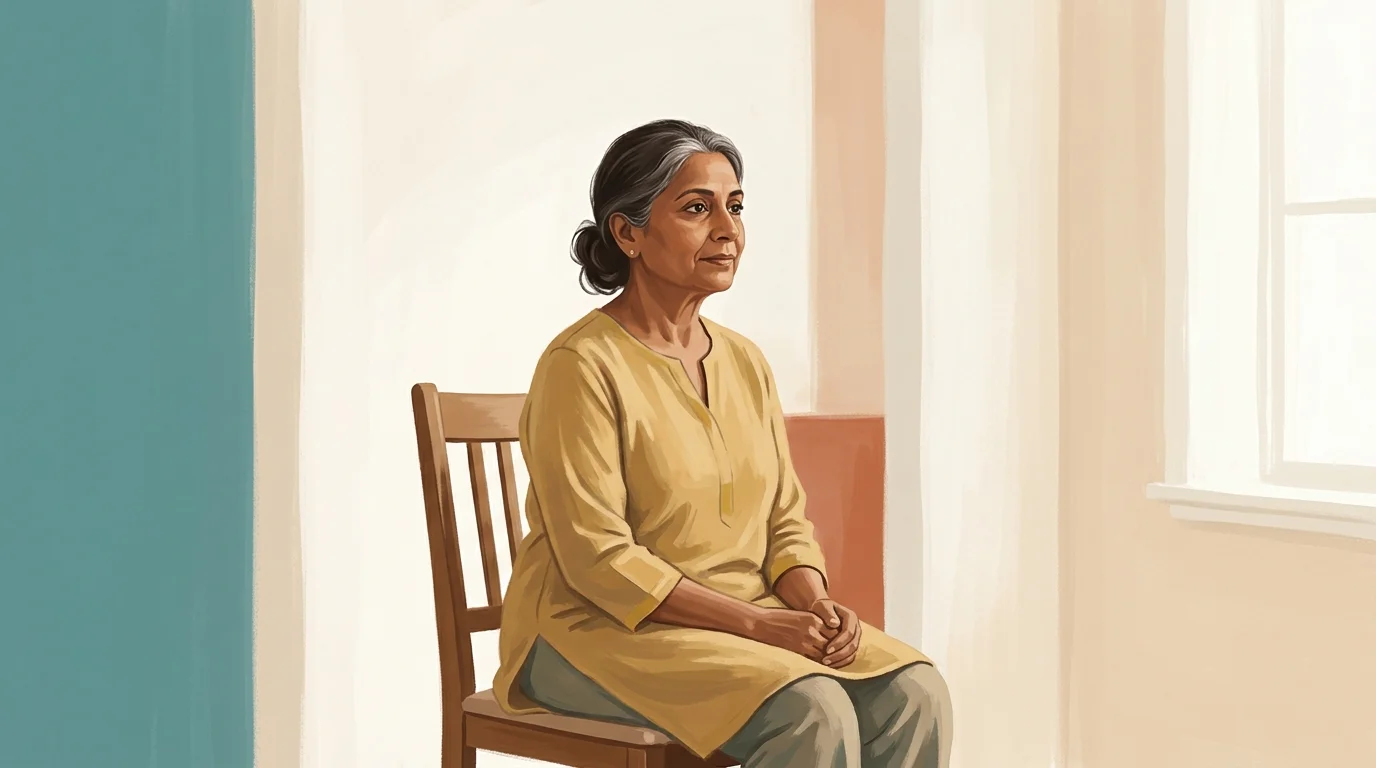
The chair slump and back pain: a sit bones experiment
A July 2026 pressure map study of 68 older adults found the more the pelvis rolled backward at rest, the more likely chronic low back pain. A short lesson to feel where you sit.
Sit any older adult in a chair long enough and you can usually see what happens next. The pelvis rolls back, the lower spine rounds, the shoulders drift forward, and the head follows. A new cross-sectional study puts a number on what happens when that slump becomes the resting shape.
What the study found
Researchers at the Chinese University of Hong Kong measured the sitting posture of 68 older adults living in long-term care facilities and published their findings on July 21 in Geriatric Nursing. Half of the residents, 50 percent, reported chronic low back pain. The team used a pressure mat under each seat to quantify how the pelvis was tilted while the person simply sat, then adjusted for age and other factors.
The result was tidy. The greater the posterior pelvic tilt, the more likely the person was to report chronic low back pain, with an adjusted odds ratio of 2.13. Pelvic obliquity, whether the pelvis was tilted more to one side than the other, showed no such association. It was the forward and backward roll of the pelvis away from vertical that tracked with the pain.
Two things about this are worth pausing on. First, this is a study of what sitting looks like at rest, not what sitting looks like when someone is trying to sit up straight. Nobody was coached, nobody was corrected. The pressure mat just recorded what the body chose when it was not being asked. Second, the association runs in one direction only. The study cannot tell us whether the slump caused the pain, whether the pain led to the slump, or whether both are downstream of something else that has been quietly shaping how a person carries themselves for years. But it does say the shape of a person's sitting pelvis is worth looking at.
What that pressure mat cannot tell you
What the study cannot tell you, and what almost no ergonomics advice tells you either, is where in your body the pelvis actually is right now. Most people cannot say, because most of us do not habitually feel the two bones under our sitting weight. We know we are sitting. We do not know how.
Here is a short experiment you can do in any chair over the next few minutes to change that.
A short practice to find your sit bones
About 5 minutes. Move slowly, do less than you can, and stay well below any pain. Rest whenever you need to.
- 1
Sit near the front edge of a firm chair, feet flat, hands on your thighs. Notice how you have arranged yourself.
- 2
Which parts of you feel heavy? Which parts feel held? Bring your attention to the bones you are sitting on.
- 3
Roll your pelvis slowly backward, so the lower back rounds. Notice where the sitting bones go. Then stop and rest.
- 4
Now roll the pelvis slowly forward, so the lower back hollows a little. What does your head do? Rest again.
- 5
Roll back and forward a few times, smaller each time. Only as far as is comfortable. Which direction is easier?
- 6
Come to rest somewhere in the middle, without trying to sit up straight. Where are the sitting bones now, compared with the start?
Let Feldy guide you, eyes closed
A calm voice walks you through gentle moves so your attention stays in your body, not on the screen.
Try Feldy Free for 7 daysNo credit card needed.
What just happened
Nothing about that lesson tried to correct anything. It was not a postural cue asking you to hold a shape for the rest of the afternoon. It was a five minute experiment in finding out where your pelvis actually sits, so that when it drifts, you notice.
That noticing is what the pressure mat in the study made visible from the outside. Every one of us can learn to feel it from the inside. The Feldenkrais Method® is built on exactly this kind of self sensing. It sits alongside physiotherapy for anyone already working on chronic low back pain from sitting with a clinician, and works in a different mechanism from yoga or Pilates, both of which are worthwhile but usually more effortful. Awareness Through Movement® is quieter.
In practice, what changes when a person begins to feel their own pelvis is not primarily the pelvis. It is the amount of time it spends at the far end of the range. The slump does not go away because you told it to. It goes away because you kept noticing where you were, and every time you noticed, the body found a slightly easier place to be. That is what the Feldenkrais approach means by learning.
What to take from this
You do not need to fix your pelvis today. You need to know where it is. Try the experiment above once, and then, once or twice more this week, notice where your sitting bones are when you next sit down at your desk, at dinner, in the car. Where has the weight arrived? What is the head doing?
That noticing is the beginning of a different relationship with your chair. It is also the point where, for most people, the amount of time they spend slumped begins to quietly decrease, without anyone asking them to sit up straight.
Sources
Movement Pulse is informational, not medical advice. See our editorial policy.
Move better with Feldy
See the programMovement Pulse Weekly
The week's best research, in your inbox Tuesday.
Movement science, gentle-practice ideas, and a practitioner's read on what's new. Free.
More from Movement Pulse
With neck pain, the shoulder blade shift you make yourself may outlast one done for you
A physiotherapist's hands and people's own movement both eased neck pain at first, but in a trial of 78 people only the self made change still showed half an hour later.
Oct 13, 2026
The same pose held two ways looked identical, but the heart could tell them apart
Eight experienced yoga teachers held warrior pose twice: once with everything working, once letting go of what the pose did not need. The shape stayed the same. The heartbeat did not.
Oct 6, 2026
Why neck pain trials keep working on the mid back, and what the pain score misses
Fifty four people, six weeks, and a result that keeps repeating in this literature. The mid back work did not beat neck work on pain, and beat it on almost everything else.
Sep 12, 2026Ready to start moving better?
Gentle, guided lessons for your body. Try your first one free, no credit card required.