

How to Get Up Off the Floor With Bad Knees, Safely
How to get up off the floor with bad knees using a safe, gentle technique that protects the joints, leans on sturdy support, and shares the effort across your body.
In short
To get up off the floor with bad knees, roll onto your side, press up onto your hands and knees, bring one foot flat to the floor, then push up through that leg using a sturdy chair or wall for support. Move slowly, lead with the stronger leg, and share the effort across your arms and hips so the sore knees carry less.

Prefer to ease in gently?
See a few gentle exercises for knees and hips to try.
Before you begin. This is general movement guidance, not medical advice. Use a sturdy chair, sofa, or wall that will not move, and clear the space around you first. If you cannot get up safely on your own, if you have fallen and may be hurt, or if you feel faint, stay where you are and call for help. Check with a doctor or physical therapist if standing up is consistently hard, painful, or unsteady.
If kneeling, sitting, or playing on the floor has become something you avoid because rising again feels daunting, you are not alone, and learning how to get up off the floor with bad knees is a skill you can practice. The aim is not to power up through aching joints but to break the movement into small, shared steps so your arms, hips, and stronger leg do most of the lifting. With sturdy support and a slow pace, sore knees can carry far less of the load. This gentle, attentive way of moving sits at the heart of the Feldenkrais Method®, which helps the whole body cooperate rather than asking one tired part to do everything.
Getting down to and up from the floor matters more as the years pass, partly because confidence on the ground is tied to confidence on your feet. In the United States, about 1 in 4 adults aged 65 and over report falling each year (CDC, 2021). Knowing a safe, repeatable way back to standing is one quiet way to keep the floor a friendly place rather than something to fear.
What makes it hard to get up off the floor with bad knees
Standing up from the floor is one of the most demanding everyday movements we ask of our bodies. It needs strength, balance, and a fair bend in the knees and hips, all at once. When the knees are sore, the instinct is to protect them, which often means trying to rise in one big heave or avoiding the floor entirely. Both responses make the movement feel harder over time.
The kinder approach turns one large effort into several small ones. Rolling, coming onto all fours, and rising through a half-kneel each ask only a little, and each lets a different part of you help. Spread across your arms, your hips, and your stronger leg, the work that lands on any single sore knee drops considerably. For more on why knees stiffen and feel less willing with age, our Feldypedia page on knee stiffness after 60 gives the bigger picture.
Step by step: from the floor to standing
- Roll onto your side. From lying on your back, bend your knees and roll gently to one side, letting your head and shoulders follow. Rest there for a breath.
- Press up to your hands and knees. Use your top arm to push the floor away and come onto all fours, taking your time.
- Move toward your support. Crawl the short distance to a sturdy chair, sofa, or wall so your hands can reach it easily.
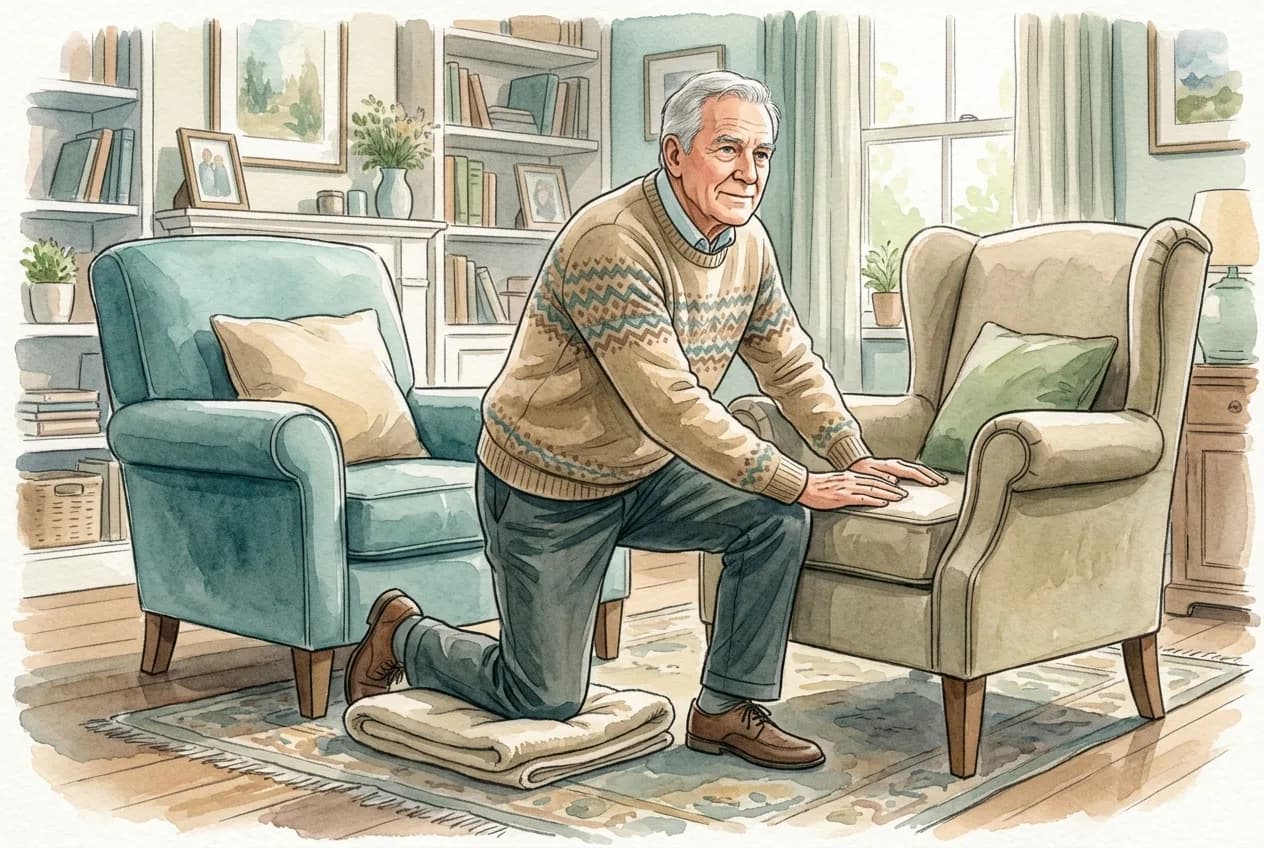
- Come to a half kneel. Bring the foot of your stronger leg flat to the floor in front of you, so one knee is down and one foot is standing. A folded towel under the down knee makes this kinder.
- Push up through the standing leg. Lean your hands into the support and let your arms and stronger leg do the lifting as you rise slowly.
- Pause once you are up. Keep a hand on the support for a few breaths and let your balance settle before you walk away.
A safe, gentle technique that protects the knees
You always have a sturdy chair, sofa, or wall within reach, and you let your hands lean into it so your arms take a genuine share of the lift. You cushion the kneeling knee, you lead with the leg that feels stronger, and you move slowly enough that you can stop at any point without losing your balance.
Notice that nothing asks a painful knee to bend deeply under full weight. The half-kneel keeps one foot flat so that leg and your arms do the pressing, while the down knee mostly steadies you. That distribution is the whole point. You are not toughing it out through the joint that hurts; you are arranging your body so the willing parts carry it.
Practice while you are calm, not when you are stuck
Before the day you need it, it helps to make the floor feel friendly again. Rehearse the steps above near your sturdy support while you are calm and unhurried, treating them as exploration rather than exercise. The more familiar each small step feels, the steadier the whole rise becomes when it counts.
This patient, comfort-first way of moving runs through every lesson in the Feldy program. If unsteadiness or a wariness of the floor is part of the picture, our Feldypedia page on balance, instability, and fear of falling is a helpful companion, and for the wider approach to easier hips, our guide on how to realign hips gently explores the same theme. You can also see the full program for knee or hip pain if you would like a guided path.
A note on care
Hold all of this as gentle, general guidance rather than a cure or a treatment. Always use support that will not move, clear the space around you, and never keep struggling if a rise does not feel safe. If you have fallen and may be hurt, if you feel faint, or if you simply cannot get up on your own, stay where you are and call for help. And if standing up is regularly painful, hard, or unsteady, please ask a doctor or physical therapist to assess your strength, balance, and joints so your plan fits your situation.
Kinder movement for knees and hips
Understanding the strain is half of it. The Feldy program helps knees and hips carry less of it by reorganising how the whole body moves, through Feldenkrais® lessons. Gentle, guided, and self-paced.
Start my free 7-day trialNo credit card needed.
Common Questions about how to get up off the floor with bad knees (FAQ)
What is the safest way to get up off the floor with bad knees?
Roll onto your side, press up onto your hands and knees, bring one foot flat to the floor in a half-kneel, then push up through that leg while your hands rest on a sturdy chair or wall. The key is to share the effort across your arms, hips, and stronger leg so the sore knees carry less, and to move slowly with solid support the whole way.
Is it safe to do this on my own?
For many people with sore but stable knees, yes, as long as you have firm support that will not move and a clear space around you. If you feel faint, if you have fallen and may be injured, or if you simply cannot rise safely, do not keep struggling. Stay where you are and call for help. Practicing first with someone nearby is a sensible way to build confidence.
How can I protect my knees while getting up?
Cushion the kneeling knee with a folded towel, lead the push with your stronger leg, and let your arms and a sturdy support take a real share of the work. Keeping the movements slow and avoiding any deep, forced bend in a painful knee also helps. The goal is to spread the load, not to grind through one joint.
How often should I practice this?
A few unhurried repetitions a few times a week is plenty, ideally when you are not tired and have support nearby. Practicing the steps while you feel steady builds the pattern so it is there when you need it. Stop for the day if your knees feel more sore rather than more confident.
How is this different from just hauling myself up?
Hauling yourself straight up tends to load the knees all at once and often relies on a single big effort, which can strain a sore joint or leave you off balance. This approach breaks the rise into small, shared steps so your arms, hips, and stronger leg do most of the lifting. It is slower on purpose, and usually steadier and kinder.
When should I see a professional?
Check with a doctor or physical therapist if getting up is consistently hard, painful, or unsteady, if your knees give way, or if you have had a fall. They can look at strength, balance, and joint health, and tailor a safe plan for you. Gentle movement supports that care; it does not replace a proper assessment.
Kinder movement for knees and hips
See the programRelated resources
The High Knee Exercise, Made Gentle: Slow Mindful Marching
A gentle take on the high knee exercise: slow, supported marching with attention, where the knee floats only as far as feels easy, no cardio required.
Top of Knee Pain: What the Pattern Tells You and What Helps
Pain across the top of the knee, just above the kneecap, usually says more about how the leg is being loaded than about the knee itself.
Aching Knees During Pregnancy: Why They Hurt and What May Help
Extra weight, a shifting posture, and looser ligaments all ask more of your knees. Gentle, optional ideas to discuss with your midwife or doctor.
Ready to start moving better?
Gentle, guided lessons for your body. Try your first one free, no credit card required.