
Alexander Technique Constructive Rest: How It Is Done
A plain guide to constructive rest, the lying down pause taught in the Alexander Technique, with a Feldenkrais® practitioner's view of how it compares.
In short
Alexander Technique constructive rest is a lying down pause: you rest on your back, knees bent, feet flat, with a few books under your head, usually for 10 to 20 minutes. The aim is not to exercise. It is to stop doing, pay quiet attention and let the body settle.

Prefer to ease in gently?
See a few gentle exercises for stress and sleep to try.
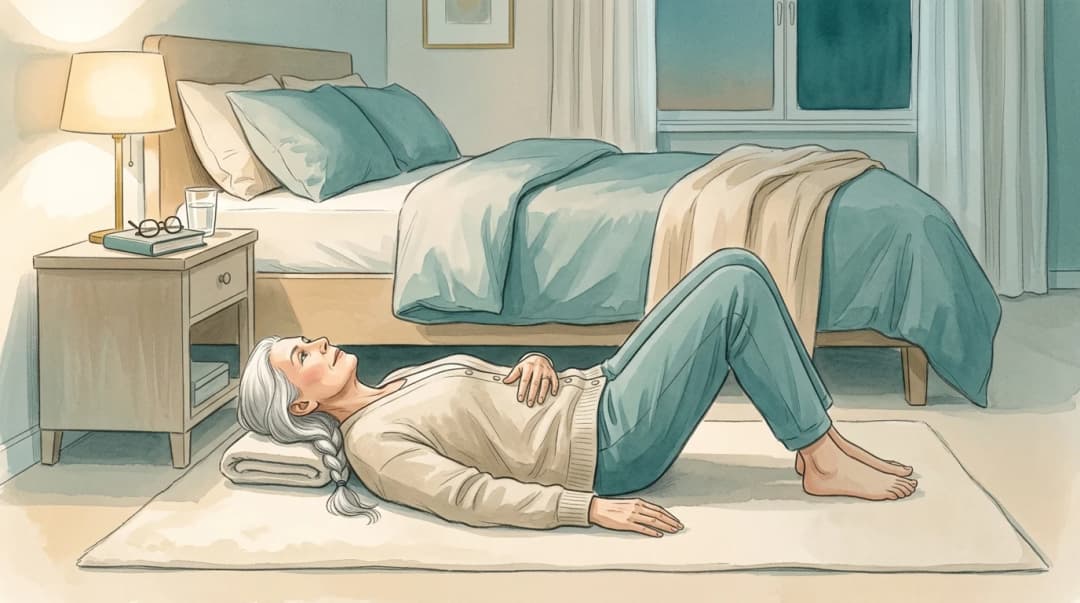
Alexander Technique constructive rest is a simple practice: you lie on your back, bend your knees, and let your body be supported by the floor. Teachers often call this position semi supine, which means half lying on your back. You do nothing in particular. You pause, notice your breathing and let the floor hold your weight. Many people look for this kind of pause because stress and busy days leave little room to stop. The World Health Organization reports that an anxiety disorder affected roughly 470 million people in 2023, close to 6% of the global population (WHO, 2026). Constructive rest is not a treatment for that. It is a quiet, free way to take a break.
What Alexander Technique constructive rest is
The Alexander Technique is a method that teaches people to notice and reduce unneeded effort in everyday activity. You can read the background in our Feldypedia article on the Alexander Technique.
Constructive rest is the lying down part of that teaching. It is not an exercise. There is no count, no stretch and no target. Teachers describe it as a time for giving attention and letting go of the urge to fix yourself.
That can feel strange at first. Most of us are used to trying. Here the invitation is to stop trying, and see what your body does on its own.
How to do constructive rest, step by step
Teachers vary in their details. This is the usual shape.
- Find a firm, quiet spot. A rug or a mat on the floor works well. A bare floor is fine too.
- Add support under your head. A few paperback books are common. The stack should lift your head just enough that your chin is not tipped up or back.
- Lie on your back. Bend your knees so they point toward the ceiling. Place your feet flat on the floor, about as far apart as your hips.
- Rest your hands. Place them on your belly, or let them lie on the floor beside you.
- Pause and notice. Feel where your body meets the floor. Let your breath move as it likes.
- Stay for about 10 to 20 minutes. Teachers often suggest this range. Shorter is fine, especially at first.
Alexander Technique teachers also speak of "directions." These are quiet thoughts, such as wishing the neck to be free. You do not push them into your body. You offer them and wait.
If the books feel too high or too low, change the stack until your head feels easy. Lying flat is not comfortable for everyone. If it bothers you, use a propped position that suits your body, and ask a professional if you are unsure.
Why people find constructive rest calming
There is no big claim to make here. Lying down gives your muscles a break from holding you upright. Bent knees let the legs rest without effort. The books keep the head from tipping back.
Giving attention to your breathing and your contact with the floor is also a gentle way to slow down. Many people find that this feels calming. That is a personal experience, not a guarantee, and it will not look the same for everyone.
If this interests you, our chronic stress and muscle tension article explains why a tense body and a busy mind often travel together.
A Feldenkrais® view of lying on your back
I am a Guild Certified Feldenkrais Practitioner. Many Feldenkrais Method® lessons also begin lying on the back. We often start with a body scan, which means slowly noticing how each part of you rests on the floor.
Then the paths split. In a Feldenkrais lesson, we add small, slow, exploratory movements. You might tip your pelvis a little, or turn your head a few degrees, and notice how the whole body takes part. The focus is on discovering new options through movement.
In Alexander Technique constructive rest, the emphasis is different. Teachers speak of inhibition, which means pausing before you act, and of giving directions. You mostly stay still. The learning comes from not doing.
Neither is better. They are two different doors into attention and ease. If you are curious about the larger picture, see our comparison of Feldenkrais vs Alexander Technique, or our wider guide to Alexander Technique exercises.
Bringing constructive rest into your day
You do not need a special occasion. A few minutes after work or before dinner is enough. Some people use it as a pause between tasks. Others like it just before bed.
Keep it light. If your mind wanders, that is allowed. If you feel restless, notice that too. Rest is a skill, and it grows slowly.
If your wish is better sleep, you might also enjoy gentle lying down lessons. Our somatic exercises for sleep page offers one. To explore the Feldenkrais way with a voice guiding you, Feldy has a free 7 day trial, and our stress and sleep page has more.
When to see a professional
Constructive rest is gentle, but it does not replace care. Talk to a doctor if you have ongoing stress, trouble sleeping, or pain that lasts. Also ask first if lying flat causes shortness of breath, reflux or pain. A teacher or clinician can suggest a position that works for you.
Find where to start
Bodies and days differ a lot. Unsure whether stillness or gentle movement would suit you better? A brief quiz can point the way.
Wondering which approach to try first? Take the 60-second Movement Match quiz for a matched movement method after three quick questions.
A calmer body, easier nights
Understanding it is calming, moving with it more so. The Feldy program is meditation in movement, slow Feldenkrais® lessons that help a busy body settle so sleep can arrive on its own. Gentle, guided, and self-paced.
Start my free 7-day trialNo credit card needed.
Common Questions about Alexander Technique constructive rest (FAQ)
Is Alexander Technique constructive rest safe?
For most people it is a very gentle position, because you are only lying down. Lying flat is not comfortable for everyone, though. If it bothers your back, neck or breathing, rest on a propped surface or in a position that suits you. If you have a health condition, ask your doctor what position is right for you.
How often should I do constructive rest?
There is no set schedule. Some people lie down for a few minutes whenever they notice they are tense. Others make it a regular pause in the day. Choose a rhythm that feels easy to keep, and let it stay optional.
How long until I notice anything from constructive rest?
Many people notice a quieter feeling during the first few minutes, while others need several tries to get used to doing nothing. It is a pause, not a treatment, so no one can promise a result. Stay curious about what you notice, and let that be enough.
How is constructive rest different from Feldenkrais?
Constructive rest stays still and gives gentle mental directions. A Feldenkrais lesson also starts lying down, but then adds small, slow, exploratory movements. Both invite attention and ease. They use different tools, and some people enjoy both.
How is constructive rest different from savasana?
Savasana is the final rest in a yoga class. It usually follows a practice and often keeps the legs long. Constructive rest uses bent knees and a support under the head. The two share the idea of resting, but they come from different traditions.
Can I do constructive rest in bed?
You can, though a firm surface such as a rug or mat is the traditional choice, because a soft bed can make the head and back sink. Many people also find it hard to stay awake in bed. If you do use a bed, keep it a short pause and see what suits you.
A calmer body, easier nights
See the programRelated resources
Body Scan for Sleep: A Feldenkrais® Lesson to Do in Bed
A body scan for sleep from the Feldenkrais tradition: tiny movements give busy attention somewhere to land, done lying in bed with the lights off.
Eye Palming: A Quiet Rest for Tired, Screen Weary Eyes
Warm hands, closed eyes and a few minutes of dark. A gentle Feldenkrais® style lesson in palming for screen breaks and the last minutes before sleep.
After 60, some of what movement does for your memory may happen while you sleep
Ready to start moving better?
Gentle, guided lessons for your body. Try your first one free, no credit card required.