
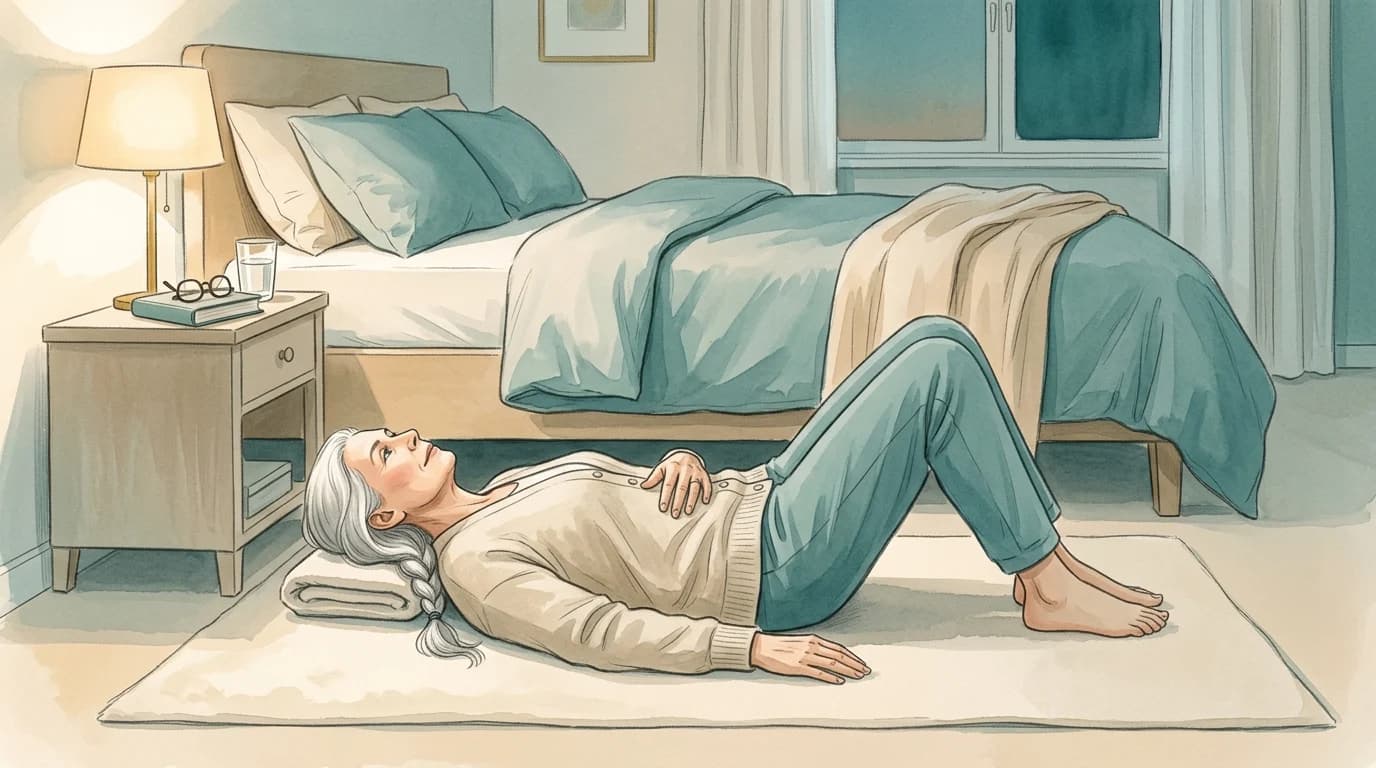
After 60, some of what movement does for your memory may happen while you sleep
Eight trials, 841 adults over 60: roughly half of the gain in thinking that came with exercise seemed to travel through better sleep.
The usual advice for keeping your memory after sixty is to keep moving. Walk, dance, lift something, join the tai chi group in the park.
That advice holds up. A review published on 28 September asked a quieter question about it: how much of the benefit happens at night?
The answer, from a team at Guangzhou Sport University writing in Frontiers in Human Neuroscience, was about half (Zheng and colleagues, 2026). A striking number. It's also a fragile one, and both of those things are worth holding at once.
What the review looked at
The team searched five databases for randomized trials of structured exercise, lasting at least four weeks, in adults aged 60 or older, that measured both sleep and thinking. Only eight trials qualified, with 841 people between them, run in Vietnam, Denmark, Greece, China, Turkey and Brazil. Average ages ran from 68 to 76. Five trials enrolled people with mild cognitive impairment, two enrolled people without memory problems, and one enrolled people with mild Alzheimer's disease.
The exercise varied: aerobic dancing and stepping, supervised aerobic training, strength work (one trial added a chair yoga group), tai chi, a gentle Chinese mind body routine, and one mixed programme. Programmes lasted 12 to 24 weeks. Sleep was measured almost everywhere with the Pittsburgh Sleep Quality Index, a questionnaire about how people feel they slept over the past month.
What it found
Across the trials, exercise came with better scores on tests of memory and thinking and with better reported sleep, and both changes were large. The team then used a statistical model to estimate how much of the thinking gain might be explained by the change in sleep, and their figure was 50.8 percent. In people who already had mild cognitive impairment the share looked bigger, about two thirds; in people without memory problems it looked smaller, about a third. Programmes longer than 16 weeks showed a bigger sleep share than shorter ones.
It's tempting to read this as proof that exercise helps memory mostly by improving sleep. The analysis can't show that; it offers one possible way the two benefits connect.
How much weight it can carry
Less than the headline suggests, and the authors say so themselves. Only six trials fed the main calculation. The middle link of the whole chain, how closely sleep and thinking move together, came from a single trial of 111 people because no other trial reported it; when the team swapped in a more modest version of that link, the sleep share fell to about a third, and with a more modest one still it fell below a quarter and could no longer be told apart from chance. Sleep was what people reported, not what a sleep lab recorded. One trial with an unusually large sleep result pulled the average up. Three of the eight were judged at high risk of bias.
What remains is still useful. In older adults, exercise and better sleep tend to arrive together, and better sleep may be one of the routes by which movement helps the mind. The exact share is a sketch, not a measurement.
Doing less
If sleep is part of the route, then how you move may matter alongside how hard. Two of the eight programmes were slow mind body practices, and the one trial that supplied the sleep and thinking link was one of them. That proves nothing about slowness. It does fit a pattern I see again and again in my classes: when a lesson asks for less effort, smaller movements and more attention to how the ribs follow the breath, people often mention their night before they mention their back. In a Feldenkrais Method® lesson nothing is pushed; you only go where it feels easy, pleasant, and comfortable. A nervous system that practises downshifting during the day may find it a little easier at bedtime.
Questions for your next appointment
1. Could my sleep be part of what I'm noticing with my memory? The review left out trials where a diagnosed sleep disorder, such as sleep apnoea, was the main condition, so it says nothing about those. If you snore heavily, wake unrefreshed, or doze off during the day, mention it. Sleep problems deserve attention in their own right, not only as part of a plan to stay sharp.
2. How will we know if my sleep is changing? Every trial here relied on people's own account of their sleep. A simple sleep diary, or the same questionnaire repeated after a few months, gives you and your doctor something to compare, instead of a vague sense that nights feel different.
3. What kind of movement fits me, and for how long? The trials ranged from dancing to strength work to tai chi, and the longer ones, past 16 weeks, showed the larger sleep share, though that alone doesn't prove the extra weeks caused it. Ask what suits your joints, your heart and your energy, and what you could keep up for four months rather than four weeks.
The Feldypedia entry on sleep trouble and physical tension explains why a body that can't let go of the day often can't let go of the night either, and the one on how movement changes with age picks up the other half of this story. Short, slow, audio guided lessons like the ones in the Feldy online movement program can fill the days between appointments; they sit alongside your doctor's and physiotherapist's care, not in place of it.
Half, a third, a quarter: the number may change as better trials arrive. Tonight, when you lie down, which part of today is your body still holding?
Let Feldy guide you, eyes closed
A calm voice walks you through gentle moves so your attention stays in your body, not on the screen.
Try Feldy Free for 7 daysNo credit card needed.
Sources
- Effects of exercise on cognitive function in older adults: a systematic review and meta-analysis of the mediating role of sleep— Frontiers in Human Neuroscience, 2026
- Effects of exercise on cognitive function in older adults: a systematic review and meta-analysis of the mediating role of sleep (PubMed record)— PubMed
Movement Pulse is informational, not medical advice. See our editorial policy.
Move better with Feldy
See the programMovement Pulse Weekly
The week's best research, in your inbox Tuesday.
Movement science, gentle-practice ideas, and a practitioner's read on what's new. Free.
More from Movement Pulse
The deep sleep number your tracker reports was not the one that matched how people felt
A new analysis of 5,469 overnight recordings from the Sleep Heart Health Study separated how long people spent in deep sleep from how deep that sleep actually ran. Only one of the two had any relationship to how they rated their health, and it was not the one anybody is counting.
Sep 25, 2026
Why moving in the evening may matter less for your sleep than how hard you move
A review of 25 comparative studies found no clear group level advantage for morning exercise. The signal that did survive was about intensity, not the hour.
Aug 24, 2026
Why more exercise can stop helping your sleep, and what the curve actually shows
Researchers mapped exercise dose against sleep quality and found a peak, not a ladder. Three questions worth bringing to your next appointment.
Aug 2, 2026Ready to start moving better?
Gentle, guided lessons for your body. Try your first one free, no credit card required.