

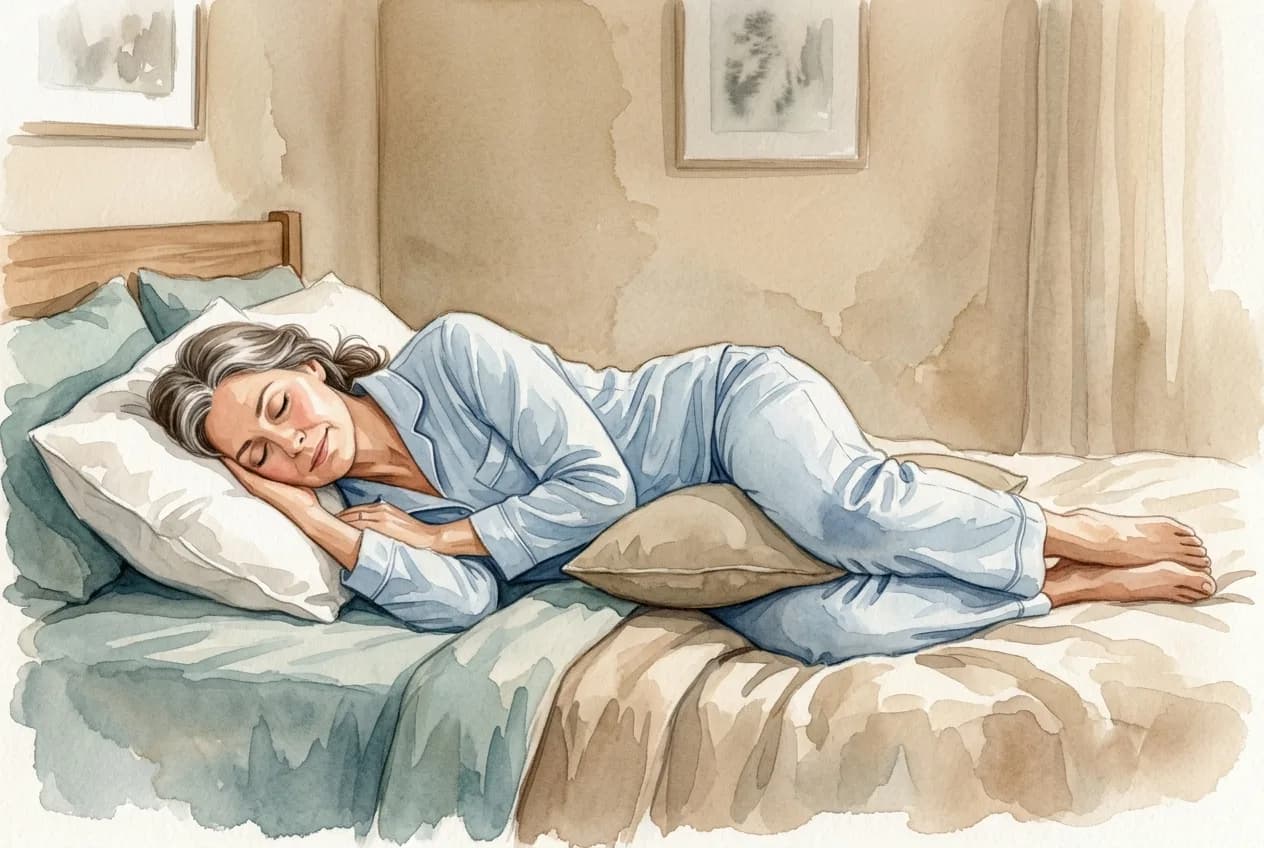
Fix Anterior Pelvic Tilt While Sleeping on Side
How to fix anterior pelvic tilt while sleeping on side: knee pillow setup, hip support, and a gentle pre-sleep awareness so a forward-tipped pelvis rests easier.
In short
You cannot truly fix anterior pelvic tilt while sleeping on side by locking into one shape, since your hips move all night and the tilt is a normal variation rather than a defect. What helps is a kinder side setup: a firm pillow between the knees so the top leg does not drag the pelvis forward, and a relaxed body. A short pre-sleep awareness lets the holding ease.

Prefer to ease in gently?
See a few gentle exercises for stress and sleep to try.
Before you begin. This is gentle self-care and general comfort guidance, not medical advice. Anterior pelvic tilt is a normal postural variation, not a disease to correct. Stop if pain radiates down a leg, and see a doctor or physical therapist for persistent or worsening back or hip pain, numbness, or tingling.
If you favor your side at night and wonder how to fix anterior pelvic tilt while sleeping on side, the starting point is that you cannot lock the pelvis into one shape and hold it, because your hips move freely all night. Anterior pelvic tilt simply means the top rim of the pelvis tips a little forward and down, deepening the natural curve at your waist. It is a normal variation, not a defect to correct. What you can do is make your side position kinder to your lower back through good knee support and a calmer body. That gentle, awareness-first approach is drawn from the Feldenkrais Method® and similar attentive movement work.
This pattern is far more common than most people assume, which is reassuring. When researchers measured a healthy group with no pain, roughly 85% of the men and 75% of the women showed at least some anterior pelvic tilt (Herrington, 2011). A gently forward-set pelvis is closer to the norm than to a problem, so the night's job is simply to support the side position you already love.
Setting up the side you sleep on
The single change that does the most is a pillow between the knees. When you lie on your side without it, the upper leg tends to drop forward and down, which rolls the top of the pelvis with it and deepens the arch in your lower back for hours. A fairly firm pillow placed between the knees and lower thighs lifts the top leg back to level with the hip, so the pelvis stays stacked rather than rotated. Choose a thickness that keeps your hips feeling square and your waist comfortable, not so thin that the knee still dips, not so bulky that the leg is propped awkwardly high.

A head pillow chosen so the head sits about in line with the spine rounds things out, since a head that sags low or perches too high sends tension down through the whole side. None of this is a hard rule, and comfort is always the test. Let your body tell you when the side feels easy.
How a gentle pre-sleep awareness helps a forward-tipped pelvis
A body that has been bracing all day brings that effort into bed, and near the hips and lower back the holding can leave a forward tilt feeling more pronounced. The remedy here is slow, attentive movement rather than force. As you offer a few tiny pelvic rocks and pay attention to how each small motion feels, the nervous system collects quiet proof that letting go is safe, so the muscles cradling the pelvis can release. A longer, calmer breath out adds to that sense of safety, and the hips settle.
To try it tonight: once you are on your side with the pillow in place, let your top hip roll a centimeter forward and back, three or four times, each one slower than the last. Then let the movement go, breathe out a little longer than usual, and notice where the mattress carries your weight. That is the whole practice.
That unhurried, listening spirit threads through everything in Feldy, whose lessons invite the body toward ease at its own pace rather than chasing a result. There is more in our Feldypedia guide to the Feldenkrais Method, and when stress and sleep are tangled together, the stress and sleep program takes the work further. Our somatic exercises for sleep lesson is a good first step if you want the whole body settled, not just the hips. For a back-sleeping companion to this guide, see how to sleep with anterior pelvic tilt.
Pairing the night with easy daytime movement
A sleep setup eases the strain of the night, but a clearer sense of a neutral, comfortable pelvis is built during the day. The two work hand in hand. A kinder side position keeps your back from arching against an unsupported leg for hours, while slow, curious movement by day teaches the hips their easier options. There is no realigning the skeleton overnight, and you do not need to. You are simply giving a common pattern a little more comfort and a little more choice. When you want a daytime practice to go with this, our gentle anterior pelvic tilt exercises make a natural next step.
Before you begin
Treat everything here as gentle self-care rather than medical advice. A forward tilt is a normal postural variation, and no position you sleep in is going to permanently realign your pelvis. Arrange your pillows so the side feels welcoming, then take each small movement slowly and let your breathing stay free. Stop the moment anything pinches, and stop especially if pain ever travels down a leg. Should back or hip pain, numbness, or tingling linger despite a comfortable setup, or if pain wakes you regularly, speak with a doctor or physical therapist.
A calmer body, easier nights
Understanding it is calming, moving with it more so. The Feldy program is meditation in movement, slow Feldenkrais® lessons that help a busy body settle so sleep can arrive on its own. Gentle, guided, and self-paced.
Start my free 7-day trialNo credit card needed.
Common Questions about how to fix anterior pelvic tilt while sleeping on side (FAQ)
Can you fix anterior pelvic tilt while sleeping on your side?
Not by holding one position, because your hips shift all night and the tilt is a normal variation rather than a fault to correct. What you can do is set up a kinder side: a firm pillow between the knees so the top leg does not pull the pelvis forward, and a relaxed body. A gentle pre-sleep awareness helps the holding ease, and daytime movement matters more for a clearer sense of neutral.
Where should the pillow go for side sleeping with anterior pelvic tilt?
Place a fairly firm pillow between your knees and lower thighs so the upper leg rests level with the hip instead of dropping toward the bed. That keeps the pelvis from rolling forward and rotating, which is what tends to deepen the arch and tug on the lower back. Adjust the thickness until the hips feel stacked and easy.
Is side sleeping bad for anterior pelvic tilt?
Not at all. Side sleeping is comfortable for many people and is not bad for a forward-tipped pelvis. Without support the top leg can drag the pelvis forward, so a knee pillow simply keeps the hips level. Comfort is the real test, so let how your back feels guide you rather than a rule.
How long until a better side setup helps?
Some people feel a more comfortable lower back within a few nights of a knee pillow and a calmer wind-down. A steadier ease tends to build over weeks, and daytime habits matter just as much. A sleep setup eases related tension; it does not permanently realign the pelvis.
How is this different from doing corrective exercises?
A sleep setup is about comfort and support through the night, not changing your structure. Daytime gentle movement is where you build a clearer, easier sense of a neutral pelvis. The two work together: a kinder night reduces strain, while slow, attentive movement by day teaches the hips their easier choices.
When should I see a professional about pelvic tilt and side sleeping?
See a doctor or physical therapist if back or hip pain, numbness, or tingling persists despite a comfortable setup, if pain wakes you regularly, or if pain radiates down a leg. On its own an anterior pelvic tilt is usually nothing to treat, so it is the company of pain or nerve symptoms that makes expert input worthwhile.
A calmer body, easier nights
See the programRelated resources
How to Sleep With Anterior Pelvic Tilt
How to sleep with anterior pelvic tilt: comfortable positions, simple pillow ideas, and a gentle wind-down to help a forward-tipped pelvis settle for the night.
Anterior Pelvic Tilt Exercises: A Gentle Set
Gentle anterior pelvic tilt exercises that ease related tension and help you sense a more neutral pelvis. Slow, small movements you can do at home today.
Lying down is not the same as resting, and researchers have now measured the difference
Ready to start moving better?
Gentle, guided lessons for your body. Try your first one free, no credit card required.