

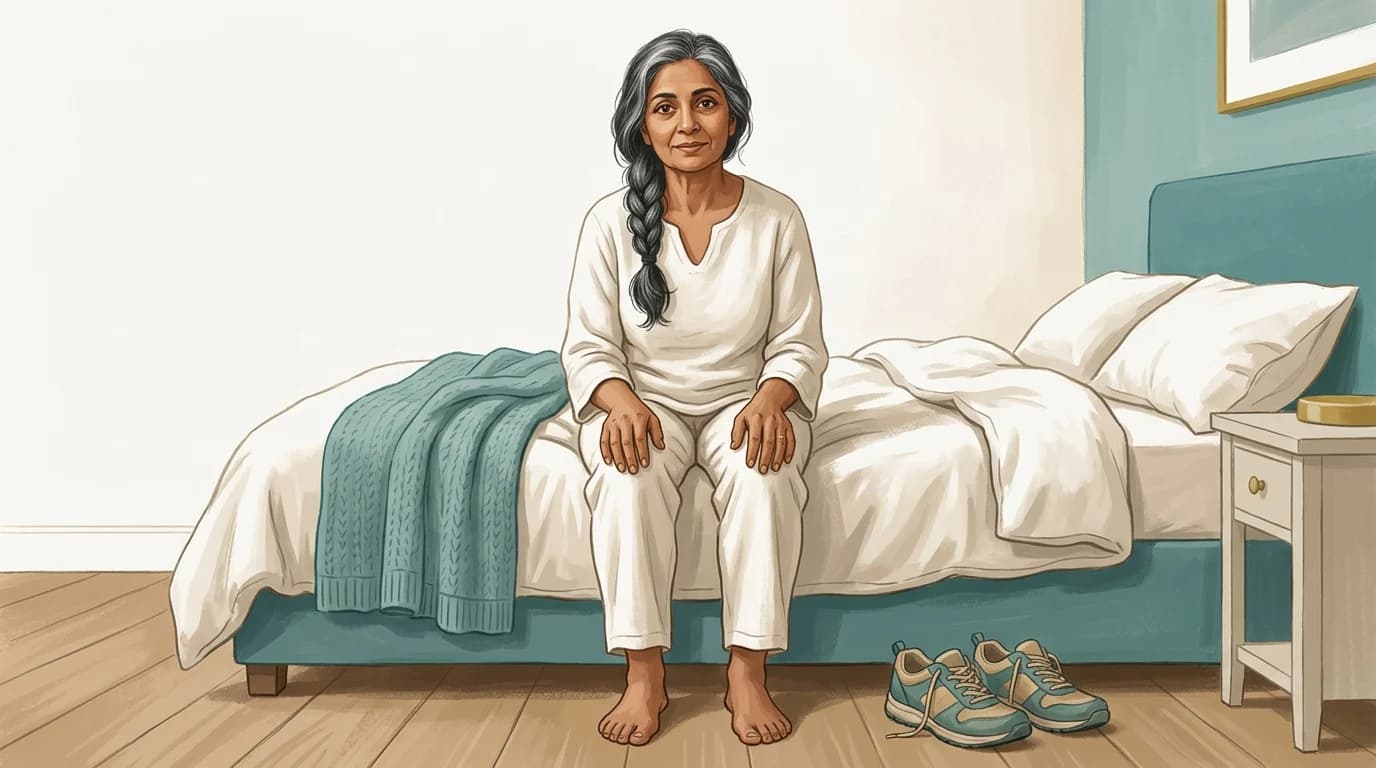
Why more exercise can stop helping your sleep, and what the curve actually shows
Researchers mapped exercise dose against sleep quality and found a peak, not a ladder. Three questions worth bringing to your next appointment.
If you are not sleeping well and someone has told you to move more, a review published this week complicates that advice in a useful way. Movement was associated with better sleep, but only up to a point. Past that point, the modelled benefit started shrinking again.
The paper appeared on 31 July in Medicine and pooled 24 trials covering 1,495 women who had finished primary treatment for breast cancer (Medicine, 2026). What makes it unusual is the question it asked. Most exercise reviews ask whether movement helps. This one asked how much, and then fitted a curve to the answer.
To do that, the researchers converted every trial's programme into one common unit: MET minutes per week, which combines how long you move, how often, and how hard. Then they modelled sleep quality against that number. The result was not a straight line going up. It rose, reached a peak, and turned back down. The strongest association with sleep quality sat at roughly 780 MET minutes per week, and the range where exercise looked helpful ran from zero to about 1,100. Beyond that, the modelled benefit faded.
For a sense of scale, 780 MET minutes lands somewhere in the region of three to four hours a week of moderate activity, depending on how hard that activity feels to you. That is not far above the 150 minutes a week that the World Health Organization uses as its general adult benchmark (WHO, 2026). In other words, the amount that looked best for sleep was an ordinary amount, not an ambitious one.
The review also ranked types of exercise against each other, and mind body practice came out on top, reaching its best effect at a lower dose of around 500 MET minutes per week. I would hold that ranking loosely. Its credible interval was wide enough to include a fairly small effect, and the authors themselves graded the overall body of evidence as low. The population is a specific one too. These were women recovering from breast cancer treatment, whose fatigue and disrupted sleep have causes that do not transfer neatly to everyone. The shape of the dose curve is the part worth carrying forward. The leaderboard is not.
Three questions worth raising at your next appointment
I am a Feldenkrais® practitioner, not a physician, and activity dosing after treatment is a clinical conversation. What this study offers is a better set of questions to bring into that conversation than "should I be exercising more."
Can we put an actual number on what I am doing in a week? Almost nobody knows their own figure. Most of us describe our activity in adjectives rather than amounts. If the entire finding here is about dose, the conversation cannot really start until there is a rough number on the table, and that number should include the walking, the stairs, and the errands, not only the sessions that feel like exercise.
My sleep has not improved since I increased my activity. Is it worth testing less before we add more? This is the question the curve actually licenses. When something is not working, the default assumption is that we have not done enough of it yet. This review is a reminder that the other direction exists, and that it can be tested deliberately rather than stumbled into.
Does the kind of movement matter as much as the amount, for my sleep specifically? Given fatigue, treatment history, or pain, the honest answer may be that a gentler kind at a smaller amount is more sustainable than whichever amount modelled best in a trial population.
What I notice in practice
The reason this curve makes sense to me has less to do with sleep research than with what I see in people's bodies. Someone who is not sleeping is already running a nervous system that is working hard. When they respond by adding a demanding routine, they are often adding more of the same signal, because the body reads effort as effort whether it arrives in a gym or in a difficult week.
What tends to shift things is not more input but different input. In Awareness Through Movement® the lessons are deliberately small and slow, and the instruction is to stay within a range that feels easy, pleasant, and comfortable. People often tell me they felt sleepier afterwards, which is not what they expect from something they had filed under exercise. That is a subjective report rather than trial evidence, and I offer it as exactly that. But it sits comfortably beside a curve that peaks and comes back down.
None of this replaces clinical care. If you are recovering from treatment, your oncology and rehabilitation teams are the ones to set your activity plan, and gentle movement work sits alongside what they give you rather than in place of it. Yoga, Pilates, and tai chi are each working with the body through their own mechanisms, and this review folded several of them together under a single heading, which is worth remembering before reading too much into where they landed.
The takeaway I would hold onto is smaller than a prescription. If more has not been working, more may not be the missing ingredient. The amount that looked best here was unremarkable, and for some people the direction worth testing is down rather than up.
Let Feldy guide you, eyes closed
A calm voice walks you through gentle moves so your attention stays in your body, not on the screen.
Try Feldy Free for 7 daysNo credit card needed.
Sources
Movement Pulse is informational, not medical advice. See our editorial policy.
Move better with Feldy
See the programMovement Pulse Weekly
The week's best research, in your inbox Tuesday.
Movement science, gentle-practice ideas, and a practitioner's read on what's new. Free.
More from Movement Pulse
Yoga, tai chi, walking: movement and insomnia
A 2026 network meta analysis compared yoga, tai chi, and walking for insomnia. Different mechanisms, but a shared thread matters more than the ranking.
Jul 11, 2026
Why moving in the evening may matter less for your sleep than how hard you move
A review of 25 comparative studies found no clear group level advantage for morning exercise. The signal that did survive was about intensity, not the hour.
Aug 24, 2026
The best exercise for neck pain may matter less than how often you actually do it
A new analysis pooled 51 trials to compare exercise types for neck pain. Mind body work, resistance, flexibility, and coordination training all landed in much the same place.
Jul 31, 2026Ready to start moving better?
Gentle, guided lessons for your body. Try your first one free, no credit card required.