

How to Get Comfortable in Bed: Settle and Soften
A gentle guide to how to get comfortable in bed: support for the neck and knees, a longer exhale, and small settling movements to help your body release its weight.
In short
Getting comfortable in bed is less about the perfect position and more about letting your body fully release its weight into the mattress. Supporting the neck and knees with pillows, lengthening the exhale, and a little gentle settling movement all help your body let go and rest.

Prefer to ease in gently?
See a few gentle exercises for stress and sleep to try.
Before you begin. This is general comfort guidance, not medical advice. If pain, numbness, or restlessness keeps you from sleeping despite a comfortable setup, or your sleep is persistently unrefreshing, please see a doctor.
If you lie down at night and cannot quite settle, learning how to get comfortable in bed is less about finding one perfect position and more about letting your body fully release its weight into the mattress. When you stop holding yourself, support the neck and knees, lengthen the exhale, and add a little gentle movement, the body settles far more easily. A short wind-down, drawn from the Feldenkrais Method®, can help you let go before sleep.
Comfort and sleep are closely linked, and the body often gets in the way of both. Musculoskeletal conditions, which frequently disturb comfort and sleep, affect about 1.71 billion people worldwide (WHO, 2022). A calmer, better supported body can quietly make bedtime easier.
What it really takes to get comfortable in bed
Your body naturally turns and resettles many times across a night, and that quiet rearranging is healthy. So the aim is not one perfect position to lock into. It is to make the few positions you tend toward feel kinder, with enough support that your weight can pour down into the bed.
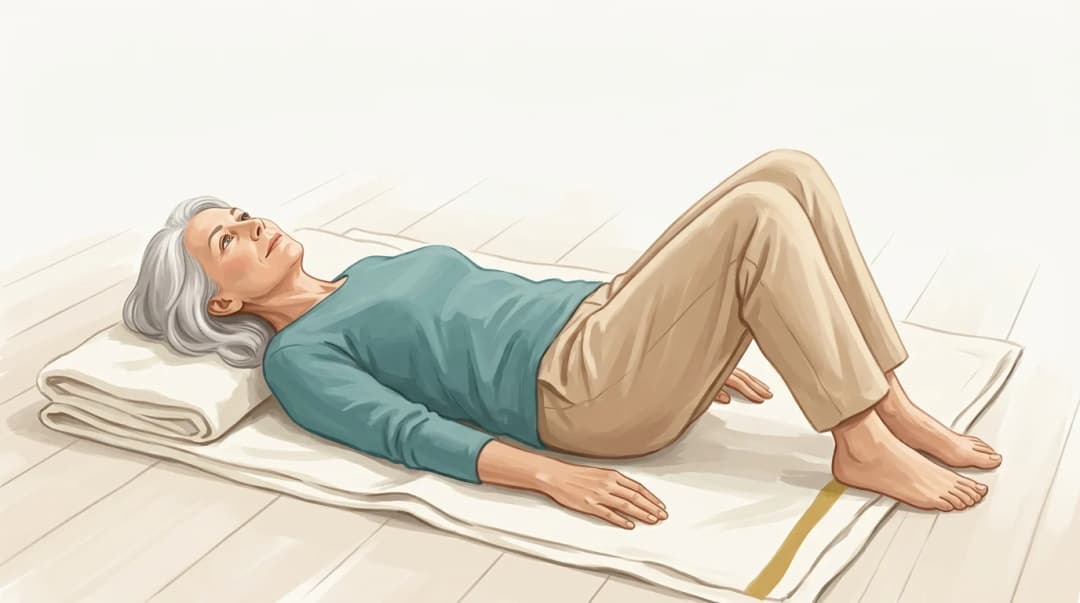
A handful of small choices do most of the work. Pick a pillow height that leaves your head close to in line with the rest of your spine, not stacked up high and not pressed nearly flat, so the neck stays at ease. Tuck a pillow under your knees on your back, or between them on your side, to take strain off the lower spine. None of these are fixed rules. Whether it actually feels good is the only test that matters.


How settling movements help you get comfortable in bed
Most of us arrive in bed still carrying the low-grade tension of the day, and a body that is still bracing struggles to settle whatever position it lands in. Slow, curious movement is what loosens that grip. As you make a small motion and pay close attention to how it actually feels, the older parts of the brain start to register that nothing more is being demanded, and the bracing quietly drains away. Drawing the out-breath out a touch longer reinforces the same message, so the muscles loosen and your weight sinks more completely into the mattress.
That very principle is what the Feldy program is built on: lessons that move you slowly and with attention so the body discovers ease on its own, instead of straining toward a goal. For more on how held tension and rest play off each other, see our guide to sleep disruption and physical tension.
Before you begin
What follows is general comfort guidance rather than medical advice. If pain, numbness, or restlessness keeps you awake even with a comfortable setup, or your sleep leaves you persistently unrefreshed, please check in with a doctor. Otherwise, arrange your bed however feels most inviting tonight, keep the breath unhurried, and move at a lazy pace. None of this is a task to complete. When you want a brief guided wind-down to pair with a kinder setup, our bedtime stretches in bed routine offers your body a gentle route to letting go, all without leaving the covers, and it is there for you any night you want it.
A calmer body, easier nights
Understanding it is calming, moving with it more so. The Feldy program is meditation in movement, slow Feldenkrais® lessons that help a busy body settle so sleep can arrive on its own. Gentle, guided, and self-paced.
Start my free 7-day trialNo credit card needed.
Common Questions about how to get comfortable in bed (FAQ)
What is the best position to get comfortable in bed?
There is no single best position, since your body shifts through several each night. Side and back both work well when your head sits roughly level with your spine and your knees are supported with a pillow. Comfort and good support matter more than holding one shape.
What should I do if I cannot get comfortable in bed?
Stop searching for the perfect position and instead help your body let go. Soften the jaw and shoulders, lengthen the exhale, and make a few tiny settling movements so your weight sinks into the mattress. Often it is held tension, not the position, that keeps you restless.
How often should I do a wind-down like this?
As often as you like. It is gentle enough for every night, and many people find it most helpful when they feel keyed up or have struggled to settle recently. There is no count to hit and nothing to overdo.
How is this different from buying a new mattress?
A new mattress changes what you lie on; this changes how your body meets it. Even on a good mattress a braced, tense body stays uncomfortable. Helping the body release its weight and let go often does as much for comfort as the surface itself.
When should I see a professional about getting comfortable in bed?
If pain, numbness, or restlessness keeps you from sleeping despite a comfortable setup, or your sleep is persistently unrefreshing, see a doctor. Treat this page as general comfort guidance rather than medical advice.
A calmer body, easier nights
See the programRelated resources
Progressive Muscle Relaxation for Sleep: Tense, Then Let Go
A guided progressive muscle relaxation lesson for bed: mildly tense each muscle group, let go fully, and notice the contrast that helps a braced body settle.
How to Fall Asleep Fast: Gentle Body-Based Ways to Settle
How to fall asleep fast by letting the body let go rather than forcing sleep: a longer exhale, releasing tension from feet to face, and feeling heavy and held.
Lying down is not the same as resting, and researchers have now measured the difference
Ready to start moving better?
Gentle, guided lessons for your body. Try your first one free, no credit card required.