
How to Relax Your Mind to Sleep: Start With the Body
A racing mind at night almost always comes with a tense body. Settling the jaw, the breath, and the weight of the head is often the easier way in.
In short
To relax your mind to sleep, give it something physical to rest on: the weight of your head on the pillow, a slightly longer breath out, the places your back meets the mattress. Aim for rest rather than sleep. Trying hard keeps you awake, while easy attention lets you drift.

Prefer to ease in gently?
See a few gentle exercises for stress and sleep to try.
Before you begin. This is general self care, not treatment. If sleepless nights keep returning, a low mood will not lift, or panic wakes you at night, please talk to a doctor. For ongoing insomnia, cognitive behavioural therapy for insomnia (CBT I) is the first line treatment with the strongest evidence.
The most reliable way to relax your mind to sleep is, oddly, not to work on the mind at all. Give your attention somewhere physical instead: the weight of your head on the pillow, a slightly longer breath out, the places where your back rests on the mattress. A racing mind almost always comes with a busy body, and the body is far easier to notice, and to let go, than a thought. This route comes from the Feldenkrais Method®, a gentle form of movement education, and it asks for no effort at all.
A mind that will not settle at night is common, and it often travels with everyday worry. In the United States, roughly 19.1 percent of adults had an anxiety disorder in the past year, 23.4 percent of women and 14.3 percent of men (NIMH). A wakeful night does not mean you are one of them. It simply means restless minds are far from rare, and a gentler tool is worth having.
Why you cannot think your way to sleep
Most bedtime advice goes straight at the mind. Count backwards. Picture a beach. Empty your thoughts. This helps some people, and for others it quietly makes things worse, because every one of those tasks takes effort. Holding a count is work. Keeping a picture steady is work. And effort is the exact opposite of falling asleep.
Here is the paradox worth naming plainly: trying to fall asleep keeps you awake. Sleep is not an action you perform. It is a state the body slips into when nothing is being asked of it. So the trick that actually works is to stop aiming for sleep and aim for rest instead. Rest is available right now, tonight, with no luck required. Sleep tends to arrive on its own once rest is genuinely there.
How to relax your mind to sleep through the body
A busy mind rarely arrives alone. Check right now: is your jaw gripped? Are your shoulders held slightly up? Is your breath sitting high in the chest, short and quick? Are your legs restless under the covers? These are the physical half of a racing mind, and they are much easier to work with than the thoughts themselves.
So the method is simple. Give your attention something concrete and physical, in small amounts, without trying to achieve anything:
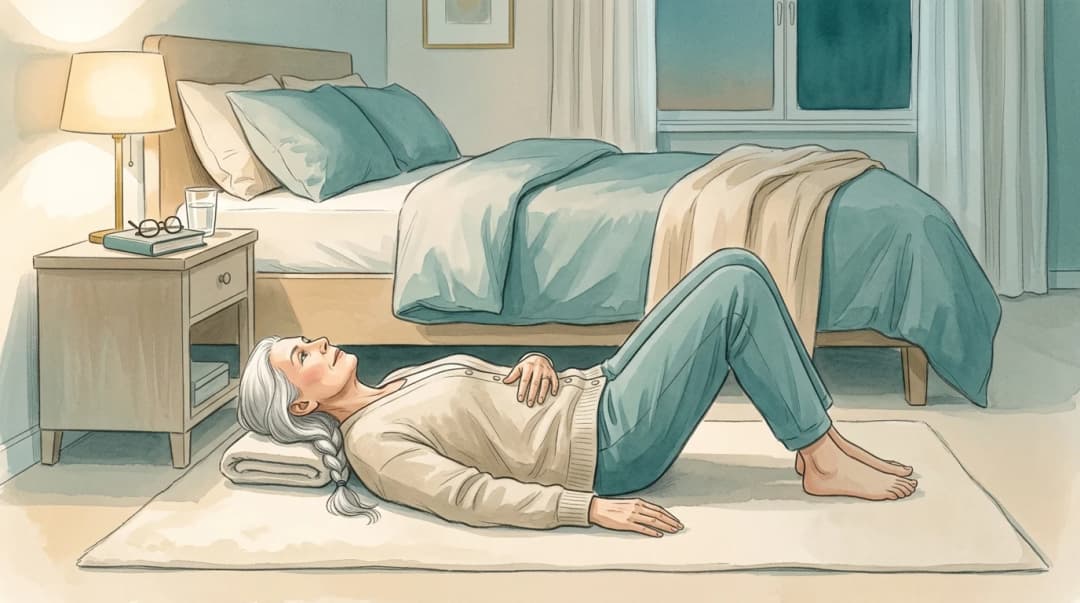
- Feel the weight of your head on the pillow. Let the pillow carry all of it.
- Notice where your back touches the mattress. Which parts press in, and which lift away?
- Let your next breath out be slightly longer than the breath in. No pushing, just a soft, unhurried exhale.
- Add a small, slow, lazy movement if you like: roll your ankles gently, or tilt your pelvis a whisker, the way you might doodle with a pen. It gives the mind something undemanding to follow.
Thoughts will still come. Let them, and return to the head, the back, the breath. If you would like this done as one guided sweep through the body, our body scan for sleep walks you through it. And if you are curious why held muscles and shallow breath disturb sleep in the first place, our Feldypedia article on sleep disruption and physical tension explains it in plain language.
What helps, night after night
A few habits make the body based route work better:
- Start your wind down before bed, not in it. Dim the lights and slow down for the last half hour of the evening, so bed is the end of the descent rather than the whole descent.
- Repeat the same few minutes of attention practice every night. The body learns the cue, and after a couple of weeks those minutes start to mean sleep is near.
- If you have been lying awake a long while and frustration is building, get up. Sit somewhere dim, do something calm and dull, and come back when you feel drowsy.
- Keep the room dark and cool, and turn the clock away so there is nothing to check.
If your struggle is more about the moment of dropping off than the racing mind, our guide on how to fall asleep fast covers that side of the night.
What tends to backfire
A few common moves push sleep further away. Doing something hard late in the evening to tire yourself out raises alertness just when you need it to fall. Scrolling in bed feeds the mind exactly the kind of quick, bright input it should be winding down from. Checking how long you have been awake turns rest into arithmetic. And treating one bad night as proof that something is wrong adds a layer of worry that follows you to bed the next evening. One rough night is just a rough night.
Something to actually try tonight
Reading about how to relax your mind to sleep is one thing. Lying down and being guided through it is another. Our somatic exercises for sleep are the natural next step: slow, simple movements and attention practices designed for the last minutes of the day. If they suit you, the full stress and sleep program builds the same skills over several weeks, and you can try Feldy free for 7 days to see how it feels. If you already see a psychologist or a doctor for sleep or worry, this practice sits alongside that care.
A calmer body, easier nights
Understanding it is calming, moving with it more so. The Feldy program is meditation in movement, slow Feldenkrais® lessons that help a busy body settle so sleep can arrive on its own. Gentle, guided, and self-paced.
Start my free 7-day trialNo credit card needed.
Common Questions about relaxing your mind to sleep (FAQ)
How do I quiet a racing mind at night?
Do not argue with the thoughts. Move your attention to something physical instead: the weight of your head on the pillow, the parts of your back that press into the mattress, a slightly longer breath out. Thoughts will keep arriving. Each time, return to the body without any drama. The mind quiets as a side effect, not because you silenced it.
How long does it take before this gets easier?
On a given night, a few minutes of easy attention can settle you noticeably. The bigger change builds over two to three weeks of nightly practice, as the body starts to read those same few minutes as a signal that the day is over. Early on it may feel clumsy. That is normal and not a sign it is failing.
How often should I practise?
Every night, for just a few minutes, at roughly the same point in your wind down. A short practice done nightly beats a long one done now and then, because the value is in the repetition. The body learns the cue the way it learns any habit: through sameness, not intensity.
How is this different from meditation or counting sheep?
Counting and visualising work on the mind directly, and holding the count is itself a small effort. Many meditation styles also ask you to sustain focus. Here the attention is physical, lazy, and allowed to wander. You are noticing weight, breath, and contact, not maintaining anything, so there is nothing to fail at. For some people that difference is what finally lets them drift.
What should I avoid before bed?
Hard exercise late in the evening to tire yourself out, scrolling in bed, checking the clock, and doing the maths on how much sleep you have left. Each of these raises alertness or adds pressure. One rough night is also not evidence of a problem, so try not to treat it as one.
When should I see a professional about sleep?
If insomnia keeps returning for weeks, if low mood or worry fills your days, or if panic wakes you at night, please see a doctor. For ongoing insomnia, cognitive behavioural therapy for insomnia (CBT I) is the first line treatment and has the strongest evidence. Gentle body based practice can sit alongside that care, not replace it.
A calmer body, easier nights
See the programRelated resources
How to Fall Asleep Fast: Gentle Body-Based Ways to Settle
How to fall asleep fast by letting the body let go rather than forcing sleep: a longer exhale, releasing tension from feet to face, and feeling heavy and held.
Benefits of Legs Up the Wall Pose: What Is Real and What Is Not
Legs up the wall pose is a quiet rest with the legs raised. What people report, what is not proven, who should skip it, and a Feldenkrais® way to notice more.
After 60, some of what movement does for your memory may happen while you sleep
Ready to start moving better?
Gentle, guided lessons for your body. Try your first one free, no credit card required.