
The exercise rules for osteoporosis are precise, and meeting them did not predict results
Eighteen trials, 1,181 women. The two tests that improved were both transitions. The one that measures holding still did not reliably move at all.
If you have low bone mass and you have gone looking for what to do about it, someone has handed you numbers. Four to five days a week of weight bearing activity. Thirty to sixty impacts a day. Twenty to forty five minutes a session. Those figures come from the American College of Sports Medicine, and they sound like they were arrived at by measurement, because they were. A review published this month asked the obvious follow up question, which is whether the trials that actually hit those numbers produced better results than the trials that did not.
As far as this evidence goes, nobody can tell.
The paper appeared in Frontiers in Physiology on 12 August and pooled 18 randomized trials covering 1,181 postmenopausal women with osteoporosis or low bone mass, drawn from 15 countries (Frontiers in Physiology, 2026). The programs inside it were the ordinary mixture: aerobic, balance, resistance, and multicomponent. Three outcomes were pooled. Exercise cut about 1.57 seconds off the Timed Up and Go, and added roughly 3.88 repetitions to the thirty second sit to stand test. On the Berg Balance Scale, which measures how steadily you hold a set of positions, the estimate came in at 3.37 points with a confidence interval running from below zero to well above it. The authors call that highly uncertain rather than merely not statistically significant, which is the more careful phrasing. Certainty of evidence was rated low for the first two outcomes and very low for the third.
Then they did the interesting part. Each of the 21 intervention arms was scored against the ACSM criteria, weighting frequency, intensity, and duration, and split into 10 arms that reached 65 percent or higher and 11 that fell below. The two groups performed about the same. For the Timed Up and Go, the higher scoring arms came in at 1.72 seconds and the rest at 1.40, and the formal test for a difference between them returned p = 0.733. For the balance scale it was p = 0.985. For sit to stand, p = 0.262.
One detail in the methods matters more than any of those p values. A prescription component a trial did not describe clearly was scored as though it had failed. When the authors tried a version of the analysis that dropped every arm with insufficient reporting, too few comparisons were left to synthesize at all. So a good part of that low scoring group is not made of trials that ignored the guidance. It is made of trials that never said.
Choosing between practices from a ranking that is not there
Yoga, Pilates, tai chi, qigong, a supervised gym program, the Awareness Through Movement® lessons I teach as a Feldenkrais Method® practitioner: these get compared constantly, and the comparison rests on an unspoken premise that somewhere there exists a table showing which one delivers the correct dose to a woman whose bone thinned in the years around menopause. For this population, on this evidence, that table has not been built. The prediction intervals here, which estimate what a nineteenth trial would probably find rather than what these eighteen averaged, crossed zero for all three outcomes.
They run on separate mechanisms and are good at separate things, and my own field sits closest to the sensing end of that spread, nearer to how clearly you register where your weight has landed than to how much force you can produce. A ranking would be more satisfying. Its absence is more usable, because it leaves you choosing on grounds you can assess yourself, like whether you will still be doing this in March.
What moved was the transitions
The two tests that improved are both transitions. The Timed Up and Go asks you to rise from a chair, walk three metres, turn, come back, and sit down. It is the sequence in which changes in how a person walks tend to show up first. The thirty second sit to stand asks you to repeat the first and last part of that over and over. The Berg scale, the one whose result stayed uncertain, is largely a set of positions you hold.
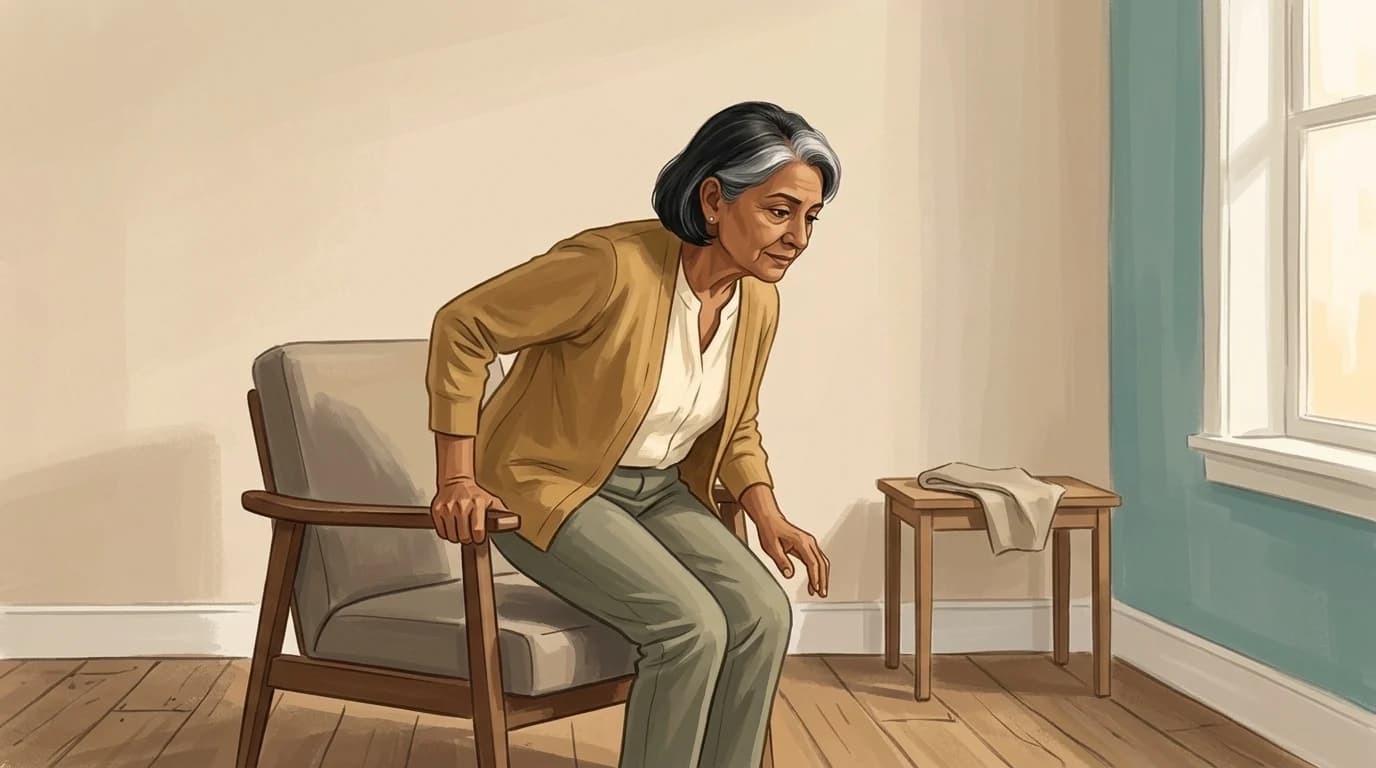
A woman I worked with last winter, seventy one, two years past a wrist fracture, could stand on one leg at her kitchen counter for a full minute and was rightly pleased about it. Getting out of the low armchair in her living room still took three tries and a hand on the radiator. Holding still and rearranging yourself are not the same skill, and it is the second one that fills an ordinary day, dozens of times, mostly unnoticed until the morning it starts requiring a plan.
Transitions are most of what a Feldenkrais lesson is made of. Not a posture to arrive at, but the sequence by which one arrangement of yourself becomes another, done slowly enough that you can feel where you brace against your own weight. That is what the daily lessons in the Feldy online movement program are built around, and it sits alongside whatever loading work your physiotherapist or your doctor has set for you rather than standing in for it.
So what might someone managing low bone mass take from this? Not a prescription, since the prescription is precisely what the review could not validate. The loading part of your week belongs in a conversation with the clinician who has seen your scan and knows your fracture history, because intensity is where both the benefit and the risk live, and this paper was not measuring bone density at all. And if you want some sense of whether what you already do is working, the one legged stand may be the wrong instrument. Time yourself getting out of the chair you actually sit in.
The eleven low scoring arms are what I keep turning over. Some of those researchers presumably ran careful, well dosed programs, wrote them up in three sentences, and now sit in the same bucket as the ones that genuinely missed the mark. Somewhere in a supplementary table there is a trial that got it right, and no one can point to it.
Let Feldy guide you, eyes closed
A calm voice walks you through gentle moves so your attention stays in your body, not on the screen.
Try Feldy Free for 7 daysNo credit card needed.
Sources
- Effects of exercise interventions on fall-related functional performance in postmenopausal women with osteoporosis or low bone mass: a systematic review and meta-analysis with an exploratory analysis of reported consistency with ACSM recommendations— Frontiers in Physiology
- Full text: Frontiers in Physiology, 10.3389/fphys.2026.1903705— Frontiers in Physiology
Movement Pulse is informational, not medical advice. See our editorial policy.
Move better with Feldy
See the programMovement Pulse Weekly
The week's best research, in your inbox Tuesday.
Movement science, gentle-practice ideas, and a practitioner's read on what's new. Free.
More from Movement Pulse
The menopause symptoms few women mention, and what eight weeks of pelvic floor work did
In a new Menopause journal trial of 58 women, guided pelvic floor training plus education eased vaginal and urinary symptoms more than education alone.
Oct 2, 2026
Back pain after menopause followed the shape of women's days, not their exercise count
A study of 566 women past menopause in Bangladesh found nearly half had low back pain in the past year. How often they exercised made no clear difference. Their daily work was the stronger clue.
Sep 27, 2026
Does exercise help menopause symptoms? The research keeps changing what it measures
Twelve trials found movement improves quality of life and mood. A thirty year cohort found fitness does not prevent severe hot flashes. Both are true.
Jul 30, 2026Ready to start moving better?
Gentle, guided lessons for your body. Try your first one free, no credit card required.