
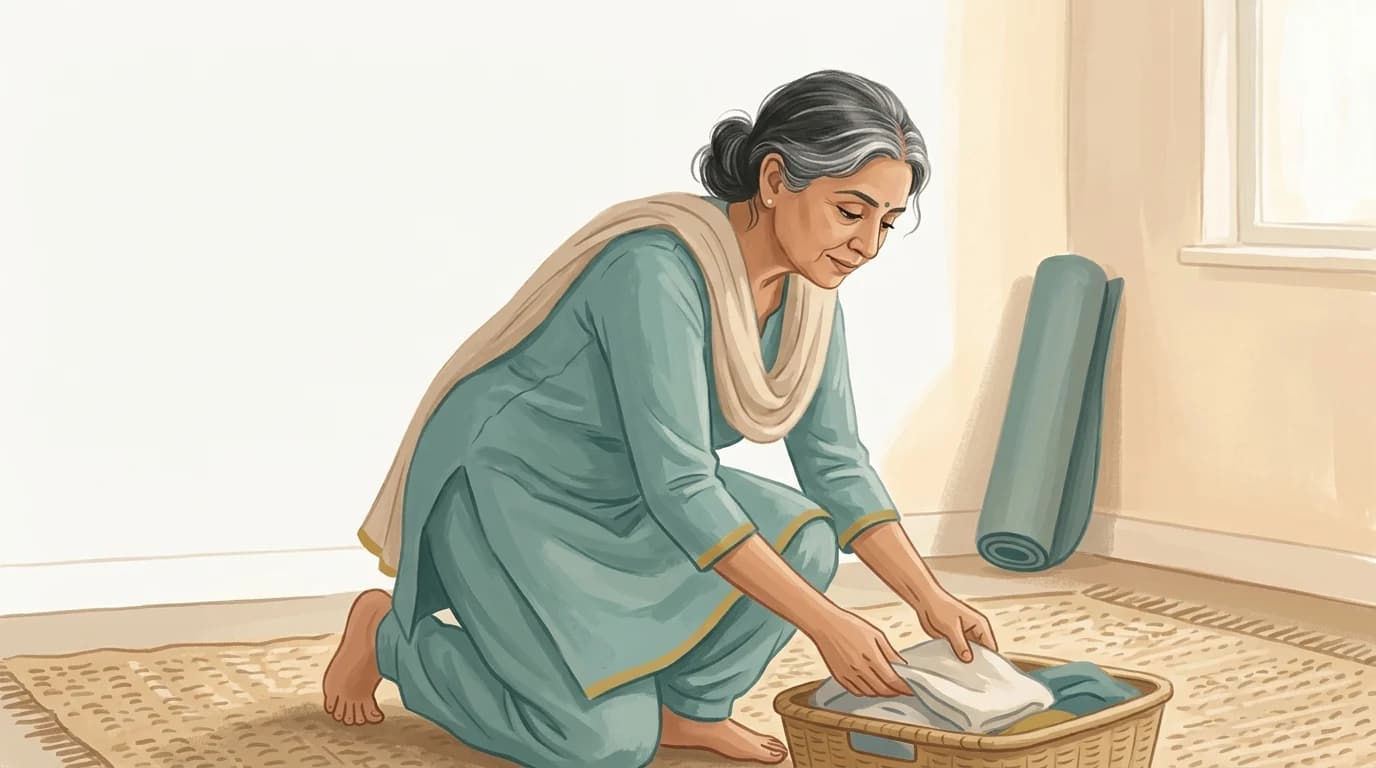
Back pain after menopause followed the shape of women's days, not their exercise count
A study of 566 women past menopause in Bangladesh found nearly half had low back pain in the past year. How often they exercised made no clear difference. Their daily work was the stronger clue.
A study published on 21 September in PLOS One asked 566 women past menopause about their backs, and the result I keep returning to is a quiet one. How often a woman exercised each week did not line up with whether her lower back had hurt in the past year. What filled the rest of her day seemed to.
The women were interviewed face to face, in Bangla, between December 2022 and December 2023, at two rehabilitation and physiotherapy centres in and around Dhaka, where they had come with some kind of muscle or joint complaint. Almost half of them, 46.6%, reported low back pain in the previous twelve months (PLOS One, 2026). The researchers then asked which parts of a woman's life travelled with that pain once age, health conditions, income, weight and everything else they had recorded were accounted for together.
Several things held. Women who described themselves as housewives, 442 of the 566, were noticeably more likely to report back pain than the teachers, retired women and others in the sample. Women living with high blood pressure or a respiratory illness were also more likely to report it. And women aged 51 to 57 reported less of it than the youngest group, aged 43 to 50, which is the reverse of what most people would guess.
Exercise was the variable that did not move. Among the 150 women who said they never exercised, 46.7% had back pain. Among the 74 who exercised more than four times a week, 51.4% did. Those two numbers sit close enough that, once everything else was in the model, weekly exercise showed no clear relationship with back pain at all.
What this study can and cannot say
It's a snapshot, not a trial. Everyone was asked once, so nobody can tell from this data whether the housework came before the pain or the other way round. The women were recruited at clinics, which means they were already seeking care, and the authors are careful to say the 46.6% belongs to that setting rather than to Bangladesh or to women in general. The income pattern ran backwards too (the lowest income group reported the least pain, at about 22%), and the authors suspect that reflects who reaches a rehabilitation centre as much as who hurts. Exercise was measured only as a count of sessions per week, with no question about what kind, how hard, or how it felt. Household work itself was never measured. It sits inside the word "housewife."
The authors' own reading of that word is specific: long periods of standing, repetitive bending, lifting, tasks done at floor level, caring for others, and very little chance to rest or change how the work is set up. There's also a machine learning section in the paper, which sorted women into pain and no pain groups fairly well; it hasn't been tested on anyone outside this sample, and the authors say so.
The Feldenkrais angle
When a woman tells me her back hurts, the next sentence is often a defence: but I walk every day, but I go to my class twice a week. As if the pain were a verdict on her exercise.
This study points somewhere else, to the rest of the day. An hour of exercise is a small slice of a week that also holds hundreds of bends toward a floor, a low shelf, a child, a pot, a bed, most of them quick and organised the same habitual way.
In the Feldenkrais Method®, that habit is not a fault. It is simply the way the bend became, and it is where the learning starts. Awareness Through Movement® lessons take ordinary actions like bending, reaching and getting down to the floor, and slow them down enough to feel which parts are doing the work. Often the whole bend turns out to live in one small place in the lower back, while the hips, knees, ankles and ribs wait. The change tends to come from noticing and doing less, going only where it feels easy, pleasant and comfortable.
So the questions worth borrowing are small ones. Where does your bend begin? Do your knees and hips join in? Does your breath pause? Feldypedia goes further on how the body changes after menopause and on chronic lower back pain.
If a physiotherapist is already working with your back, this sits alongside what they gave you, not in place of it. New or worsening back pain after menopause is worth raising with your doctor, since bone density and other causes deserve a proper look.
The researchers counted how often these 566 women exercised. They never asked how the women bend, though any day holds far more bends than workouts. That may be the hopeful part. Exercise has to be squeezed into a full day, but the bends are already there, each one a small chance to move a little more easily.
Let Feldy guide you, eyes closed
A calm voice walks you through gentle moves so your attention stays in your body, not on the screen.
Try Feldy Free for 7 daysNo credit card needed.
Sources
- Prevalence, associated factors, and machine learning classification of low back pain among postmenopausal women attending rehabilitation and physiotherapy facilities in Bangladesh— PLOS One, 2026
- Prevalence, associated factors, and machine learning classification of low back pain among postmenopausal women (PubMed record)— PubMed
Movement Pulse is informational, not medical advice. See our editorial policy.
Move better with Feldy
See the programMovement Pulse Weekly
The week's best research, in your inbox Tuesday.
Movement science, gentle-practice ideas, and a practitioner's read on what's new. Free.
More from Movement Pulse
Does exercise help menopause symptoms? The research keeps changing what it measures
Twelve trials found movement improves quality of life and mood. A thirty year cohort found fitness does not prevent severe hot flashes. Both are true.
Jul 30, 2026
The exercise rules for osteoporosis are precise, and meeting them did not predict results
Eighteen trials, 1,181 women. The two tests that improved were both transitions. The one that measures holding still did not reliably move at all.
Aug 30, 2026
What walking changed for older women, and what it didn't
A June 2026 trial found brisk walking improved older women's balance, strength, and life satisfaction, with no change on the scale. Plus a short walking experiment.
Jun 29, 2026Ready to start moving better?
Gentle, guided lessons for your body. Try your first one free, no credit card required.