

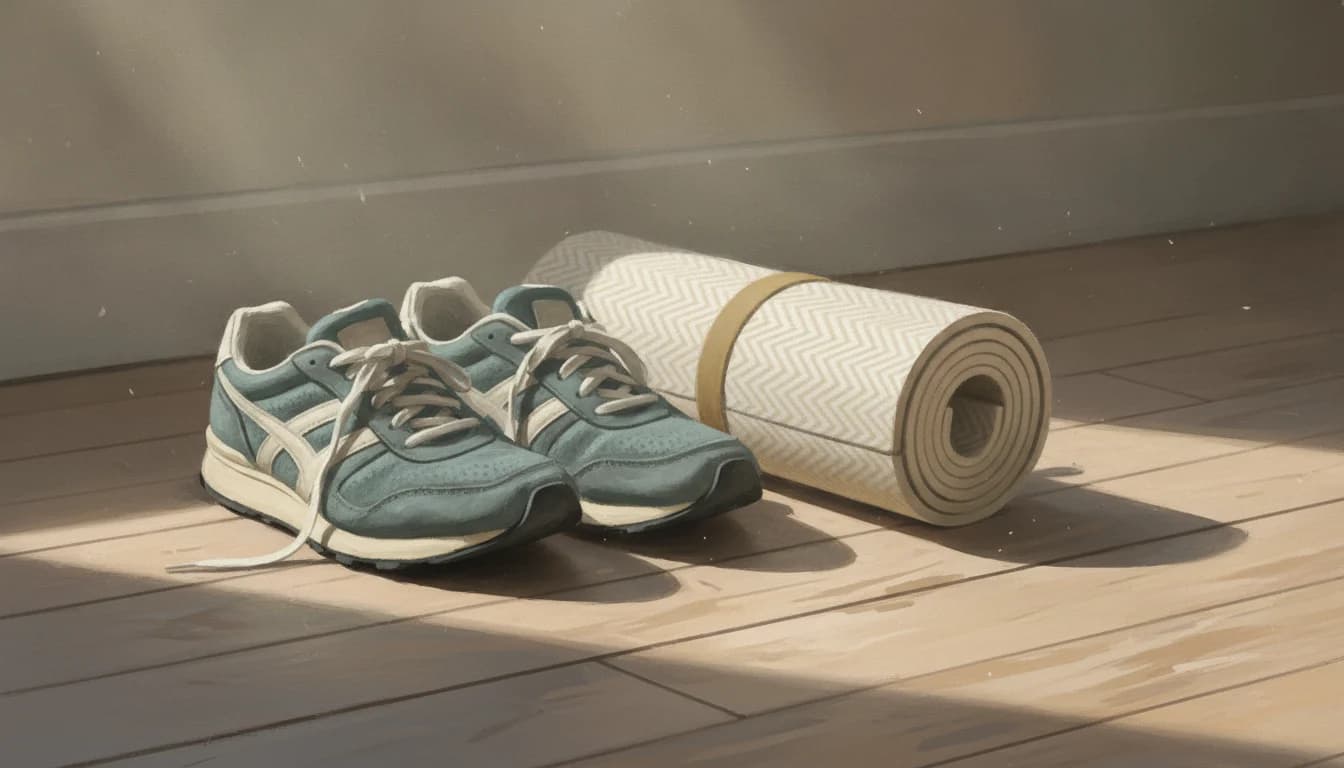
The exercise prescription that actually builds bone
A new network meta-analysis ranks aerobic exercise prescriptions for bone density. The winning protocol is not gentle. Gentle movement helps you keep doing it.
A new network meta-analysis out this month did something the bone density literature has needed for a while. It put different aerobic exercise prescriptions head to head, not just exercise versus no exercise, and asked which combination of intensity, frequency, session length, and duration moves bone mineral density the most.
The answer that came back is specific, and it is worth knowing if you, or someone you love, has been told to "exercise for the bones" without much more guidance than that.
The study, published in Frontiers in Endocrinology on June 3, 2026, pooled 27 randomized controlled trials with 2,183 participants and used SUCRA scoring to rank exercise prescriptions for lumbar spine bone mineral density (Frontiers in Endocrinology, 2026). The winning protocol was high intensity aerobic exercise, sessions of 30 to 59 minutes, performed 4 to 5 times per week, sustained for 24 weeks. That combination came out on top across every dimension the authors compared.
A few of the specifics. High intensity ranked highest on SUCRA at 90.6 percent, with medium to high intensity second at 76.3 percent. 4 to 5 sessions per week was the frequency winner at 99.6 percent, which is an unusually decisive ranking. 30 to 59 minute sessions beat both shorter and longer ones at 81.7 percent. 24 weeks of continued training was the duration sweet spot at 80.8 percent.
Notice what is missing from that list. Low intensity. Twice a week. 15 minute sessions. Eight week programs. All of those things still have value for other outcomes (cardiovascular health, mood, day to day function), but they were not the prescriptions that moved bone density the most.
Where the gentler movement methods actually fit
This is the part of the conversation that gets tangled, so let me be direct.
Gentle movement methods like the Feldenkrais Method®, Tai Chi, Pilates, and Alexander work do not, on their own, build bone the way the protocol above does. Bone responds to mechanical load, and the load has to be substantial enough to trigger the cells that lay down new bone. A slow Awareness Through Movement® lesson is not delivering that signal. Neither is a beginner Pilates class. Tai Chi has been shown to reduce falls in older adults, which is an important and separate outcome, but it is not the bone density driver this meta-analysis is identifying.
If your goal is bone mineral density at the lumbar spine, the data is clear. Load is the engine. Aerobic loading at high intensity, four to five times per week, for at least six months, with sessions in the 30 to 59 minute range. Resistance training adds to that picture in ways the current meta analysis did not directly compare, but the loading principle is the same.
So is there a role for movement quality work?
There is. It is just not the role it sometimes gets sold as.
The bottleneck in the prescription above is sustainability. Loading the bones four to five times a week for 24 weeks is a lot. The dropout literature on bone density programs is honest about this. People stop because something hurts, because they cannot recover between sessions, because they injure a knee or aggravate a hip, or because their lower back stops cooperating with the movements the program asks for. The question is rarely whether high intensity loading works. The question is whether you can keep doing it.
This is where coordinated, attentive movement work earns its place. Not as the bone driver, but as the recovery and preparation layer underneath it. If your hips can organize themselves around a squat without dumping load into the lower back, you can do more squats and recover faster. If your foot, ankle, and pelvis are working together when you walk briskly or run, you can do the aerobic loading days without your knees protesting on day three. If your spine can extend, flex, and rotate without bracing, you can lift weight without spasm.
In a Feldenkrais session, the practitioner is not trying to build muscle or bone. The practitioner is helping the nervous system find more efficient, less effortful ways to organize a movement. The output is usually not "I feel stronger." It is "I can do the thing without my back hurting tomorrow." For someone trying to stick with the 24 week bone protocol the new meta analysis describes, that can be the difference between completing the program and quitting in week 11.
The same logic applies to a good Pilates instructor, a thoughtful PT, an Alexander Technique teacher, or any movement educator working on coordination rather than load. None of them are competing with the bone protocol. All of them are in the layer that can help make the bone protocol completable.
What to take from this
If you have a recent osteoporosis or osteopenia diagnosis, especially around perimenopause or after, the meta analysis is a useful piece of evidence to bring into your next conversation with a clinician. The specifics are doable. High intensity aerobic work, 30 to 59 minutes, 4 to 5 times per week, for at least six months. Ask what version of that fits your current capacity and history. Resistance training and impact work are likely part of a full plan as well, though they were outside the scope of this particular meta analysis.
If you are already in a movement practice that you love (yoga, Feldenkrais, Pilates, Tai Chi) and have been told it is "for the bones," the honest reading is that it is probably helping you in other ways (balance, coordination, posture, mood, ease of daily movement) but is not, on its own, the bone density intervention. The two can sit comfortably side by side. They are answering different questions.
What this changes
It does not change the underlying physiology. Bone has always responded to load. What it does is sharpen the prescription. Now we have specific intensity, frequency, and duration numbers worth aiming at, drawn from a head to head comparison rather than from a single study or a clinical hunch.
For the bone work itself, follow the data. For the body that has to do the bone work, week after week without breaking down, the gentler practices still matter. Just in their actual lane.
Let Feldy guide you, eyes closed
A calm voice walks you through gentle moves so your attention stays in your body, not on the screen.
Try Feldy Free for 7 daysNo credit card needed.
Sources
Movement Pulse is informational, not medical advice. See our editorial policy.
Move better with Feldy
See the programMovement Pulse Weekly
The week's best research, in your inbox Tuesday.
Movement science, gentle-practice ideas, and a practitioner's read on what's new. Free.
More from Movement Pulse
The bone research kept saying load it harder. The largest review added a quieter line
124 trials and 18,429 adults over forty. Brisk walking led at two of the three sites measured. The one result the authors rated most confidently was not a walking result.
Sep 16, 2026
Fear of moving is linked to thinner bones, but the study cannot tell us which came first
A new cross sectional study found that fear of movement was common in people with osteoporosis and tracked with lower bone density. It cannot say which drives which, and that gap is the whole point.
Aug 19, 2026
The movement that builds bone and the movement that keeps you steady are not the same
A review published this week reaffirms that bone responds to how hard you load it. Here is where gentle movement fits, and where it honestly does not.
Jul 25, 2026Ready to start moving better?
Gentle, guided lessons for your body. Try your first one free, no credit card required.