
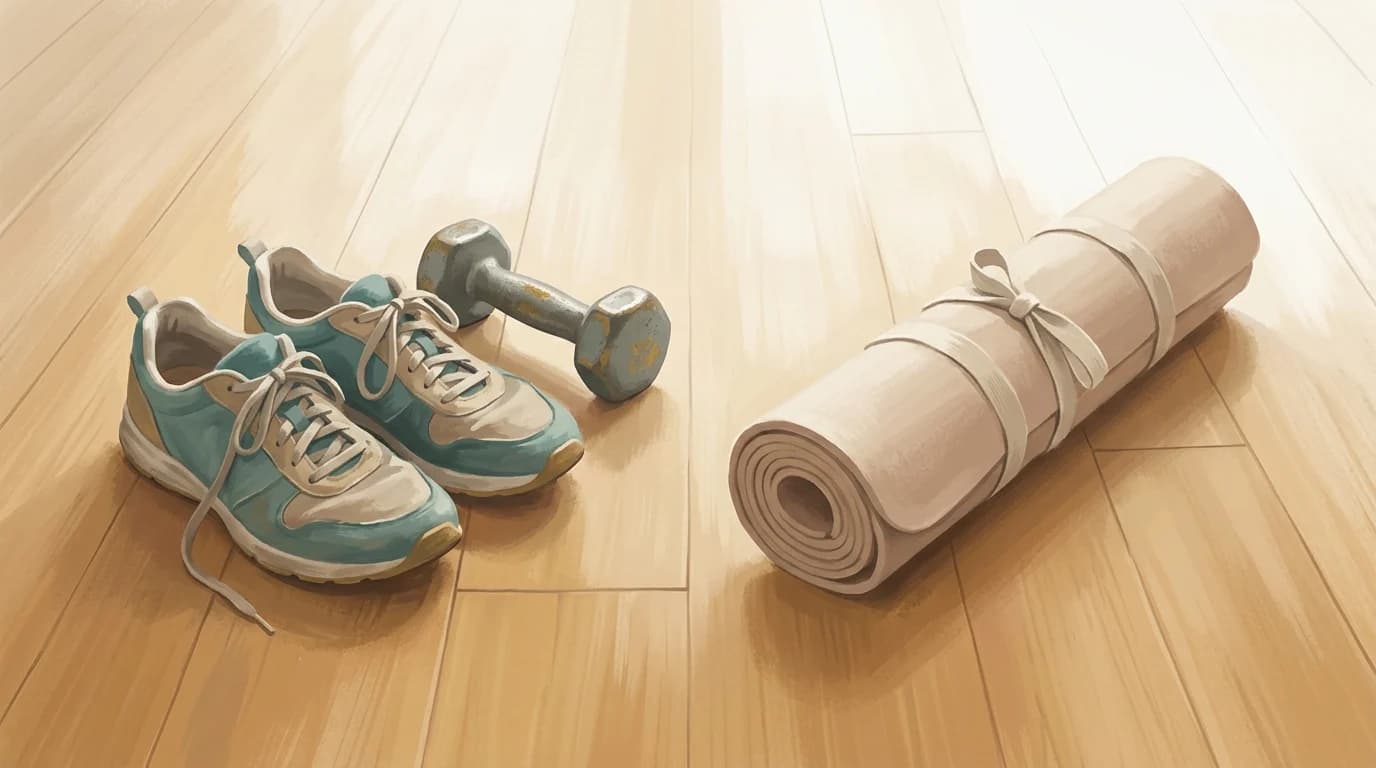
The movement that builds bone and the movement that keeps you steady are not the same
A review published this week reaffirms that bone responds to how hard you load it. Here is where gentle movement fits, and where it honestly does not.
If you are past menopause and paying attention to your bones, you have probably heard two pieces of advice that seem to pull in opposite directions. Move gently. Also, apparently, lift something heavy. A review published this week helps explain why both can be true at once, and where a soft practice like mine honestly fits into the picture.
The paper is a narrative review of resistance training for osteoporosis in postmenopausal women, and it gathered the exercise studies on bone into one fairly blunt conclusion: bone density responds to how hard you load it (Journal of Education, Health and Sport, 2026). Moderate to high intensity work, kept up over months, produced the most favorable changes in bone mineral density, especially at the lumbar spine and the femoral neck. Low intensity or short lived programs showed limited effects on bone.
I want to sit with that last sentence honestly rather than talk around it, because it is the sentence a practitioner in my field is tempted to skip. Gentle, slow, attention based movement, the kind I teach, is not what drives bone density upward. Bone reads mechanical load, and a soft lesson does not deliver much of it. The review was also careful about the limits of the evidence. Gains in strength and balance may indirectly lower the risk of a fracture, the authors noted, but the direct proof that exercise reduces fractures remains inconclusive. Given what is at stake, that caution deserves respect. Roughly one in three women over fifty will break a bone because of osteoporosis across the rest of her life, a lifetime risk greater than that of breast cancer (International Osteoporosis Foundation).
Here is the reframe I keep coming back to. A fragility fracture usually needs two things to line up: a bone weak enough to break, and a fall that loads it the wrong way. Loading work speaks to the first half. It asks the bone to become denser and stronger. Falls are the second half, and that is a genuinely different problem, with a genuinely different answer.
This is where it helps to stop ranking movement practices against one another and ask instead what each one is actually for. Resistance training, impact work, tai chi, yoga, Pilates, and the Feldenkrais Method® all get filed under the single word exercise, yet they work through different mechanisms, and each has its own strengths. Heavier loading is the mechanism for bone. The slower, attention based practices are a different mechanism altogether. They train how the nervous system organizes balance from one moment to the next. A recent meta analysis of 21 trials found that tai chi meaningfully improved balance and reduced the fear of falling in older adults (Frontiers in Public Health, 2025). And fear of falling narrows how a person moves, which quietly erodes the very steadiness she is worried about, so easing it is not a small effect.
Tai chi, and the Feldenkrais-based lessons at the heart of what I teach, live in that second group. I would never tell a woman worried about her bones that a gentle Awareness Through Movement® lesson will thicken her femoral neck. It will not. What it may do is sharpen the sensing that keeps a stumble from turning into a fall, and hand back the confidence to keep moving at all. Those are different jobs from loading, not lesser ones, and a week built around protecting against fractures arguably wants both.
So what might someone managing bone health take from all of this? Not the search for a single correct exercise, but a pairing. Something that genuinely loads the body, chosen and dosed with a clinician who knows your history, since intensity is the active ingredient for bone and also the part that carries risk if it is wrong for you. And alongside it, something slower and more attentive that trains balance and keeps the whole effort sustainable. The loading builds the bone. The gentle work helps you keep showing up for the loading, and it is what steadies you on the day your foot lands wrong.
Whether you lift, take a bone medication, or do both, is a conversation for you and your doctor, and nothing here leans on that decision either way. What I can speak to is the quieter layer underneath any of those choices. Moving in a way your nervous system reads as safe, only ever going where it feels easy, pleasant, and comfortable, is how balance and confidence return, and how a practice becomes something you are still doing a year from now. In the Feldy online movement program that is the whole point of the daily lessons. It is the half of fracture prevention that gentle movement was always meant for.
Let Feldy guide you, eyes closed
A calm voice walks you through gentle moves so your attention stays in your body, not on the screen.
Try Feldy Free for 7 daysNo credit card needed.
Sources
- Resistance training in the prevention of osteoporosis in postmenopausal women: a narrative review— Journal of Education, Health and Sport
- Epidemiology of osteoporosis and fragility fractures— International Osteoporosis Foundation
- Effects of Tai Chi on balance and fall prevention in healthy older adults: a randomized controlled meta-analysis— Frontiers in Public Health
Movement Pulse is informational, not medical advice. See our editorial policy.
Move better with Feldy
See the programMovement Pulse Weekly
The week's best research, in your inbox Tuesday.
Movement science, gentle-practice ideas, and a practitioner's read on what's new. Free.
More from Movement Pulse
Fear of moving is linked to thinner bones, but the study cannot tell us which came first
A new cross sectional study found that fear of movement was common in people with osteoporosis and tracked with lower bone density. It cannot say which drives which, and that gap is the whole point.
Aug 19, 2026
Tai chi was called too gentle to touch bone, yet 17 trials in women found a small gain
If you love a slow standing practice, it may be doing a little for your spine as well as your balance. Keep the walking and the strength work beside it.
Oct 17, 2026
The bone research kept saying load it harder. The largest review added a quieter line
124 trials and 18,429 adults over forty. Brisk walking led at two of the three sites measured. The one result the authors rated most confidently was not a walking result.
Sep 16, 2026Ready to start moving better?
Gentle, guided lessons for your body. Try your first one free, no credit card required.