
Back pain and the risk of losing daily independence
A large cohort study of nearly 19,000 adults found back or waist pain predicted later trouble with everyday tasks. Here is what to raise with your doctor.
Back pain is easy to file under discomfort, something you wait out and move past. A large new cohort analysis suggests that in midlife and beyond it can also be a quieter signal about something larger. It may say something about whether you will still be dressing, bathing, and getting around your home on your own a few years from now.
Researchers at Peking University drew on the China Health and Retirement Longitudinal Study, a big national sample, and followed nearly 19,000 adults aged 45 and older who could all still manage their daily tasks without help at the start. Over the next several years they tracked who went on to develop difficulty with the basics, things like bathing, dressing, eating, and moving around, and separately with the more complex tasks of independent living such as shopping, cooking, and managing money (Innovation in Aging, 2025).
The pattern was steady. Adults who reported back or waist pain at the outset were about 64 percent more likely to develop trouble with basic self care over the follow up, and those who reported both back and waist pain together were roughly twice as likely. The same held for the more complex tasks of running a household independently. The associations survived once the researchers accounted for age and other factors, and they showed up across both men and women and across age groups.
It is worth being precise about what this is and is not. This was an observational study presented as a conference analysis rather than a full clinical paper, so it can show a strong link but cannot prove that the pain itself causes the later decline. Pain and lost function keep a lot of the same company, from reduced activity to other health conditions that travel alongside both. Still, the size of the sample and the consistency of the pattern make the finding hard to wave away, and it fits a much larger picture. Low back pain is already the single leading cause of disability worldwide, affecting an estimated 619 million people (World Health Organization, 2023). What this analysis adds is a time dimension. Today's chronic lower back pain may be quietly telling you something about tomorrow's independence.
If you are living with back pain in midlife or later, a finding like this is less a warning than a reason to have a particular kind of conversation. Here are three things worth raising at your next appointment.
First, ask whether your back pain is being followed over time, not just treated when it flares. A lot of back care is organized around episodes. Something hurts, you get help, it settles, everyone moves on. What this study points at is the slow version, the drift that only becomes visible in hindsight. Ask whether it is worth noting how the pain affects specific daily actions, getting out of a chair, climbing stairs, carrying groceries, so that a gradual narrowing of what you do gets caught early rather than late.
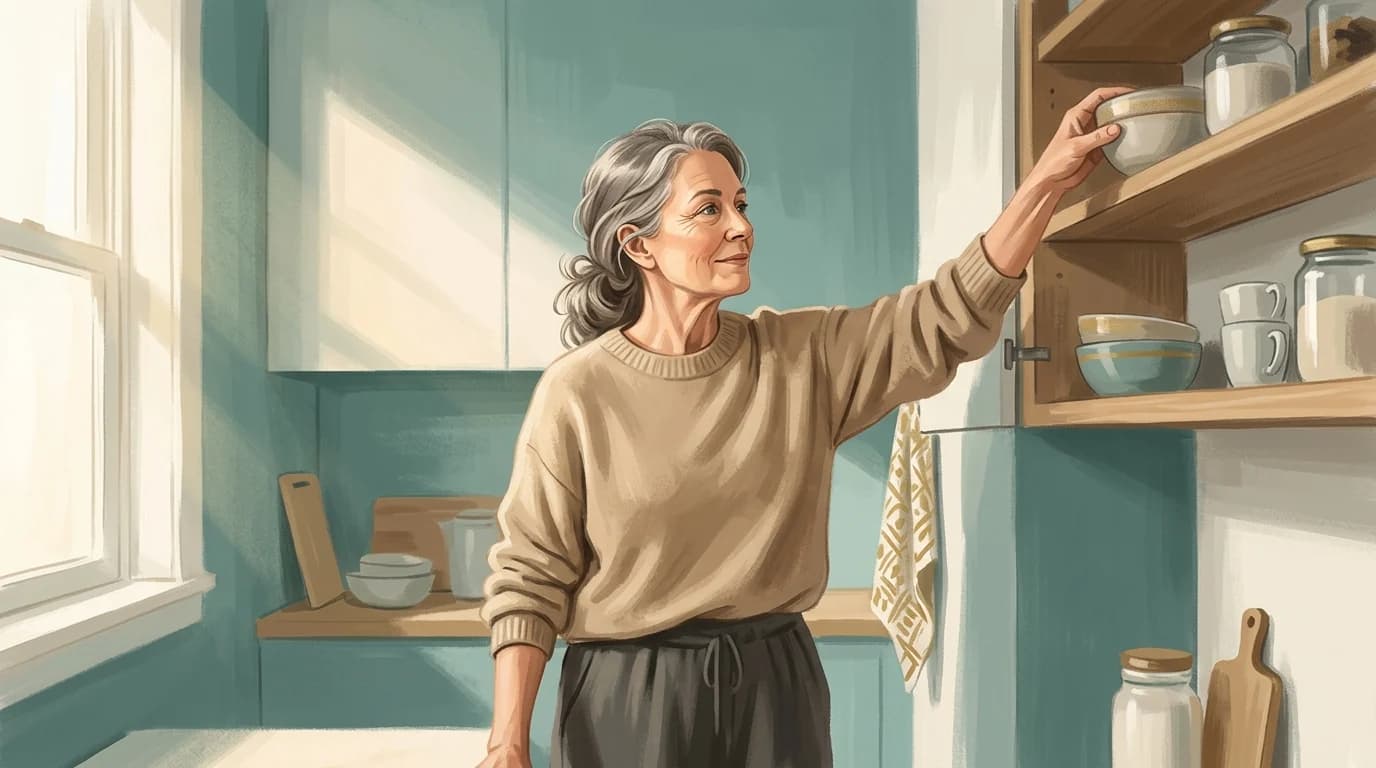
Second, ask what you can do between appointments to protect everyday function. Medication and hands on care each have their place, and a course of physiotherapy sits alongside them well. But the thing this study is really about is your capacity for ordinary movement, getting up off the floor, reaching a high shelf, turning to look behind you. Ask your clinician which of those everyday actions are worth practicing gently and regularly, and how to do them in a way that does not provoke a flare. The goal is not to push through pain. It is to keep the movements of daily life familiar and available.
Third, ask about the fear part, not only the pain part. When a back has hurt for long enough, it is natural to start protecting it, moving less, bending carefully, quietly editing activities out of the week. Some of that caution is wise and some of it outruns the actual risk, and the two are hard to tell apart from the inside. Ask what movement is genuinely safe for you to keep doing, and where you may be guarding more than you need to. Avoiding movement to protect a sore back can slowly become its own road toward stiffness and lost function.
That last question is close to how I think about all of this. I teach the Feldenkrais Method®, and what I see most often in people carrying long standing back pain is not a body that has run out of movement. It is a body that has lost trust that movement will help. The guarding that begins as sensible protection hardens into a habit, and the range of things a person feels able to do keeps shrinking, which is much of what movement decline with age actually looks like up close. Rebuilding that trust is slow and undramatic work. When a lesson is done gently enough that you only go where it feels easy, pleasant, and comfortable, the body's alarm settles a little on its own, and movements that had felt risky begin to feel like yours again. Awareness Through Movement®, the group lessons of the method, uses exactly this kind of small, curious motion as its way back in, and it is the same principle woven through the Feldy online movement program.
Whether your back pain needs more attention than it is currently getting is a question for you and your clinician, and a study like this gives you honest material to bring to that conversation. What I would add is smaller and it holds either way. The daily habit of moving a little, gently, with attention, is one of the plainest ways to keep the everyday actions this study measured within comfortable reach. You have not lost the capacity for ease in your body. Often you have only lost the habit of looking for it.
Let Feldy guide you, eyes closed
A calm voice walks you through gentle moves so your attention stays in your body, not on the screen.
Try Feldy Free for 7 daysNo credit card needed.
Sources
- Low Back Pain and Disability in Activities of Daily Living Among Middle-aged and Older Adults in China: A Cohort Study— Innovation in Aging
- Low back pain fact sheet— World Health Organization
Movement Pulse is informational, not medical advice. See our editorial policy.
Move better with Feldy
See the programMovement Pulse Weekly
The week's best research, in your inbox Tuesday.
Movement science, gentle-practice ideas, and a practitioner's read on what's new. Free.
More from Movement Pulse
The kind of exercise that helped attention most was the slowest one in the set
One hundred and ten trials, 8,130 people over sixty. No exercise type won across the board. The winner changed with the mental skill being measured.
Sep 10, 2026
For memory changes after sixty, twelve years of reviews keep pointing to slow practice
Mild memory trouble is a stage where a new practice can still be learned, and the research has moved on from asking whether slow practice is worth it to asking how many weeks it takes.
Oct 9, 2026
Brisk walking eased frailty more than strolling, and the stroll still helped nearly half
A Chicago trial in 14 retirement communities found a brisker pace moved more older adults out of frailty. Read the fine print and the casual walkers did better than the headline suggests.
Oct 5, 2026Ready to start moving better?
Gentle, guided lessons for your body. Try your first one free, no credit card required.