
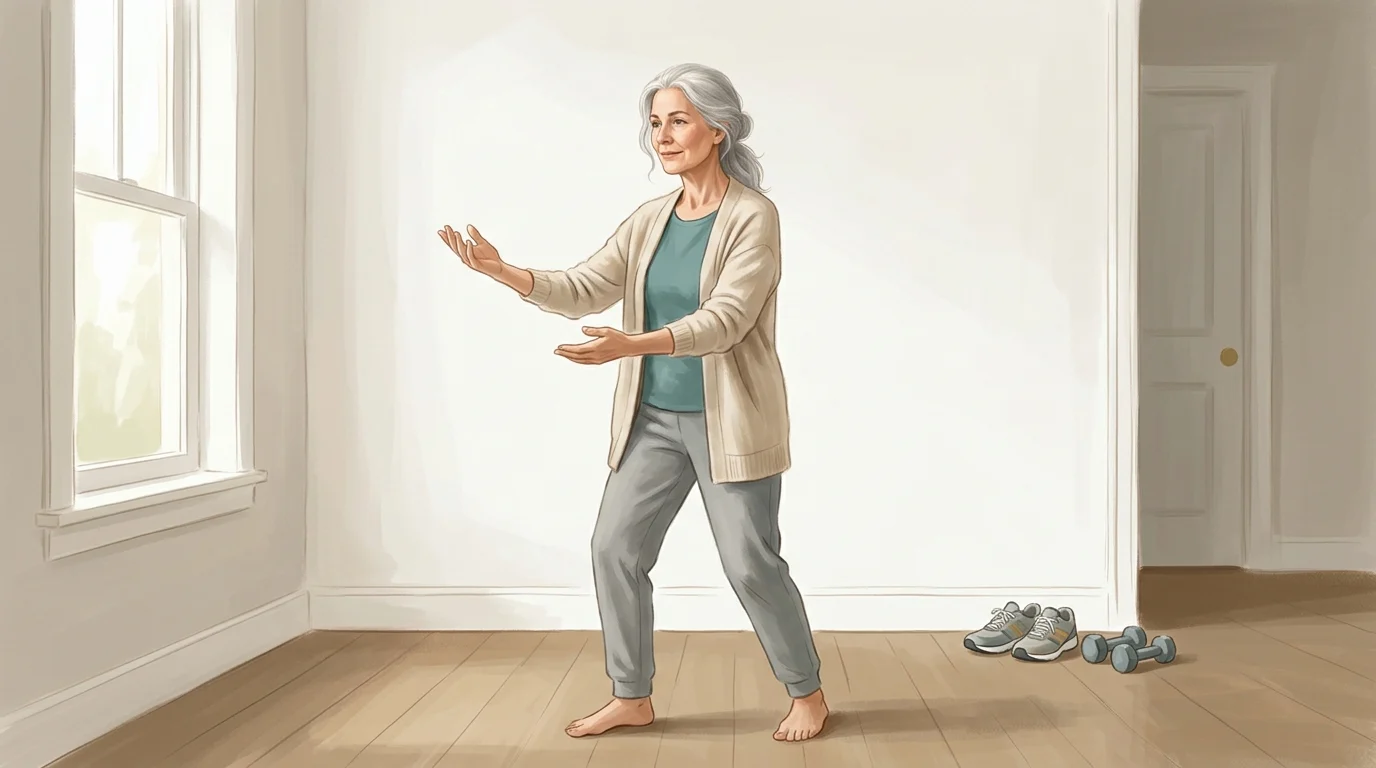
Women with fibromyalgia saw the biggest pain drop with slow movement
Tai chi and qigong led, and gains may start under an hour a week. Across 24 trials, the doses are still early estimates.
If you live with fibromyalgia, someone has told you to exercise. What they rarely tell you is which kind, and how much, without leaving you in pain for the next two days. A review of the trials points to a gentle answer: slow, mindful practices such as tai chi and qigong.
Maybe you tried a brisk class, or a long walk on a morning when you felt well. Then the pain came back, sometimes worse than before, and stayed for days. After a few rounds of that, "stay active" can start to sound like advice written for somebody else's body, and it's easy to decide that yours is the exception.
It isn't. You can start from where your body is today, and the early evidence suggests a gentler start than you might expect.
The review, published last month, brought together 24 trials in women with fibromyalgia and asked both questions at once (Sheng and colleagues, Frontiers in Physiology, 2026). Of everything tested, the slow practices that join movement with attention were linked to the largest drop in pain: about three points on a ten point scale more than in the comparison groups, at the amount that seemed to help most.
Slow practice, the largest drop
The review calls this group mind and body exercise. In the trials it meant mostly tai chi and qigong: slow, continuous movement, with the breath and the attention on how it feels. Its best result came at roughly four hours a week. That doesn't mean you need to start there. By the review's estimates, a benefit may begin at around 40 minutes a week, though that low end is the least certain part of the estimate.
You don't have to start with the hardest option, or with long sessions, for the effort to count. The authors make a similar point: these practices ask relatively little of the body, which suggests, in their words, "a potentially favorable balance between effectiveness and feasibility." In other words, they may be both helpful and manageable.
Walking and strength counted too
If walking suits you better, it was linked to less pain too. For aerobic exercise like walking, the pattern was simple: more went with more relief, right up to the largest amounts any trial asked for. Nobody tested beyond that, so the review can't say where it levels off.
Strength training was linked to less pain as well, with a smaller effect, inside a fairly narrow band of about two to two and a half hours a week. Its evidence, though, was the most solid in the review; for most of the rest, the evidence was weak or very weak. That fits what an earlier review of strength training for fibromyalgia found: a real benefit, more modest than earlier estimates suggested.
Flexibility routines, balance work, water exercise and mixed programs showed no clear effect. There were only a handful of trials for each, and the authors say they can't tell whether that means no benefit or simply too few studies to see one.
What the headline will miss
The doses are calculated, not measured. To compare a tai chi class with a gym session, the researchers converted every program into a common unit of effort, and they call the resulting doses "exploratory estimates" rather than prescriptions. Certainty was low for tai chi and qigong and very low for aerobic exercise, mostly because of how the trials were run and how much they differed from one another. The ranking also rests partly on comparisons across different trials rather than side by side, and tai chi and qigong came out only a little ahead of aerobic exercise.
A few more things to keep in mind. The women averaged 49 years old, and the programs ran from a few weeks to six months. Pain was the only thing the review looked at, so it says nothing about fatigue, sleep or mood. Most of the slow practices were tai chi and qigong, which means yoga and Pilates aren't really covered here. And a few side effects were reported across the trials, including one woman who stopped because her pain worsened during a flexibility program: a fair reminder to build up slowly.
Doing less
As a Feldenkrais® practitioner, I notice that people with fibromyalgia often arrive very good at pushing. They've pushed through work, through years of caring for other people, through the pain itself, and by the time they lie down for a first lesson they bring that same effort with them, as if the body were a task to finish rather than something to listen to. In an Awareness Through Movement® lesson I ask for the opposite: slower, lighter, less, which is the heart of how Feldenkrais lessons approach fibromyalgia. You only go where it feels easy, pleasant and comfortable. This review didn't test the Feldenkrais Method®, so it can't tell us whether the method helps with fibromyalgia, or why the slow practices did so well. But what I see again and again is that when effort goes down, people notice more, and the next day often costs them less.
Start where you can repeat it
Gentle practice sits alongside what your doctor or physiotherapist has recommended, not in place of it. If you have other health conditions, or if exercise brings new swelling, numbness or a flare that doesn't settle within a few days, check with them before you build up.
You don't have to prove what your body can do. Whatever you choose (tai chi, a walk, some strength exercises), start with an amount you could happily repeat tomorrow, and let tomorrow tell you whether it was the right amount.
Let Feldy guide you, eyes closed
A calm voice walks you through gentle moves so your attention stays in your body, not on the screen.
Try Feldy Free for 7 daysNo credit card needed.
Sources
Movement Pulse is informational, not medical advice. See our editorial policy.
Move better with Feldy
See the programMovement Pulse Weekly
The week's best research, in your inbox Tuesday.
Movement science, gentle-practice ideas, and a practitioner's read on what's new. Free.
More from Movement Pulse

Tai chi, qigong, yoga for fibromyalgia: a 2026 review
A 2026 review pooled 23 trials of qigong, tai chi, and yoga for fibromyalgia. The methods looked broadly similar. What that means for choosing one.
Jun 25, 2026
What 151 trials say fibromyalgia medicines can change, with sleep moving more than pain
Across 32,592 people, several drug classes may ease sleep or how people feel in general a little, and one or two more in every ten saw their pain drop by a third.
Oct 12, 2026
Lightheaded on standing with fibromyalgia: what a pulse check can show
Dizziness can belong to fibromyalgia itself. A new review links it, in some people, to the automatic controls of pulse and blood pressure.
Nov 4, 2026Ready to start moving better?
Gentle, guided lessons for your body. Try your first one free, no credit card required.