
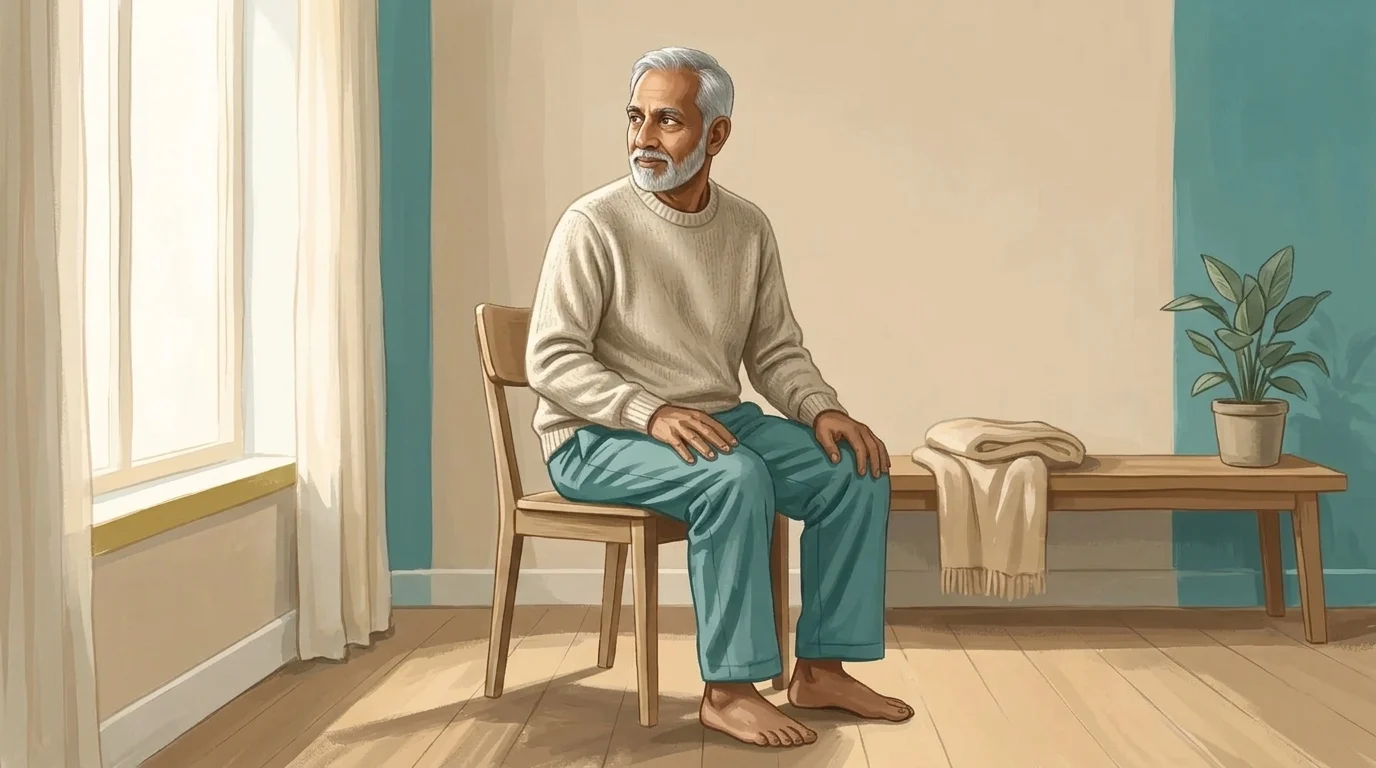
Shoulders turned further after a slow, varied lesson than after repeating one twist
56 young adults sat and turned in a German motion lab. After a lesson that moved the eyes, head and shoulders in new combinations, head turning widened by about two thirds.
Ask most people how to turn further and they'll tell you to keep turning. Ten twists to each side, then ten more, with a little push at the end of each one.
A movement lab at the Technical University of Darmstadt set that idea beside one slow lesson of varied turns. By the end of the lesson, people were turning their head about two thirds further than when they began. The group that repeated the same plain twist for just as long showed no real change in how far their head turned.
What the lab measured
The study, published this month in Frontiers in Human Neuroscience, followed 56 healthy adults, about 22 years old on average, none of whom had tried the Feldenkrais Method® before. Of these, 44 sat through a single Awareness Through Movement® lesson of 45 to 60 minutes, led by a certified practitioner: fifteen short steps of seated turning that gradually separated the eyes, the head, the shoulders and the pelvis, so each could move in a new combination with the others. They were asked to move slowly, without stretching or force, and to stop wherever the movement ended on its own. No targets. No goals.
The other 12 did the first step of that lesson, a plain seated turn, over and over: the same practitioner, the same number of repetitions, the same rests in between.
Motion cameras tracked the turn at the start and at the end. In the lesson group, head rotation widened by about two thirds and the shoulders by about a third, and the elbows and wrists travelled further too. The repetition group showed no real gain at the head, shoulders or wrists, and their elbows actually moved less by the end, by about a fifth (Alokla and colleagues, 2026).
The muscles kept working
Here's the part that runs against intuition. You might guess that a bigger turn means the neck and back muscles finally let go. Sensors on the skin showed the opposite in the lesson group: muscles along the spine and at the side of the neck were working more after the lesson, not less. The authors read the extra range as coordination, more of the body joining the turn, rather than tissue that had loosened. Nobody stretched anything, which may matter more than it sounds: a muscle lengthened too fast tends to answer with the stretch reflex and pull back.
Not everything improved. Both groups' movements became a little less smooth over the session, and the gap between them on that measure wasn't clear enough to count.
The habit underneath
When people in my classes turn to look behind them, most of them turn as one block. Eyes, head and shoulders lock together and travel as a unit, and when the turn runs out, the usual response is to push. Repeating that turn ten more times gives the nervous system little new to work with. It mostly rehearses the block.
A lesson goes sideways instead: the eyes go one way while the head goes the other, the shoulders turn while the head stays still, and for a few minutes the familiar pattern stops being the only option. A habit like this isn't a fault; it is simply how your nervous system learned to turn, and it can learn another. That's my reading as a practitioner, though. The cameras can show that the movement changed; they can't show what someone was learning.
A slow turn to look behind you
About 5 minutes. Move slowly, do less than you can, and stay well below any pain. Rest whenever you need to.
- 1
Sit toward the edge of a firm chair with both feet standing. Notice how your weight rests on your sitting bones.
- 2
Turn slowly to look to the right, only as far as is easy. Notice where your eyes land. Come back and rest.
- 3
Turn right again and let your eyes go first. Notice your shoulders following. Return to the middle and rest.
- 4
Keep your eyes on a spot ahead. Turn only your head a little to the right and back. Smaller is fine.
- 5
Now turn your shoulders a little to the right while your head and eyes stay facing forward. Then rest.
- 6
Turn your head to the right while your eyes look left, a few slow times. Stop and rest.
- 7
Turn to look right once more, the plain way. Where do your eyes land now? What has changed?
Let Feldy guide you, eyes closed
A calm voice walks you through gentle moves so your attention stays in your body, not on the screen.
Try Feldy Free for 7 daysNo credit card needed.
What one session cannot tell us
Quite a lot. These were young, healthy adults, while the people who usually come to a Feldenkrais class are older and often stiff or sore, so whether bodies like theirs respond the same way is still open. Nobody was randomly assigned; which group you were in depended on which session you attended.
The comparison group was only 12 people, which is why just a few of the differences, the shoulder turn among them, held up firmly when the two groups were compared directly, and the head, elbow and wrist gains remain a consistent pattern rather than a settled result. It was also one session, measured the same day, with no check a week later. One of the four authors works at a Feldenkrais centre in Heidelberg, and the study received no funding.
Where this leaves your next turn
What the study hints at, cautiously, is that range may be as much something you organize as something you lengthen, and that in this lab the variety of the movement mattered more than its volume.
If your neck has started to turn less than it used to, neck and shoulder tension is rarely only about the muscles that ache, and the same holds for the wider sense of losing flexibility after 50.
The next time you reverse out of a parking space and look over your shoulder, notice what your eyes do before your head moves. Do they lead, or do they wait to be carried?
Sources
Movement Pulse is informational, not medical advice. See our editorial policy.
Move better with Feldy
See the programMovement Pulse Weekly
The week's best research, in your inbox Tuesday.
Movement science, gentle-practice ideas, and a practitioner's read on what's new. Free.
More from Movement Pulse
The back exercises helped more when older women learned to feel them, not just do them
A small randomized trial gave one group core stability exercises, and another the same exercises plus Feldenkrais awareness lessons. The second group ended up moving with noticeably less fear.
Aug 19, 2026
Why a Feldenkrais balance study looks almost too good, and what is worth keeping
A new randomized trial found the Feldenkrais Method improved balance and fear of falling more than conventional drills, and its small size asks for caution.
Jul 24, 2026
When feet lose feeling, can balance still improve?
A new randomized trial tested a gentle Feldenkrais approach to balance in people with diabetic nerve damage. Here is what to raise at your next appointment.
Jul 1, 2026Ready to start moving better?
Gentle, guided lessons for your body. Try your first one free, no credit card required.