
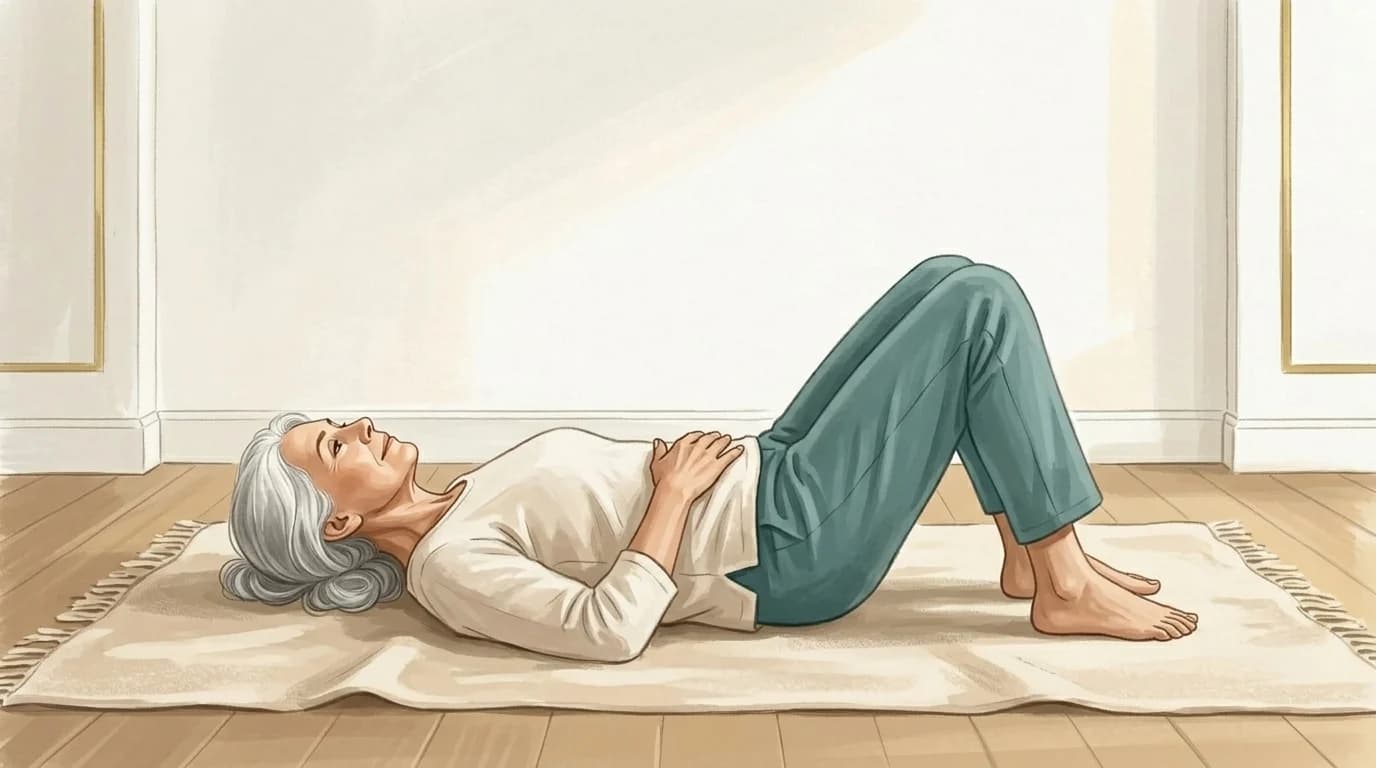
The back exercises helped more when older women learned to feel them, not just do them
A small randomized trial gave one group core stability exercises, and another the same exercises plus Feldenkrais awareness lessons. The second group ended up moving with noticeably less fear.
A small trial that came out recently asked a quietly radical question about the back exercises older women are so often handed. Not whether the exercises work, but whether it matters how much attention a person pays while doing them.
The study, published in BMC Geriatrics, followed thirty women between sixty and eighty who had lived with ordinary low back pain for a long time, the common kind with no single structural culprit (BMC Geriatrics, 2025). For eight weeks, three times a week, every woman did the same core stability program, a well regarded approach called dynamic neuromuscular stabilization that trains the deep trunk muscles through the movement patterns we all passed through as babies. Half the group did only that. The other half did the same program and then spent thirty more minutes in guided Feldenkrais Method® awareness lessons, slow attentive movements of the pelvis and spine with no effort and no goal beyond noticing.
By the end, both groups were better, which is worth saying plainly. But the group that added the awareness lessons improved more, and the gap showed up in a few specific places. Their pain scores fell further. Their lower backs bent and straightened through a wider range. And the single largest difference, larger than the difference in pain, was in something the researchers tracked with a questionnaire called the Tampa Scale: fear of movement. The women who had spent time simply feeling themselves move ended up markedly less afraid to move.
That last result is the one I keep sitting with, because it matches what I see almost every week with the people I work with. When someone arrives carrying long standing back pain, they usually already own a handful of exercises. A physiotherapist gave them a sheet, or a video did. The exercises are rarely the problem. What I notice is how they do them. They move the way you would carry something fragile, braced, breath held, one part of attention always scanning ahead for the twinge. The body is technically exercising and guarding at the same moment, which is close cousin to not moving at all.
The awareness layer that this trial added is not a better exercise. It is a different relationship to the exercise. When attention shifts from "am I doing this correctly" to "what does this actually feel like," the guarding starts to soften, and the same movement becomes available in a way it simply was not before. That is why I think the fear number moved so much. This kind of awareness work does not argue anyone out of being afraid. It offers repeated small experiences of moving that turn out not to hurt, until the nervous system quietly revises its own estimate of what is safe. People do not lose the ability to move so much as they lose trust that moving will help, and trust comes back through evidence the body can feel, not through instruction.
It is worth being clear about where this sits. The core stability work in the study is the kind of thing a physiotherapist prescribes, and gentle awareness work sits alongside that, not in place of it. If a clinician has given you exercises, keep doing them. Nothing here suggests trading them away. The suggestion is smaller and stranger than that: the attention you bring to a movement may matter as much as the movement itself.
So if your own back routine has gone stale, or you catch yourself grinding through it tensely and waiting for it to be over, you might try a single round at a quarter of the usual speed, eyes closed if that feels safe where you are, asking only what you can actually sense. Where does the movement begin. Which side gives back more information. Where does your breath stop without your permission. You are not trying to perform the exercise better. You are trying to feel it at all, and feeling it is what seems to change the fear.
A fair word about the limits. This was thirty women, all older, over eight weeks, with no long term follow up, so it is a signal rather than a settled verdict, and awareness lessons in a study are led by a trained teacher rather than done alone. Still, the shape of the result is hard to unsee. The most measurable change these women made was not in their muscles but in their fear of using them. That is the part of back pain the exercise sheets rarely reach, and it is often the part that decides whether a person keeps moving through the years or slowly, sensibly, and sadly stops. If you want the wider picture rather than one trial, our page on is feldenkrais evidence based weighs what the research so far does and does not show.
Let Feldy guide you, eyes closed
A calm voice walks you through gentle moves so your attention stays in your body, not on the screen.
Try Feldy Free for 7 daysNo credit card needed.
Sources
Movement Pulse is informational, not medical advice. See our editorial policy.
Move better with Feldy
See the programMovement Pulse Weekly
The week's best research, in your inbox Tuesday.
Movement science, gentle-practice ideas, and a practitioner's read on what's new. Free.
More from Movement Pulse

When feet lose feeling, can balance still improve?
A new randomized trial tested a gentle Feldenkrais approach to balance in people with diabetic nerve damage. Here is what to raise at your next appointment.
Jul 1, 2026
Why a Feldenkrais balance study looks almost too good, and what is worth keeping
A new randomized trial found the Feldenkrais Method improved balance and fear of falling more than conventional drills, and its small size asks for caution.
Jul 24, 2026
Welcome to Movement Pulse
A short note on what this section is for, who writes it, and how we choose what to cover each week.
Jun 7, 2026Ready to start moving better?
Gentle, guided lessons for your body. Try your first one free, no credit card required.