
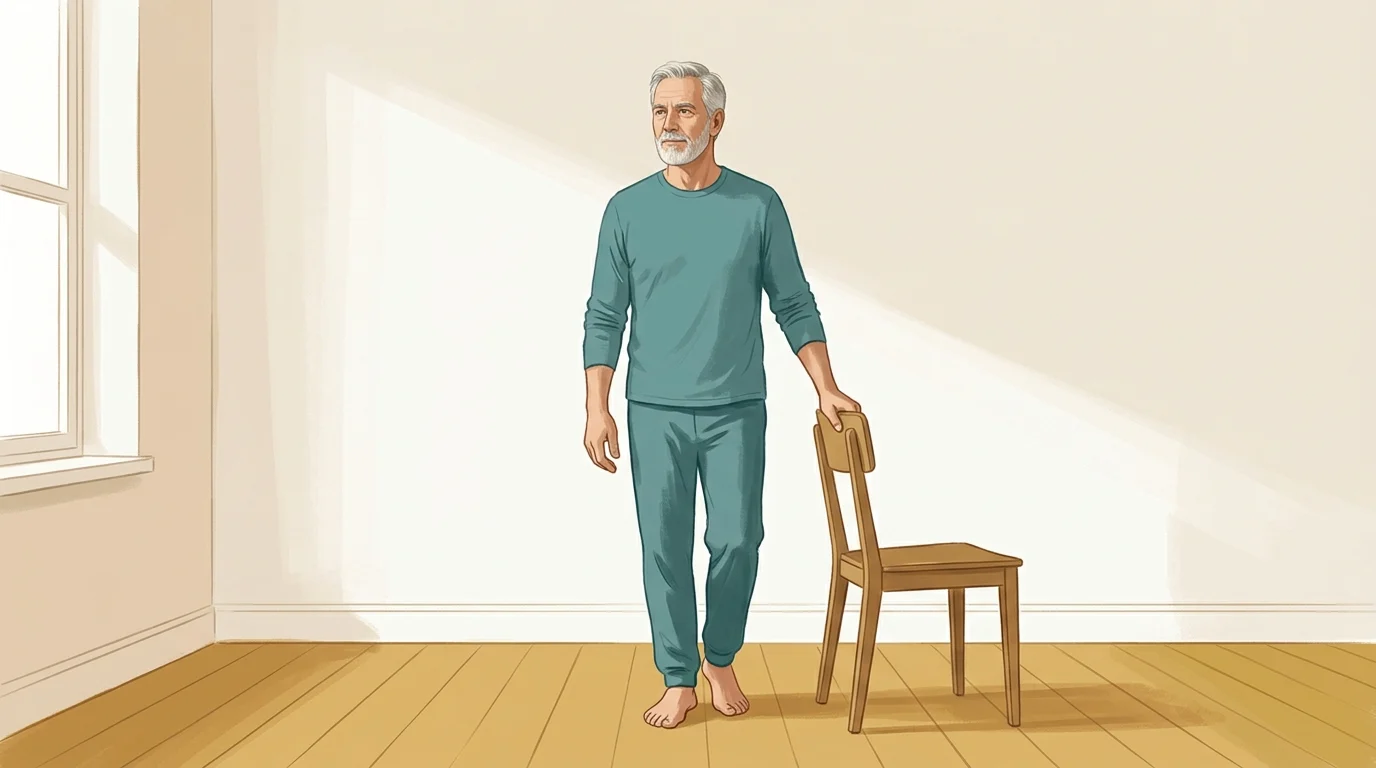
Why a Feldenkrais balance study looks almost too good, and what is worth keeping
A new randomized trial found the Feldenkrais Method improved balance and fear of falling more than conventional drills, and its small size asks for caution.
A new trial reports that the Feldenkrais Method improved balance and confidence on every measure it tracked, while the comparison group barely moved. When a small study delivers a clean sweep like that, the honest first move is to slow down and read it carefully.
The study, published in Physiotherapy Research International, followed 26 adults between 45 and 60 years old who were living with diabetic polyneuropathy, a condition where nerve changes dull sensation in the feet and make steady balance harder to hold. Half were randomized to Feldenkrais Method® lessons and half to conventional balance training, each twice a week for 24 weeks. On the Timed Up and Go test, a common walking and turning measure, on the Limits of Stability, which tracks how far a person can lean without losing balance, and on the Falls Efficacy Scale, which captures how much fear of falling shapes daily life, the Feldenkrais Method group improved and the conventional group did not change in any way the researchers could call significant (Physiotherapy Research International, 2026).
What makes the result worth a second look is the population. These participants had reduced sensation in their feet, the raw signal most of us assume balance depends on, and their balance and their confidence still improved through slow, attentive movement. That points at something about how balance is actually built.
Here is what a tidy headline would skip. The trial included 26 people, around 13 in each group. A single small study, however encouraging, is a place to start looking, not a place to stop and conclude. The result was also unusually clean. The outcomes the authors highlight, from the balance tests to fear of falling to quality of life, were all reported at the same very low p value of 0.0001, while the comparison group moved on nothing. Results that uniform are exactly the ones that ask to be repeated in a larger, independent sample before anyone leans on them. And this was one specific clinical population. The Feldenkrais Method is not a treatment for neuropathy or for diabetes, and none of this is medical guidance for either.
It also helps to place the trial inside the wider evidence rather than on its own. A 2022 systematic review pooled 16 randomized trials of the method and found, in older adults, meaningful gains in mobility, balance, and quality of life, with a large effect on that same Timed Up and Go test (Cohen's d around 1.14 in magnitude, in the direction of improvement). The same review was candid that only 5 of those 16 trials reached good methodological quality, that samples were often small, and that the findings should be read with caution (International Journal of Environmental Research and Public Health, 2022). So the direction of the evidence is consistent and quietly encouraging. The strength of the evidence is still thin. Both of those are true at once, and holding them together is the honest position.
What survives the caution is the mechanism, and that is the part I find genuinely useful as a Feldenkrais® practitioner. Balance is not only leg strength or intact sensation in the feet. It is how the nervous system organizes movement moment to moment, and how much of the information available to it that it actually uses. Awareness Through Movement®, the guided lessons at the center of the method, work on exactly that. Small, slow movements, taken only to the range where they feel easy, pleasant, and comfortable, give the nervous system clearer information to organize balance with. That is a plausible reason balance can improve even when sensation in the feet has declined. If you want a sense of what those lessons actually look like, our set of 10 feldenkrais exercises walks through a few.
The fear of falling result deserves as much attention as the balance test. Fear of falling narrows how a person moves, which over time erodes the very balance they are worried about. Often the problem is not that balance has been lost. It is that trust has been lost, the felt sense that movement will hold you. That trust returns through repetition of movements the nervous system reads as safe, which is a slower and gentler process than drilling harder.
The usual two distinctions matter here. What this kind of gentle practice offers sits alongside physiotherapy and the care of the clinician following someone's nerve or diabetes picture, not in place of any of it. And among the movement methods a person might practice on their own, yoga, Pilates, tai chi, and the Feldenkrais based work I teach, the honest framing is different mechanisms, each with its own strengths, rather than a ranking with a winner. If you are weighing those options for yourself, this short guide on which movement method is right for you can help you think it through.
For someone whose footing feels less certain than it used to, the takeaway is not this study's exact protocol. It is smaller and steadier. Slow, attentive movement, kept well inside the range that feels comfortable, is a reasonable thing to practice on the days between clinician visits, and confidence is part of what that practice builds, not just strength.
This trial will need a larger and cleaner replication before anyone can say how much the method adds over ordinary balance training. That question is genuinely open. What is not in much doubt is the value of the practice this line of research keeps circling back to. Gentle, attentive movement is worth doing in the body either way. The Feldy online movement program is one way to keep that kind of practice going between visits. It is not a treatment, it does not replace clinical care, and its aim is modest and steady: to give the nervous system, day after day, small evidence that the body is safe to move.
Let Feldy guide you, eyes closed
A calm voice walks you through gentle moves so your attention stays in your body, not on the screen.
Try Feldy Free for 7 daysNo credit card needed.
Sources
- Effect of Feldenkrais Method in Enhancing Postural Control for Patients With Diabetic Polyneuropathy— Physiotherapy Research International
- Effects of the Feldenkrais Method as a Physiotherapy Tool: A Systematic Review and Meta-Analysis of Randomized Controlled Trials— International Journal of Environmental Research and Public Health
Movement Pulse is informational, not medical advice. See our editorial policy.
Move better with Feldy
See the programMovement Pulse Weekly
The week's best research, in your inbox Tuesday.
Movement science, gentle-practice ideas, and a practitioner's read on what's new. Free.
More from Movement Pulse

When feet lose feeling, can balance still improve?
A new randomized trial tested a gentle Feldenkrais approach to balance in people with diabetic nerve damage. Here is what to raise at your next appointment.
Jul 1, 2026
The back exercises helped more when older women learned to feel them, not just do them
A small randomized trial gave one group core stability exercises, and another the same exercises plus Feldenkrais awareness lessons. The second group ended up moving with noticeably less fear.
Aug 19, 2026
Welcome to Movement Pulse
A short note on what this section is for, who writes it, and how we choose what to cover each week.
Jun 7, 2026Ready to start moving better?
Gentle, guided lessons for your body. Try your first one free, no credit card required.