
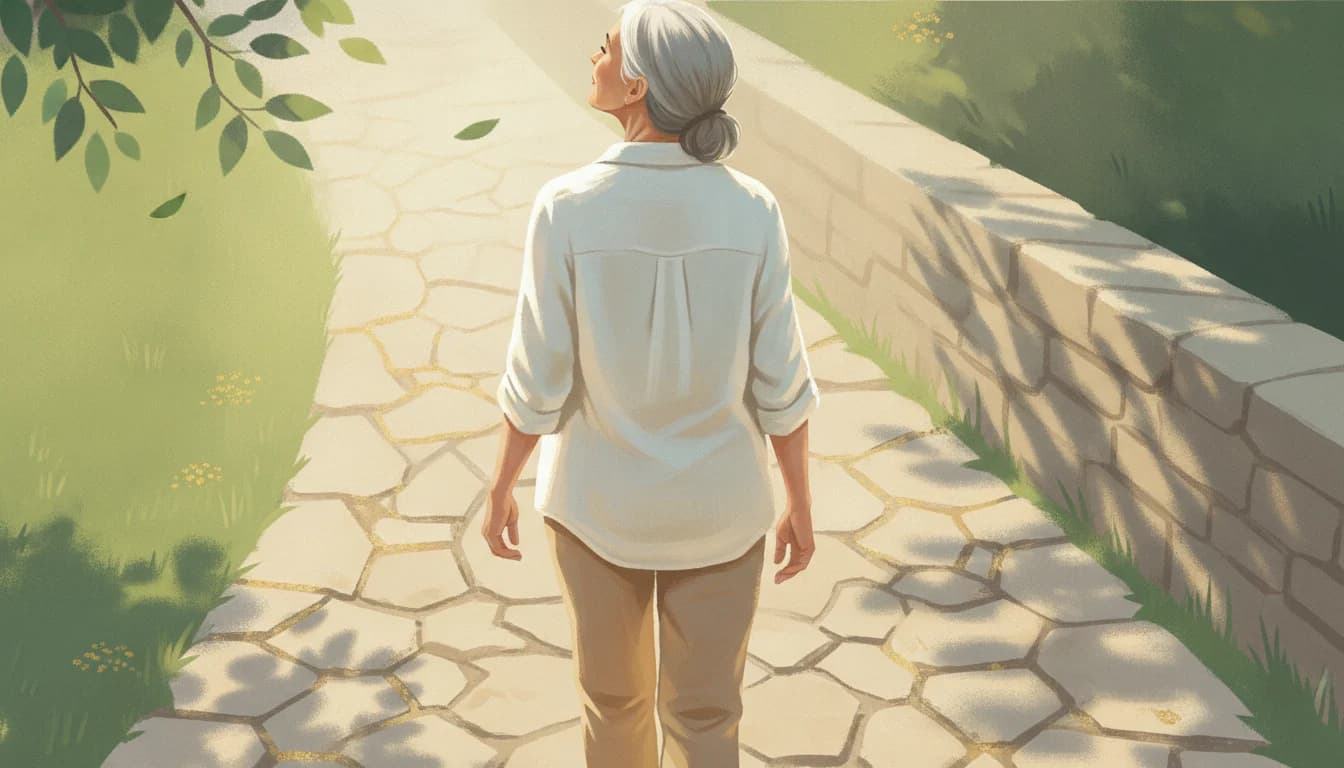
What walking changed for older women, and what it didn't
A June 2026 trial found brisk walking improved older women's balance, strength, and life satisfaction, with no change on the scale. Plus a short walking experiment.
A trial published this week takes one of the most ordinary things a person can do, walking, and measures what twelve weeks of it actually changes. The answer is encouraging, and one part of it is a little surprising.
The study, a cluster randomized trial in PLoS One, followed 54 women between the ages of 60 and 69. Half were asked to walk briskly three times a week, in sessions of 35 to 60 minutes, for 12 weeks. The other half carried on with their usual routine. At the end, the walking group had improved across almost everything the researchers measured: cardiorespiratory fitness, flexibility, muscular strength, muscular endurance, balance, and life satisfaction (PLoS One, 2026).
One measure barely moved. Body composition, the balance of fat to lean tissue, stayed essentially where it started. The women became stronger, steadier, more flexible, and more satisfied with their lives, and the scale and the tape measure had almost nothing to say about it. That gap is the interesting part. If you judged the twelve weeks by body shape alone, you would conclude that not much happened. By every measure of how these women could move, and how they felt about their days, a great deal happened.
This is the quiet point I keep coming back to with the people I work with. So much of what we are sold about movement is framed around changing how the body looks, and that framing quietly sets people up to feel they have failed. The research keeps pointing somewhere else. The real return on moving tends to show up first in function and in mood, in steadier balance and a better sense of one's own life, often well before, and sometimes instead of, any change on the scale. You have not lost movement. More often you have lost trust that movement will do anything worth the effort. A study like this is a small piece of evidence that it will.
There is a second thing worth saying, because it decides whether any of this lasts. A habit only pays off if you keep it, and people keep what feels good. Brisk walking three times a week sounds simple, and the protocol here was deliberately modest, but the thing that determines whether someone is still walking in week ten is rarely willpower. It is whether the walking itself feels light and pleasant, or heavy and effortful.
That is where a little attention to how you walk earns its place. The Feldenkrais Method® works with movement as something you can sense and refine rather than grind out. In an Awareness Through Movement® lesson, walking is not a workout to push through. It is a coordination to feel: where the weight transfers from foot to foot, how the ground meets each step, whether the eyes and the ribs are free or locked. Walking is something you practise on your own, a different way of working with the body than a treatment a clinician gives you, and very gentle changes in how you organize it can make the same distance feel noticeably easier.
Try the following on a flat, familiar surface, with a wall or a rail within reach if your balance is uncertain. Go slowly, and only where it feels easy, pleasant, and comfortable.
A short walking experiment
About 5 minutes. Move slowly, do less than you can, and stay well below any pain. Rest whenever you need to.
- 1
Take a reading. Walk a short stretch the way you normally would, across a room or a hallway, and simply notice how walking feels right now. Where do you push from. How much effort is in it. Is your gaze up or fixed on the floor. You are not changing anything yet, only taking a reading.
- 2
Slow it down. Walk the same stretch noticeably slower than usual. As the pace eases, let the push off ease too. Pay attention to the moment your weight passes from one foot to the other, the small handover that happens with every step. There is no rush to get anywhere.
- 3
Let the ground come up. Keeping the slow pace, sense each foot meeting the floor, the heel arriving and the weight rolling forward toward the toes. You are not stamping or pressing. You are letting the ground come up to meet you, and noticing how the contact feels through each foot.
- 4
Free the eyes and the ribs. Let your gaze lift off the floor and rest softly on the far side of the room. Let your ribs, shoulders, and arms swing easily rather than holding still. Notice whether your head floats a little more freely once your eyes are no longer fixed down.
- 5
Compare. Return to your ordinary walking pace and compare. Does walking feel a little lighter, a little more pleasant, than it did at the start. There is nothing to achieve here. You are only noticing what a few minutes of attention changed.
Let Feldy guide you, eyes closed
A calm voice walks you through gentle moves so your attention stays in your body, not on the screen.
Try Feldy Free for 7 daysNo credit card needed.
This is a small experiment, not a walking program, and one quiet try will not transform your gait. What it tends to reveal is that some of the effort in walking is not strictly necessary. It is bracing, fixed eyes, a held breath, a push harder than the ground asks for. When a little of that drops away, the same walk costs less, and a walk that costs less is one you are more likely to repeat.
Why the easier walk is the one you keep
For anyone whose balance has started to feel uncertain, the steadiness the study measured is not a small thing. Balance is part of what keeps walking safe enough to stay enjoyable, and it tends to grow through doing, through the nervous system getting more practice at sensing and adjusting. You can read more about how walking shifts over time in our Feldypedia entry on gait changes and walking difficulty, and about the way unsteadiness can quietly shrink a life in the entry on balance, instability, and the fear of falling. If walking itself is painful, that is worth raising with a physiotherapist or doctor, and gentle movement work sits alongside that care rather than standing in for it.
The headline most of us would write for a walking study is about weight, and here the weight barely changed. The better headline is the one the numbers actually support. Twelve weeks of an unremarkable activity left these women stronger, steadier, and more content with their lives. The payoff was in how they could move and how they felt, which is exactly where it tends to live. An easier, more pleasant walk is simply the version of that you are most likely to keep doing, and that may be the most useful thing attention to movement has to offer.
Sources
Movement Pulse is informational, not medical advice. See our editorial policy.
Move better with Feldy
See the programMovement Pulse Weekly
The week's best research, in your inbox Tuesday.
Movement science, gentle-practice ideas, and a practitioner's read on what's new. Free.
More from Movement Pulse
Back pain after menopause followed the shape of women's days, not their exercise count
A study of 566 women past menopause in Bangladesh found nearly half had low back pain in the past year. How often they exercised made no clear difference. Their daily work was the stronger clue.
Sep 27, 2026
The exercise rules for osteoporosis are precise, and meeting them did not predict results
Eighteen trials, 1,181 women. The two tests that improved were both transitions. The one that measures holding still did not reliably move at all.
Aug 30, 2026
Does exercise help menopause symptoms? The research keeps changing what it measures
Twelve trials found movement improves quality of life and mood. A thirty year cohort found fitness does not prevent severe hot flashes. Both are true.
Jul 30, 2026Ready to start moving better?
Gentle, guided lessons for your body. Try your first one free, no credit card required.