

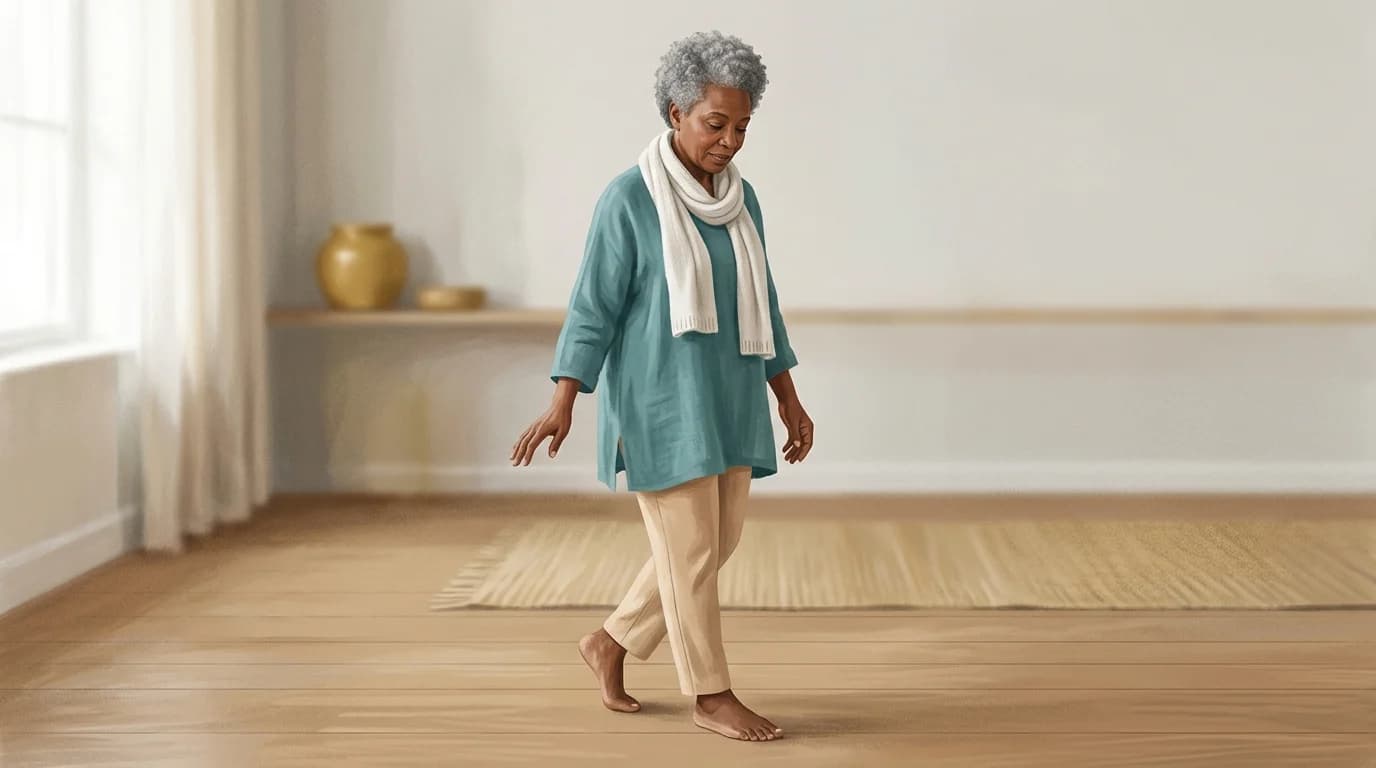
Tai chi walking is the balance trend of the summer. What the research actually shows
Tai chi walking is everywhere this summer. The evidence on balance and falls is encouraging, and it comes from classical tai chi, not the viral version.
Open any wellness feed this summer and tai chi walking is there. Slow, deliberate steps, a long pause on each foot, and the promise that it will steady your balance. It is one of the movement trends of 2026, and the honest question underneath the enthusiasm is a fair one. Does it actually work, and if it does, what is doing the work?
Start with what the trend actually is. Tai chi walking is not a studied intervention with its own body of trials. It is a simplified, everyday version of classical tai chi, spread largely through social media, that stretches out the weight transfer of an ordinary step and asks you to slow down and feel it (Premium Medical Circle, 2026). That distinction matters, because almost all of the evidence people cite for it comes from research on the classical practice, not on the viral walking format.
On the classical practice, the evidence for balance is genuinely encouraging, and worth stating plainly. Reviewing the trials, the National Center for Complementary and Integrative Health reports high certainty that tai chi may reduce the number of older adults who fall, by around 20 percent, and lower certainty that it may reduce the overall rate of falls by around 19 percent (NCCIH). A 2021 meta analysis of 11 randomized trials in older adults with knee osteoarthritis found that those practicing tai chi walked about 47 meters farther on a six minute walk test, and moved noticeably faster on a timed stand, walk, and turn test, than those who did not (Medicine, 2021).
Here is what the headline tends to skip. The same NCCIH review that credits tai chi with fewer falls also found that ordinary balance and functional exercise did slightly better on the same measure, lowering the rate of falls by about 24 percent. Tai chi is a good option, in other words, not a uniquely magical one. And the tidy phrase improves your balance hides how modest and specific the real numbers are. A 20 percent reduction in the share of people who fall is a meaningful effect across a population. It is not a personal guarantee, and it was earned through consistent classical practice, not through a two week trial of a walking trend.
So if the label is not the magic, what is? The part I keep coming back to as a Feldenkrais® practitioner is the one thing the trend gets right almost by accident. Tai chi walking slows down the moment when your weight shifts from one foot to the other, and it repeats that moment while you pay attention to it. That extended, attended weight transfer is most of what balance training actually is. Balance is not a fixed quantity you either have or lack. It is how well your nervous system reads where your weight is and organizes the next step, and that reading tends to sharpen with slow, repeated, attentive practice more than with speed or effort. It is the same skill that quietly fades when the way weight moves through a step changes with age.
That reframes what to take from the trend. You do not have to adopt the whole format, or call it anything, to get the ingredient that matters. On your next unhurried walk you can let one weight shift take a beat longer than usual and simply notice it: where the weight lands, how the other foot lightens, whether you can stay easy through the change. Kept inside the range that feels easy, pleasant, and comfortable, that kind of attention is a key part of what the research points to, available without the choreography.
There is a quieter reason this matters, and it is worth naming. Much of what erodes balance with age is not only weaker legs. It is the fear of falling, which narrows how a person moves until the caution itself makes movement less steady. Slow, attentive practice can help with this too, by giving the nervous system repeated evidence that a weight shift is safe to make. Often the issue is less that balance is gone and more that trust in it has thinned.
It helps to place tai chi honestly among the other ways of moving. Tai chi, yoga, Pilates, and the awareness based lessons I teach are all methods you practice on your own, each with a different mechanism and its own strengths, not a ranking with a single winner. None of them replaces the care of a physiotherapist or clinician following a specific balance problem. What they offer sits alongside that care, and each is a gentle, low risk way to practice the same underlying skill of sensing and organizing movement.
So the trend is not a miracle, and it is not nothing. Underneath the branding is a real and modest truth. Slow, attentive movement can help build steadier balance, and the choice of which practice carries you there is yours. In the Awareness Through Movement® lessons at the center of what I teach, that attention to weight and its transfer is the whole point rather than a side effect, and it is the kind of thing worth practicing on ordinary days, not only trendy ones. The Feldy online movement program is one way to keep that going. It is not a treatment and it does not replace clinical care. Its aim is smaller and steadier: to give your nervous system, step after step, better information about where you are and where you are going.
Let Feldy guide you, eyes closed
A calm voice walks you through gentle moves so your attention stays in your body, not on the screen.
Try Feldy Free for 7 daysNo credit card needed.
Sources
- Tai Chi: What You Need To Know— National Center for Complementary and Integrative Health
- Effects of Tai Chi exercise on improving walking function and posture control in elderly patients with knee osteoarthritis: A systematic review and meta-analysis— Medicine (Baltimore)
- Tai Chi Walking: How Healthy Is This Trend, Really?— Premium Medical Circle
Movement Pulse is informational, not medical advice. See our editorial policy.
Move better with Feldy
See the programMovement Pulse Weekly
The week's best research, in your inbox Tuesday.
Movement science, gentle-practice ideas, and a practitioner's read on what's new. Free.
More from Movement Pulse
Tai Chi changed how older brains process back pain
An 8 week randomized neuroimaging trial found Tai Chi lowered chronic back pain and quieted the brain circuits that build the pain. The mechanism is the interesting part.
Jun 21, 2026
The strongest predictor of falls is not strength
A new 2026 study put proprioception, vibration sense, and muscle strength head to head against fall frequency in older women. The sensing variable won.
Jun 20, 2026Ready to start moving better?
Gentle, guided lessons for your body. Try your first one free, no credit card required.