
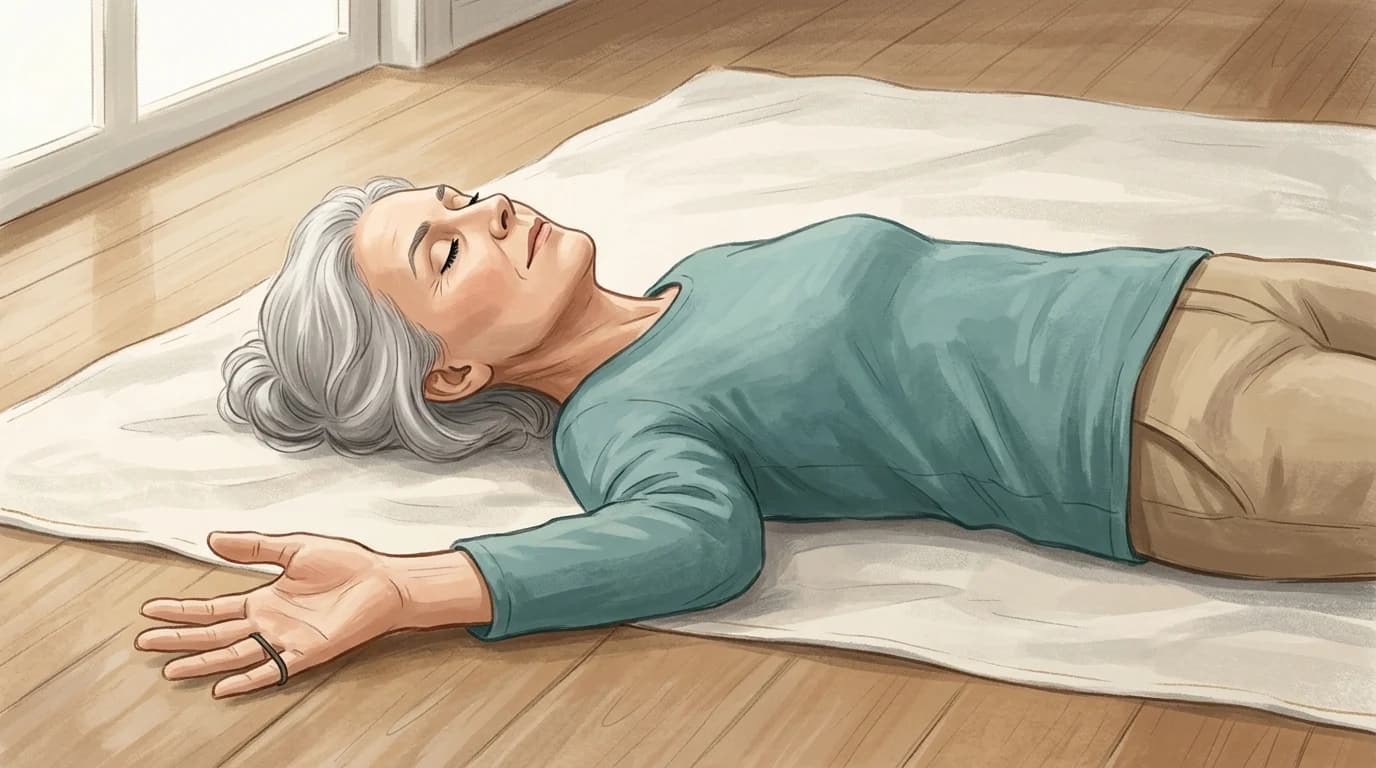
Why paying attention to one small spot can make you feel something somewhere else
A float tank, a rubber ring on a little finger, and 100 volunteers. Most of what people felt was not where the ring was.
A hundred people floated in warm salt water with a small rubber ring on one finger or one toe, and were asked to rest their attention there. Nearly all of them felt something. Most of what they felt was not at the ring.
The study appeared in August in Frontiers in Human Neuroscience, from Daria Iwasinski, Olivia Delahaye and Florian Beissner (Frontiers in Human Neuroscience, 2026). The setup was deliberately quiet. Participants floated in body temperature salt water, which strips away most of the ordinary sensory traffic a body deals with all day. Fifty of them were given one specific instruction, to hold their attention on a small tactile anchor. The anchor was a 15 millimetre ring cut from a bicycle inner tube, moved between the right little finger, the left index finger, the right second toe and the left little toe across four ten minute trials. The remaining fifty floated in two comparison groups without that instruction. Afterwards everyone drew what they had felt onto a digital outline of a body.
What came back was not a louder version of the ring. About 77 percent of the sensations the focused group reported turned up somewhere other than the digit they were attending to, and nearly every participant in that group had at least one. Roughly two thirds of those stayed on the same side of the body as the ring. People described pressure, tingling, pulling, warmth, throbbing. When the researchers analysed the shapes that had been drawn, they fell into two families: compact patches, about six in ten of them, and longer forms that ran like pathways across several joints.
The comparison with the other two groups is the part I keep coming back to. Set beside the people who floated without an instruction, the focused group reported more separate sensations per trial, at lower intensity, marked over far smaller areas of the body outline, and the vague everywhere sort of feeling that showed up in nearly a fifth of the comparison reports did not appear in the focused group at all. Attention did not turn the volume up. It raised the resolution.
What I notice when this happens in a lesson
Students apologise to me for this. In a lesson a few weeks ago, a woman working on a small turn of her head told me, a little embarrassed, that the clearest thing she could feel was a line running down the outside of her left hip. We had not gone anywhere near her hip. She thought she had lost the thread.
She hadn't. That report is the lesson working. In an Awareness Through Movement® lesson the movements are usually smaller than people expect, and a good part of the time is spent lying still and noticing. The quiet is not filler. It's the condition under which anything gets noticed at all, and this is the first study I've seen that puts a number on how much of what surfaces in that quiet arrives somewhere other than where you were looking.
Two honest limits. This research was not about the Feldenkrais Method® and does not test it. And the focused group averaged around 26 years old while the comparison groups were older, which the authors flag themselves, alongside the fact that they collected only what people reported and drew, with no brain measurements at all. A float tank is also not a living room floor.
What does connect is older and smaller. In 2021 a group publishing in Brain Sciences put 25 people through a 28 session guided Feldenkrais protocol and measured brain activity before and after, finding increased sensorimotor activation while participants watched, performed and imagined movements (Brain Sciences, 2021). Different question, neighbouring territory. Attention based practice appears to change how the sensorimotor system responds, not only how a person feels afterwards.
What this might mean for your own practice
If you have ever wondered whether you were making it up when a sensation appeared somewhere you weren't attending to, the answer this research points toward is more interesting than yes or no. The sensation may be partly built by the attention itself, and still be real information about how you are organised. Your sense of where your body is in space is not a camera feed. It is closer to a working sketch, redrawn constantly, and this study suggests the sketch gains detail when you give it less to compete with.
Which is a practical point rather than a prescription. If you practise in a room with the television on, you are asking the same system to do finer work against more noise. Quiet helps. So does going slowly, and only ever where it feels easy, pleasant and comfortable. None of this replaces clinical care, and if you already see a physiotherapist, gentle attention work sits alongside what they gave you rather than instead of it. Yoga, Pilates and Tai Chi each work through their own mechanisms and carry their own strengths, and none of them is trying to do quite what this study was probing.
The detail I keep turning over is the haze that disappeared. In the groups that floated with no instruction, roughly one report in five was a diffuse, everywhere kind of feeling. Give that same nervous system one small rubber ring and somewhere to put its attention, and the haze resolves into patches and lines with edges. Whether that is the body becoming clearer to itself, or attention drawing a map it half invents as it goes, this study cannot yet say.
Let Feldy guide you, eyes closed
A calm voice walks you through gentle moves so your attention stays in your body, not on the screen.
Try Feldy Free for 7 daysNo credit card needed.
Sources
Movement Pulse is informational, not medical advice. See our editorial policy.
Move better with Feldy
See the programMovement Pulse Weekly
The week's best research, in your inbox Tuesday.
Movement science, gentle-practice ideas, and a practitioner's read on what's new. Free.
More from Movement Pulse

The body awareness that fades with age is not the body awareness that predicts function
Four studies across eleven years have quietly taken apart the idea that interoception is one ability sliding down one curve.
Aug 22, 2026
Practising a new movement sideways and upside down helped about as much as repeating it
Across 11 experiments, Yale volunteers practised unfamiliar symbols turned sideways or upside down. Their upright copies improved about as much as with plain repetition.
Oct 22, 2026
Asked to picture a short walk, older adults imagined four seconds. It took them six
Picture yourself walking across the room and back. A new study timed that picture in 85 adults in their seventies, then timed the real walk.
Oct 3, 2026Ready to start moving better?
Gentle, guided lessons for your body. Try your first one free, no credit card required.